
Torres Strait Islands
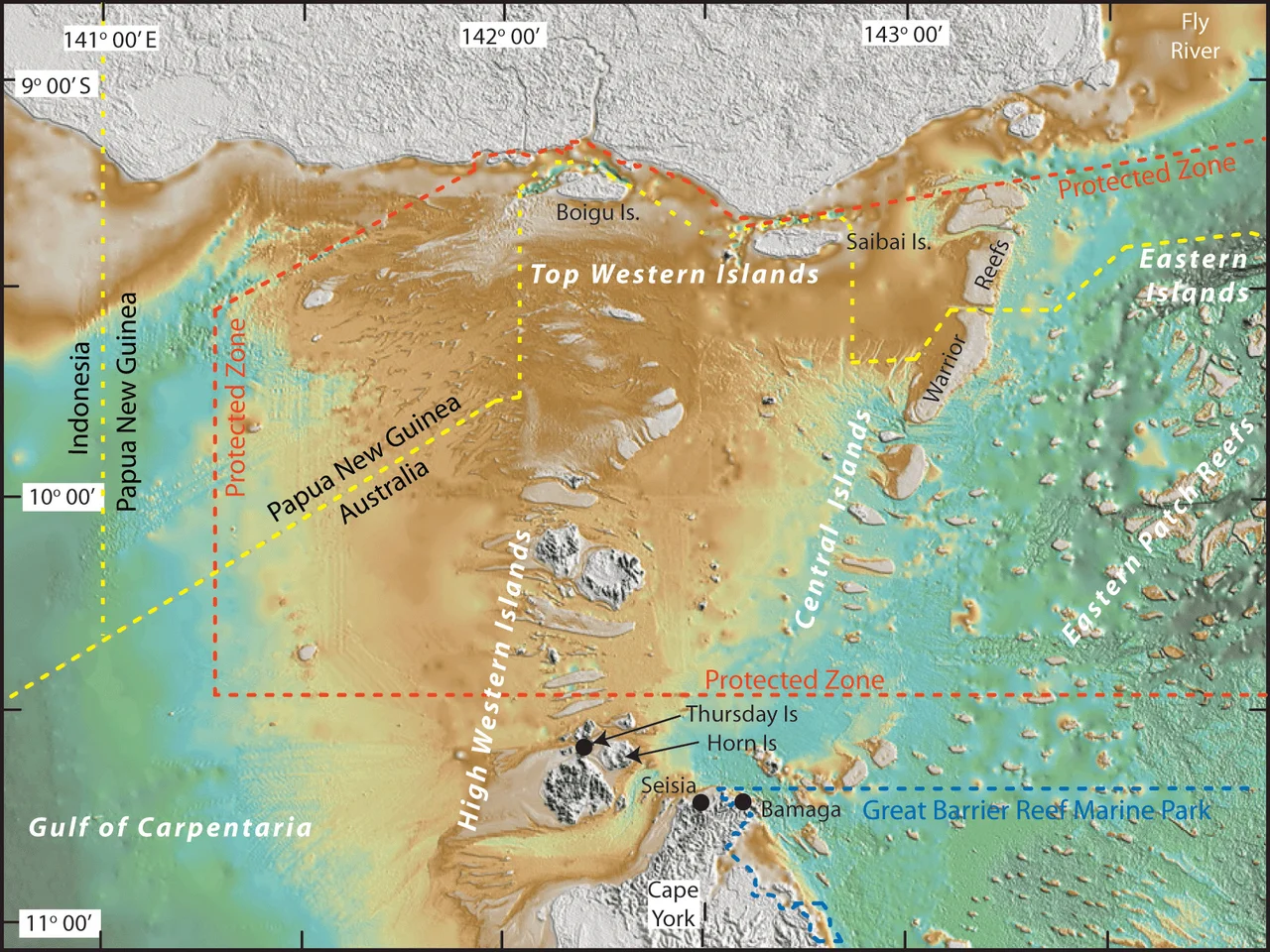
Stand on the right hilltop in the Torres Strait Islands and you can see Papua New Guinea. This is the only place in internationally recognized Australia where another sovereign country is visible from shore -- a geographic fact that hints at everything unusual about this archipelago. Strung across the shallow waters between Cape York Peninsula and New Guinea, fourteen inhabited islands and dozens of uninhabited ones form a cultural region that is neither Aboriginal nor mainline Australian but something distinct: Torres Strait Islander, ethnically Melanesian, with languages, traditions, and a fierce independence that survived colonialism and continues to confound anyone who tries to fit these islands into a simple national narrative.
Two Islands, One Gateway
Thursday Island and Horn Island function as the archipelago's twin hubs. Thursday Island, known locally as TI, packs a population of around four thousand onto just 3.5 square kilometers -- one of the highest population densities in rural Australia. It serves as the administrative center and hosts a permanently manned military barracks. Horn Island, ten minutes away by ferry, provides the main airport with daily Qantaslink flights to Cairns, the nearest city on the mainland some 1,100 kilometers to the south. Most Horn Island residents commute to Thursday Island for work and school. These two islands are the most accessible, with developed accommodation, restaurants along Douglas Street, and the Green Hill fort museum built into old military tunnels. Beyond them, the islands become progressively more remote, and visiting requires permission, planning, and sometimes a helicopter.
The Coming of the Light
Torres Strait Islanders were traditionally headhunters -- a fact they acknowledge openly. The arrival of missionaries transformed island culture, and the anniversary is celebrated every year on 1 July as 'The Coming of the Light,' one of the most important dates in the Torres Strait calendar. But the adoption of Christianity did not erase Islander identity. Torres Strait Islanders have a distinct culture, history, and relationship to their land, and they do not identify as Aboriginal. They are ethnically Melanesian, more closely connected to the peoples of Papua New Guinea than to their southern neighbors on the Australian mainland. Their languages -- Meriam Mir in the eastern islands, Kala Lagaw Ya in the west and center -- are still spoken daily, unlike many Aboriginal languages that were disrupted or destroyed by colonization. Torres Strait Creole, known as Yumplatok or simply 'Broken,' serves as the common tongue across the islands, with each island maintaining its own variant.
Where Cook Claimed a Continent
On 22 August 1770, Captain James Cook climbed a hill on a small island in the Torres Strait and claimed the entire east coast of Australia for the British Crown. He named it Possession Island, and in his journal recorded the words: 'I now once more hoisted English Coulers and in the Name of His Majesty King George the Third took possession of the whole Eastern Coast...by the name New South Wales.' The island, known locally as Bedanug and Bedhan Lag, is now a national park. In 2001, the Kaurareg people successfully claimed native title rights over it -- a quiet reversal of Cook's grand gesture. Nearby, the pearling industry that once drove the regional economy has left its own mark: the cemetery on Thursday Island arranges its dead by class, with pearl divers buried at the bottom of the hill and the island's aristocracy at the top. Today, pearls are still farmed on Friday Island, and visitors can buy them at a fraction of mainland prices.
Getting There Is Part of the Story
Reaching the Torres Strait requires commitment. The 1,100-kilometer distance from Cairns is greater than Barcelona to Zurich, and most of the roads on Cape York are unpaved and impassable during the wet season. Peddell's Ferries runs passenger boats from Seisia on the mainland to Thursday Island, operating six days a week in the dry season and three in the wet. Sea Swift freighters carry cargo and up to eight passengers from Cairns. For the outer islands -- Badu, Mabuiag, Murray, Saibai, and others -- scheduled light aircraft, helicopters, and water taxis provide connections, but some islands require permits from their land councils before visitors can arrive. The fishing is extraordinary, the snorkeling spectacular but hazardous, with sharks and crocodiles sharing certain reefs. Locals know which reefs to avoid, and going without one is inadvisable. This is not a place that makes tourism easy, and that difficulty is part of what keeps the Torres Strait distinct.
Islands at the Margin
The outer islands are divided into three groups: western (Saibai, Dauan, Boigu), central (Badu, Moa, Mabuiag, Yam), and eastern (Warraber, Coconut, Yorke, Stephen, Darnley, Murray). Some are so remote that they are closer to Papua New Guinea than to any part of the Australian mainland. Residents of most islands are overwhelmingly Indigenous, with non-Indigenous Australians -- primarily teachers, health workers, police, and military personnel -- forming a small and often temporary minority. The ratio is roughly six to one. Life on the outer islands is shaped by distance from services, the rhythms of tide and season, and a cultural continuity that urbanized Australia has largely lost. Islander generosity is legendary; visitors who make the effort to arrive are often welcomed with a warmth that reflects a culture built on reciprocity. Just bring respect: do not attend ceremonies without invitation, and remember that the people here are Torres Strait Islanders, not Aboriginal Australians. The distinction matters to them, and it should matter to you.
From the Air
Coordinates: 9.88S, 142.59E. The Torres Strait Islands are visible from altitude as a chain of islands stretching between Cape York Peninsula (Australia) and Papua New Guinea. Horn Island Airport (ICAO: YHID) is the main gateway, with daily flights to Cairns (ICAO: YBCS). Thursday Island, the administrative center, is a short ferry ride from Horn Island. Smaller airstrips serve Badu (ICAO: YBAU), Murray Island, and other outer islands. The strait's shallow waters, coral reefs, and strong tidal currents are clearly visible from above. Weather is tropical with monsoon rains November through April.
Nearby Stories
- Holy Trinity Church, Saibai Island 33 km away
- RMS Quetta 47 km away
- Booby Island (Queensland) 47 km away
- Daru 66 km away
- Booby Island Light 76 km away
- All Saints Anglican Church, Darnley Island 83 km away
- HMS Pandora (1779) 163 km away
- Wasur National Park 177 km away