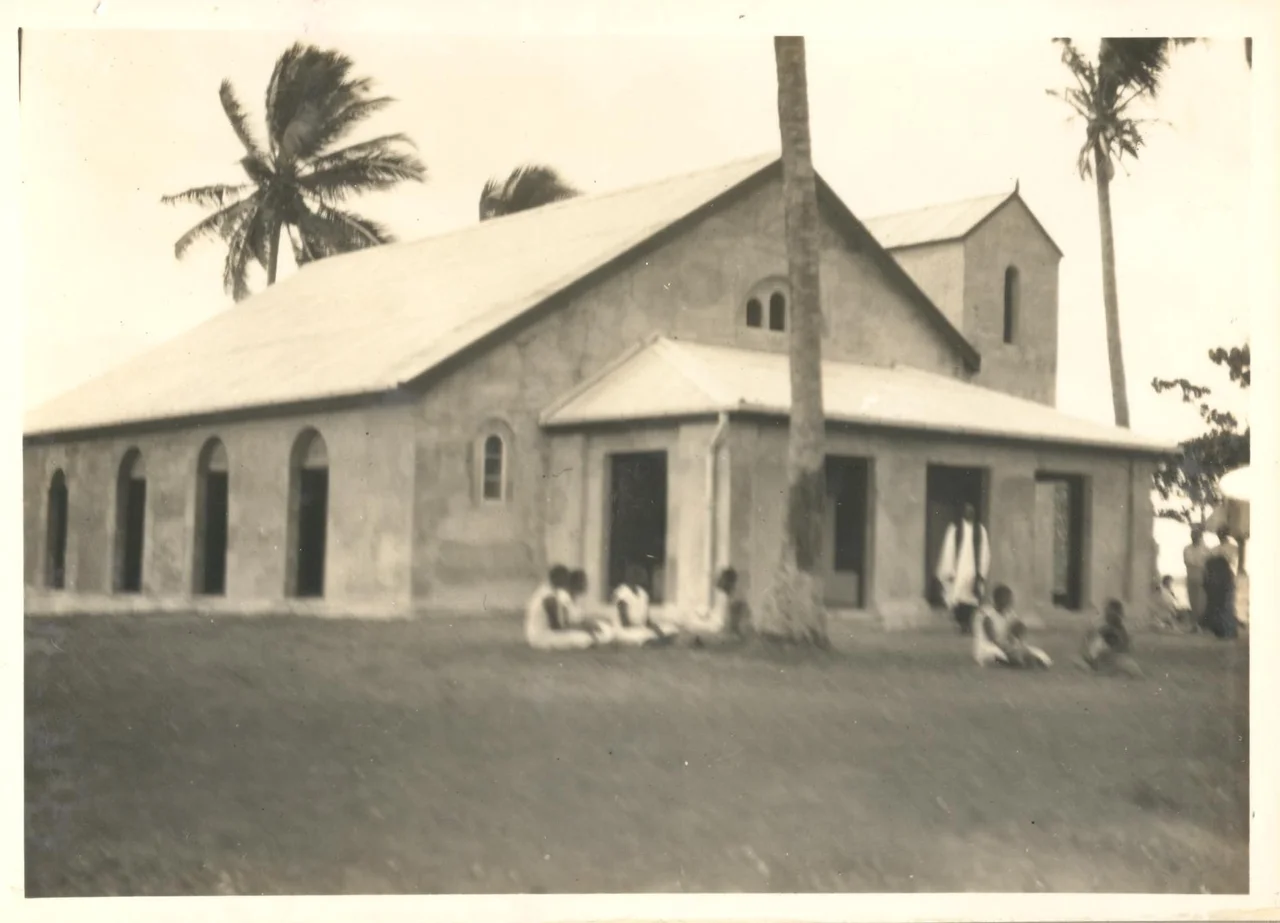

Holy Trinity Church, Saibai Island
Before the bell arrived, they used a bu-shell. The large native shell from the Torres Strait reefs would sound across Saibai Island, calling people to worship at a spot where Christians had gathered since before 1881. When Thomas Soki finally donated a proper bell around the time of World War II, it took its place in a tower built from mass concrete blocks stacked with little mortar between them. The tower still stands, though it is no longer used. The church it belongs to, Holy Trinity, sits just 12 metres from the water's edge on Saibai Island, looking directly across less than 7 kilometres of sea toward New Guinea.
The Coming of the Light
The story of Holy Trinity begins not on Saibai but on Darnley Island, 150 kilometres to the southeast. On 1 July 1871, London Missionary Society evangelists arrived at Erub (Darnley Island), an event now celebrated annually by Torres Strait Islanders as the Coming of the Light. Eight Lifu evangelists from the Loyalty Islands, expelled from French-controlled New Caledonia in 1869, had been redirected by the LMS to the Torres Strait and New Guinea. They and their wives established the first sustained Christian presence in the region. That same month, the LMS reached Saibai Island, where a substantial building for Christian worship was constructed in 1881 by a Samoan missionary. The faith took root in coral soil and salt air.
Nineteen Years of Building
Construction of Holy Trinity Church began around 1917 to replace the earlier building. It would not be completed until about 1938, a span of 19 years that speaks to the realities of building on a remote island with limited materials and labor. Saibai Islanders and LMS missionaries did the work themselves, using what the island could provide: burnt coral for cement, mangrove timber for framing, sand from the shore. The church incorporated hand-carved furnishings of Wongai plum wood salvaged from the earlier building, known as Panetha. Islanders Aki, Kebisu Baira, and Daku Garmai carved the original furniture: a cross, two candlesticks, and a lectern. New Wongai carvings were produced for Holy Trinity as well. On 4 December 1938, Reverend Stephen Davies, the Bishop of Carpentaria, dedicated the finished church.
Coral Walls and Arched Doors
The building is simple in form but substantial in presence. Unreinforced mass concrete footings, floor, and walls rise from a foundation of crushed coral, sand, and cement. A timber-framed gable roof, clad with fibrous cement sheeting, spans the nave with exposed trusses and no ceiling lining. Three bays extend from the rectangular central area: a front entry facing the road, an alcove at the rear toward the coast, and the bell tower to one side. Double arched doors open on each flank. The architectural style draws from Torres Strait vernacular tradition, with its locally sourced materials, decorative internal arches, and mass cement construction. A freestanding crucifix stands behind the bell tower, and a white rainwater tank occupies the rear. The grounds are grassed with a scattering of trees, open to the sea and the low green line of New Guinea beyond.
Heritage on the Waterline
Holy Trinity was listed on the Queensland Heritage Register on 21 October 1992, recognized as important evidence of missionary activity in the Torres Strait dating to 1871 and as a significant example of Torres Strait Christian architecture. The register notes the church's strong religious significance to Torres Strait Christians and to the London Missionary Society and Anglican Church. A sea wall protects the building from waves, but the real protection lies in the community's relationship to this place. The site has served as a focus of Christian worship since before 1881, making it one of the oldest continuously used church sites in the Torres Strait. That continuity, from the first Samoan-built chapel through Panetha to Holy Trinity, connects Saibai Islanders to the moment eight Loyalty Islander evangelists stepped ashore at Darnley Island and changed the spiritual landscape of the entire strait.
From the Air
Holy Trinity Church sits on the waterfront of Saibai Island (9.38S, 142.62E), the closest inhabited Australian island to Papua New Guinea, with the New Guinea coast visible less than 7 km to the north. The church is identifiable near the waterline on the island's coast. Horn Island Airport (YHID) is the primary regional airfield. Approach from the south to appreciate the startling proximity of Saibai to Papua New Guinea, with the church visible as a landmark structure on the waterfront.
Nearby Stories
- Gebar Island 14 km away
- Daru 14 km away
- All Saints Anglican Church, Darnley Island 77 km away
- Booby Island (Queensland) 105 km away
- Booby Island Light 134 km away
- Bramble Cay 144 km away
- Wasur National Park 145 km away
- HMS Pandora (1779) 213 km away