.jpg)
Raine Island Beacon
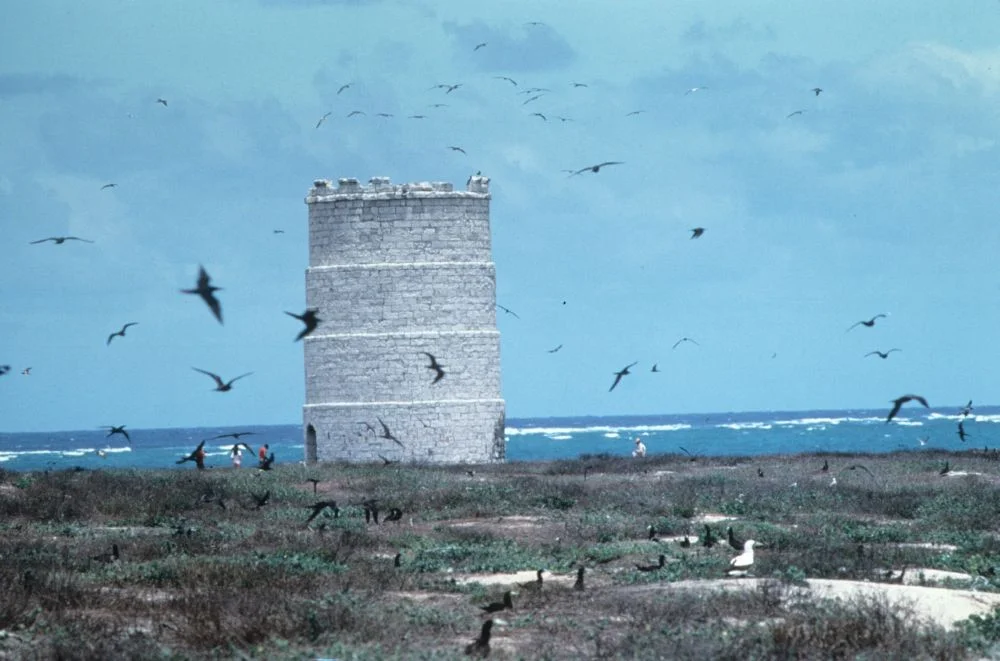
It is a strange thing to find on a speck of coral barely a kilometre long, lost in the open Coral Sea at the far northern edge of the Great Barrier Reef: a stone tower, twelve metres tall, crowned with a battlemented parapet like a fragment of medieval castle. The Raine Island Beacon has stood here since 1844, weathering cyclones and salt spray on a cay so remote that almost no one ever sees it. It is the oldest surviving European structure in tropical Australia — and it was raised, stone by stone, by convicts marooned on this sandbank for the sole purpose of warning ships away from the reef that had already swallowed so many.
A Graveyard of Ships
The reason for the tower lay beneath the waves all around it. Sailing ships running north from the Australian colonies toward Asia had to find a way out through the Great Barrier Reef — a labyrinth of coral that wrecked vessel after vessel. Many took the Outer Passage and turned west toward Torres Strait, threading a gap near Raine Island that was as deadly as it was vital. The waters here were notorious, littered with the bones of ships that had misjudged the maze. In 1844 the colonial authorities decided to plant a marker on the cay itself: a beacon tall enough to be seen from far off, a fixed point in a seascape that offered sailors almost nothing to steer by. On an open ocean with no headlands and no high ground, a single stone tower could mean the difference between a safe passage and the reef.
Built by the Damned
The labour fell to convicts — around twenty stonemasons and labourers shipped to this barren cay and set to work under the watch of New South Wales soldiers. They had almost nothing, so they built from what the island and the sea provided. They quarried coral limestone from the rock beneath their feet. They burned seashells to make lime for mortar. And they salvaged timber from the Martha Ridgway, a ship wrecked nearby in 1842, turning one vessel's disaster into another's salvation. In roughly four months of brutal labour under the tropical sun, with no shade and no relief, they raised a cylindrical tower that stepped inward as it climbed and could be seen for thirteen nautical miles. Then they sailed away and left it to the birds.
Voices in the Stone
The beacon's working life was almost laughably brief. Soon after it was finished, a better northern passage was charted, and the tower it had taken months of suffering to build slipped quietly into obsolescence. Yet it never fell silent. In 1890 a guano-mining company arrived to strip the island's seabird droppings, working a crew of a hundred Chinese labourers whose quarries still scar the cay; a lone tombstone marks the grave of Annie Eliza Ellis, who died here in 1891. For generations afterward, passing sailors climbed inside the empty tower and scratched their names and messages into its inner walls — hundreds of inscriptions, an unofficial logbook carved in stone by people who paused on the loneliest of landmarks.
The Turtles' Tower
Today the beacon guards something far more precious than shipping. Raine Island is the largest green turtle nesting ground on the planet — on peak nights, tens of thousands of females haul themselves ashore to lay their eggs in the same sand their ancestors used. It is also the most important seabird rookery in the entire Great Barrier Reef. Human access is now tightly restricted, and the cay is a protected scientific reserve. The old convict tower presides over it all: a crumbling, crenellated sentinel, its stones quarried by prisoners, weathered by two centuries of storms, and now watching over one of the most extraordinary concentrations of wild life left on Earth.
From the Air
Raine Island and its beacon lie at 11.59°S, 144.04°E, on the outer edge of the northern Great Barrier Reef, well offshore in the Coral Sea east of Cape York. The island is a strictly protected scientific reserve with no public access by sea or air, so it is purely a landmark to observe from altitude. The nearest mainland airfields are far to the west on Cape York — Weipa (YBWP) on the Gulf side, and Lockhart River (YLHR) on the east coast. From the air Raine Island reads as a brilliant white-and-green cay ringed by the deep blue of the open sea and the pale turquoise of surrounding reef, with the small dark vertical of the beacon tower at its eastern end. Clear, calm conditions in the dry season (May–October) give the best visibility over the reef colours.
Nearby Stories
- Kutini-Payamu (Iron Range) National Park 99 km away
- Somerset Graves Site 108 km away
- Aboriginal Shire of Mapoon 122 km away
- Lockhart River, Queensland 131 km away
- RMS Quetta 163 km away
- Lizard Island 338 km away
- Japanese submarine Ro-33 339 km away
- Mrs Watson's Cottage 366 km away