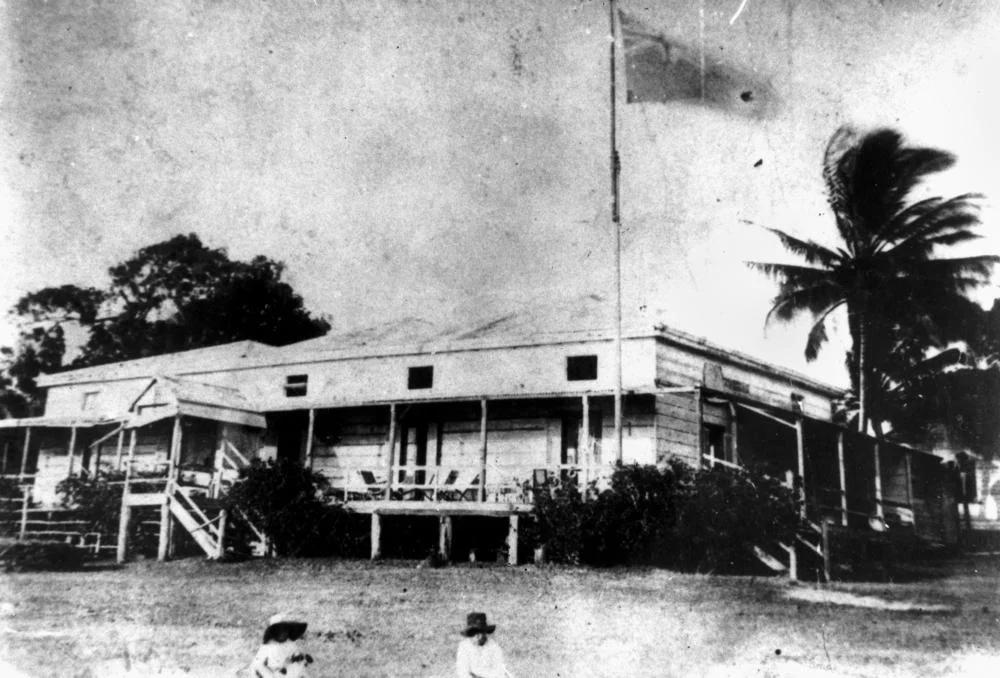

Somerset Graves Site
The headstone of a pearl diver named Cancan faces a different direction from every other grave in the cemetery. Oriented north-south rather than the conventional east-west, cracked across its marble face and held together with fencing wire and a star picket, it is the oldest known burial in the Somerset Graves Site -- dating to 1890, the same year the RMS Quetta sank in the Torres Strait nearby. This small, 2,379-square-meter patch of ground on the northwest edge of Somerset Bay contains just seven marked graves, a memorial cenotaph, and a monument to a doomed explorer. Together, they compress more than a century of Cape York's turbulent history into a space smaller than a suburban house block.
An Outpost Named for a Duke
Somerset was established in 1864 as a joint venture between the Queensland and British governments, intended as a port of refuge and refueling depot near the tip of Cape York Peninsula. Governor Bowen had sailed from Brisbane aboard HMS Pioneer in 1862 to select the site, choosing a location opposite Albany Island and naming it after Edward Seymour, 12th Duke of Somerset, then First Lord of the Admiralty. A town survey followed in 1864, land sales began in Brisbane the next year, and for a little over a decade Somerset served as the regional center for Cape York -- its government buildings arranged around the bay, marines garrisoned on the northern shore. But the settlement's importance was already eroding. A safer shipping route through the Torres Strait was found, and by 1876 Thursday Island had begun to replace Somerset as the region's hub.
The Jardine Legacy
No family is more closely identified with Somerset than the Jardines. John Jardine arrived in 1864 as the settlement's first Police Magistrate. His sons Frank and Alick had already undertaken a grueling overland expedition from Rockhampton to Cape York, driving the first cattle into the peninsula -- a feat that earned them Fellowships of the Royal Geographical Society and the Murchison Award in 1886, and gave their name to the Jardine River. Frank married Sana Sofala, a Samoan woman, in 1873. He accumulated titles -- Magistrate, Postmaster, Inspector of Police -- but his tenure was not without controversy. The Indigenous population was dispossessed under his watch, and he was once suspended while investigated for using his position to obtain a pearl diving license. After Somerset's decline, Frank stayed on, raising cattle, growing coconuts, and aiding shipwreck survivors, including those from the Quetta. He died at Somerset in March 1919. His grave and Sana's lie side by side in the cemetery's southern area, their 1924 memorial cenotaph placed between them with plaques facing each spouse's resting place.
Pearl Divers and the Price of Shell
The northern section of the cemetery belongs to the pearl divers. Cancan's grave, the earliest known burial, dates to 1890. Nearby lies Kobori Itchimatsu, a Japanese pearl diver who died in 1909. Itchimatsu came from Nishi Mukai village in Wakayama prefecture, a region that supplied eighty percent of the roughly seven thousand Japanese who left their homeland to work the Torres Strait pearl beds. The pearling industry was central to Queensland's economy from the 1870s onward, relying on a multiethnic workforce that included Japanese, Malay, Aboriginal, and Torres Strait Islander divers. The work was dangerous -- deep free diving and later hard-hat diving claimed lives regularly through drowning, decompression sickness, and cyclones. That two pearl divers from different backgrounds ended up buried together in this remote cemetery speaks to the industry's reach and its human cost.
What Remains at the Edge of the Map
Between the cemetery's two grave areas stands the Kennedy Memorial Monument, unveiled on 13 December 1948 to mark the hundredth anniversary of Edmund Besley Court Kennedy's failed attempt to explore Cape York Peninsula -- an expedition in which Kennedy himself was killed. The monument is a concrete slab with a bronze plaque, modest in scale but significant in what it represents: the persistent European impulse to chart, name, and claim this coast, often at fatal cost. Several Indigenous groups occupied the region long before any of these events. Archibald Meston estimated the Indigenous population between Newcastle Bay and Cape York at around three thousand in the 1870s; by 1896, he believed it had fallen to roughly three hundred, devastated by introduced disease, exclusion from hunting grounds, and frontier violence. The Somerset Graves Site was listed on the Queensland Heritage Register on 25 January 2018. Today it stands empty of living inhabitants -- Somerset's population is officially zero -- but the graves remain, their chain-link decorations rusting, their headstones cracking, holding the stories of an outpost that the empire built and then abandoned.
From the Air
Coordinates: 10.74S, 142.59E, on the northwest edge of Somerset Bay at the tip of Cape York Peninsula. Albany Island is visible just offshore to the north. The nearest airstrip is Bamaga (ICAO: YBAM), approximately 30 km to the northwest. Thursday Island's Horn Island Airport (ICAO: YHID) lies across the Torres Strait to the northeast. From low altitude, the cemetery is extremely small and not visible, but Somerset Bay and the surrounding coastline are distinctive landmarks.
Nearby Stories
- Booby Island Light 26 km away
- Aboriginal Shire of Mapoon 39 km away
- Asia (1818 ship) 53 km away
- HMS Pandora (1779) 103 km away
- All Saints Anglican Church, Darnley Island 129 km away
- Janszoon Voyage of 1605–1606 131 km away
- Raine Island 135 km away
- Wasur National Park 253 km away