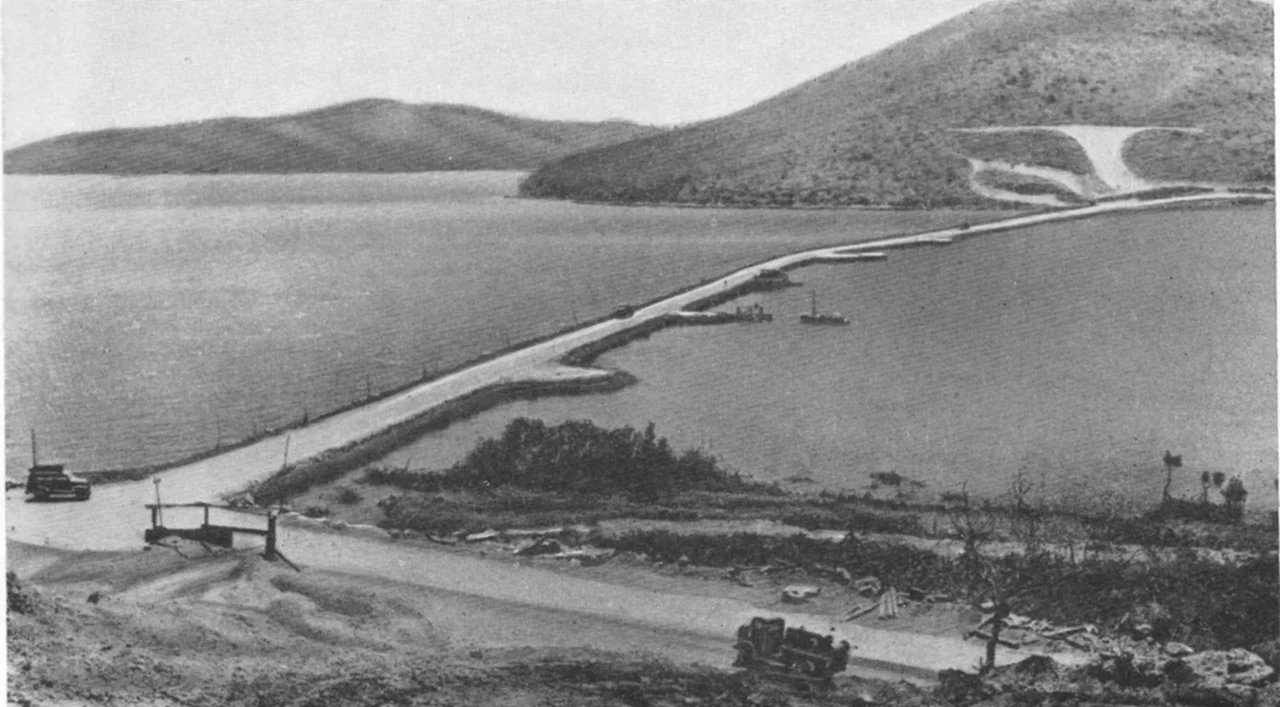

Naval Base Port Moresby
Seventy men started it. On 20 June 1943, the first contingent of U.S. Navy Seabees from the 55th Construction Battalion arrived at Port Moresby, detached from Naval Base Brisbane with orders to build an advance base headquarters and communications center for the Seventh Fleet. The United States Army and Australian forces already had substantial operations here, tied to the Port Moresby Airfield Complex that had been defending the city against Japanese air raids since early 1942. What the Navy needed was a forward node - a place where the Pacific war's signals could be handled, its messages relayed, its ships coordinated. By 15 July 1943, less than four weeks after the Seabees arrived, the radio communications station was operational.
Fairfax Harbor
Port Moresby had the geography a fleet wanted. The protected anchorage at Fairfax Harbor-Moresby Harbor runs five miles long by three miles wide, with a bottom of sand and clay that holds an anchor. Headlands block the weather. The city's proximity to the Kokoda Track and the Owen Stanley mountain battles made it strategically central to the New Guinea campaign, while its distance from Japanese airfields - long enough to make round-trip bombing runs punishing - kept it safer than forward bases. Port Moresby had been bombed dozens of times in 1942, but by mid-1943 the air threat had receded. The conditions were right to build something more permanent.
What the Seabees Built
The 55th Battalion's crew of 70 Seabees from Brisbane put up a large radio station and communications center - two transmitters and a power station tied together in the kind of tropical infrastructure that required engineering nobody had quite standardized yet. They built a Port Director center at the harbor. They put up Quonset huts for the staff and a supply depot. In September, 50 more Seabees from the same battalion - these detached from Naval Base Milne Bay - arrived to accelerate the work, staying through December 1943. When construction was done, the original crew returned to Brisbane. The base they left behind was not a conventional naval station with dry docks and barracks for thousands. It was a hub - relaying signals, coordinating shipping, directing the flow of men and material that the Pacific War consumed in quantities nobody had anticipated.
The Flying Boat Base
Port Moresby Flying Boat Base predated the American arrival by years. The Royal Australian Air Force marine section had built it in 1939, with seaplane ramps and mooring areas along the harbor. When the U.S. Navy came, they operated patrol squadron VP-101 - flying Consolidated PBY Catalinas - from the base between August and December 1943. The RAAF ran its own PBY squadrons here, 11 Squadron and 20 Squadron. The Catalinas went out on long-range anti-submarine patrols, reconnaissance missions over Japanese-held coastlines, and rescue runs for downed pilots. After the war ended, Qantas took over the facility for civilian PBY and Short Sandringham flying boat services - the passenger flying-boat era lasting into the 1950s before land airports made it obsolete.
Day-to-Day Operations
When the construction was complete and the 55th Battalion went home, a smaller Seabee unit - Construction Battalion Maintenance Unit 546 - arrived on 3 April 1944 to handle day-to-day operations. This was the unglamorous work that made everything else possible: maintaining the radios when tropical humidity ate through wiring, keeping the generators running when supply shipments were delayed, repairing quonset huts after tropical storms, fixing the thousand small things that break every day on a military base at the equator. The Fleet Post Office number was 162 SF Port Moresby - a bureaucratic address that anchored the base in the enormous paper infrastructure of wartime Navy communications. Every letter from a sailor to a mother back home ran through a number like that one.
When the War Moved On
By October 1944, Naval Base Port Moresby had outlived its usefulness. The war had shifted north - to the Philippines, to the Marianas, to bases like Hollandia in Netherlands New Guinea, where MacArthur was running the invasion of the Philippines from an advance headquarters the Seabees had thrown up that spring. Port Moresby was suddenly a backwater. The Seabees started shipping out its useful parts to forward bases where the action had moved. By 1 November 1944, the closure was complete - not yet 17 months after the first construction crew had arrived. The communications equipment came down. The huts came apart. What remained of the base was absorbed by the ongoing Australian and civilian infrastructure. Port Moresby went back to being what it had been before the war: the capital of Australian-administered Papua, quieter than it would be again for a long time.
From the Air
Coordinates 9.43 degrees south, 147.11 degrees east, at Port Moresby on the southeast coast of New Guinea. Jacksons International Airport (AYPY / POM) is the modern primary field; Fairfax Harbor is immediately southwest of the city. The Port Moresby Flying Boat Base occupied a portion of that harbor, with seaplane ramps and mooring areas now mostly replaced by modern port infrastructure. The harbor itself remains distinctive from altitude - five miles long by three miles wide, with the mountains of the Owen Stanley Range rising behind the coast to the northeast. Tropical climate with a dry season (May-October) offering much better visibility than the wet season's afternoon thunderstorms.
Nearby Stories
- First Battle of Eora Creek - Templeton's Crossing 15 km away
- Battle of Mission Ridge-Brigade Hill 28 km away
- Kapa Kapa Trail 45 km away
- Second Battle of Eora Creek - Templeton's Crossing 68 km away
- Strathallan Estate 230 km away
- Gulf of Papua 253 km away
- Milne Bay Province 265 km away
- HMS Pandora (1779) 343 km away