
Battle of Mission Ridge-Brigade Hill
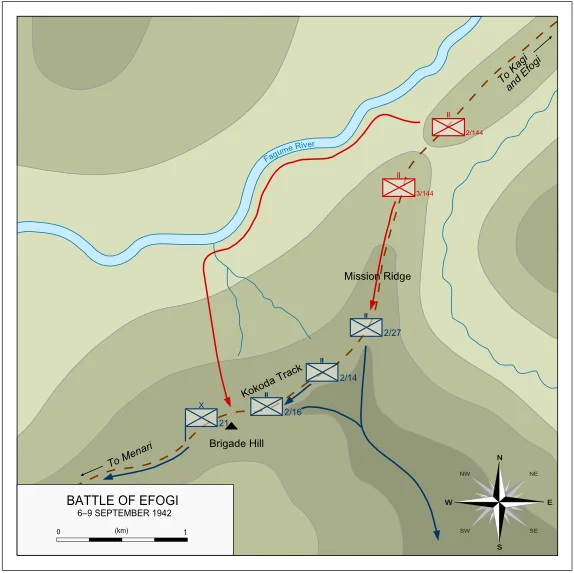
Brigadier Arnold Potts had been ordered to stop retreating. Above Efogi village, on a feature shaped like a boomerang that arched southwest from Mission Ridge to Brigade Hill, he thought he had found his ground - a long spine of high earth with commanding views north up the Kokoda Track and cleared zones where Allied aircraft could strike attacking Japanese formations. His three battalions, around 1,400 men of the 2/14th, 2/16th, and 2/27th, dug in during the first days of September 1942. What Potts could not know was that the Japanese would not come at him the way he expected. They would come through the ground west of his position that he had thought impassable, led by a Papuan guide who knew the country the Australians were still learning.
The Ground and the Orders
Mission Ridge ran north from Brigade Hill along the main track, and Brigade Hill itself anchored the southern end of the feature. To the east, steep ground protected the Australian flank. To the west, the land fell away toward the Fagume River - broken country, thick with rainforest, rising and falling through drainages that locals had navigated for generations. Potts' 21st Brigade had just fought successful delaying actions at Isurava and Eora Creek, and Lieutenant General Sydney Rowell had ordered him to stop withdrawing and make a stand. The 2/27th Battalion, freshly released from reserve in Port Moresby, had marched up to join him. On 7 September, after days of Japanese preparation and an Allied air raid at Kagi that inflicted minor Japanese casualties, Japanese artillery opened on the 2/27th's positions and the III Battalion of the 144th Infantry Regiment attacked straight up the track.
The Flank That Wasn't
The frontal assault was held. The 2/27th absorbed the artillery barrage and refused to break. Then, under cover of darkness, the II Battalion of the 144th slipped off the track to the west and disappeared into the country Potts had thought unusable. They did not stumble through the forest. A Papuan guide led them - a man whose name was not recorded, who knew the pathways across the ravines west of Mission Ridge and guided the Japanese column around the Australian flank and back to the track behind the rear Australian battalion. By morning on 8 September, the II/144th had cut the main supply route behind the 2/16th Battalion and severed the three Australian battalions from their headquarters. Japanese artillery, which had been pounding the 2/27th forward, now shifted to the 2/16th in the rear. The Australians were surrounded in detail.
A Costly Counter-Attack
Potts launched counter-attacks to reopen the track. They failed. Each assault up the steep slopes into Japanese positions cost lives that the thinned battalions could not afford - men of the 2/14th and 2/16th fighting through scrub and up rising ground to try to reach their brigade headquarters. The Australians finally broke contact and withdrew overland, leaving the track entirely, hacking their way through dense forest toward Menari with their wounded. Some of the wounded could not be brought out. Those who made it to Menari arrived exhausted and depleted. Higher command's reaction was political: Potts, who had fought a masterful fighting withdrawal from Isurava south, was relieved and replaced by Brigadier Selwyn Porter. History has been kinder to him than his superiors were at the time. The battle honour "Efogi-Menari" was awarded to the 2/14th, 2/16th, and 2/27th Infantry Battalions after the war.
The Men on Both Sides
Australian command called it a disaster. The South Seas Detachment's soldiers - men of the 144th Infantry Regiment from Kochi Prefecture in Japan - had pulled off a textbook pin-and-flank maneuver in country every manual described as impossible. They had also, by this point, been marching and fighting for six weeks over some of the hardest terrain on Earth. Many were sick with malaria and dysentery; their uniforms rotted on them; they ate rice that had been carried on human backs over the Owen Stanley Range. The Australians facing them were in similar condition. Peter Brune and other historians have noted that the Papuan carriers and Papuan Constabulary who supported the Australian withdrawal - carrying stretchers down the hills through gunfire, bringing up supplies under artillery - made the retreat possible at all. Without them, the wounded of Brigade Hill would not have reached Menari.
The Ridge Today
Brigade Hill today is a memorial site, about a day's walk north of Menari on the modern Kokoda Track. Trekkers pause at the top where the Australian headquarters stood, looking north up the ridge where the 2/27th held their ground and west into the broken country through which the Japanese came. The Brigade Hill memorial marks the line of Australian graves; many of the dead from the counter-attacks were buried where they fell and later moved to Bomana War Cemetery outside Port Moresby. Trekking guides - some descendants of the carriers - tell the story standing on the ridge, pointing down the track and off into the trees. The country has grown back over the slit trenches, but the shape of the land still tells how the battle went.
From the Air
Mission Ridge and Brigade Hill lie at approximately 9.16 degrees south, 147.66 degrees east, in the central Owen Stanley Range about 80 km north of Port Moresby. The nearest airfield is Efogi airstrip (grass, unmarked) immediately north of the battlefield; larger airports are Jacksons International (AYPY/POM) at Port Moresby 55 nautical miles south, and Kokoda (AYKO) 45 nautical miles north. Recommended viewing altitude is 8,000 to 10,000 feet - the ridge sits around 4,800 feet above sea level and is often in cloud. The boomerang-shaped feature is visible as a distinctive high ridge oriented north-south on the western side of the main divide.
Nearby Stories
- Battle of Oivi-Gorari 6.4 km away
- Kokoda Track 17 km away
- Papua New Guinea National Museum and Art Gallery 25 km away
- Japanese submarine Ro-33 25 km away
- Invasion of Buna–Gona 35 km away
- Sirinumu Dam 39 km away
- Battle of Wau 192 km away
- Milne Bay Province 199 km away