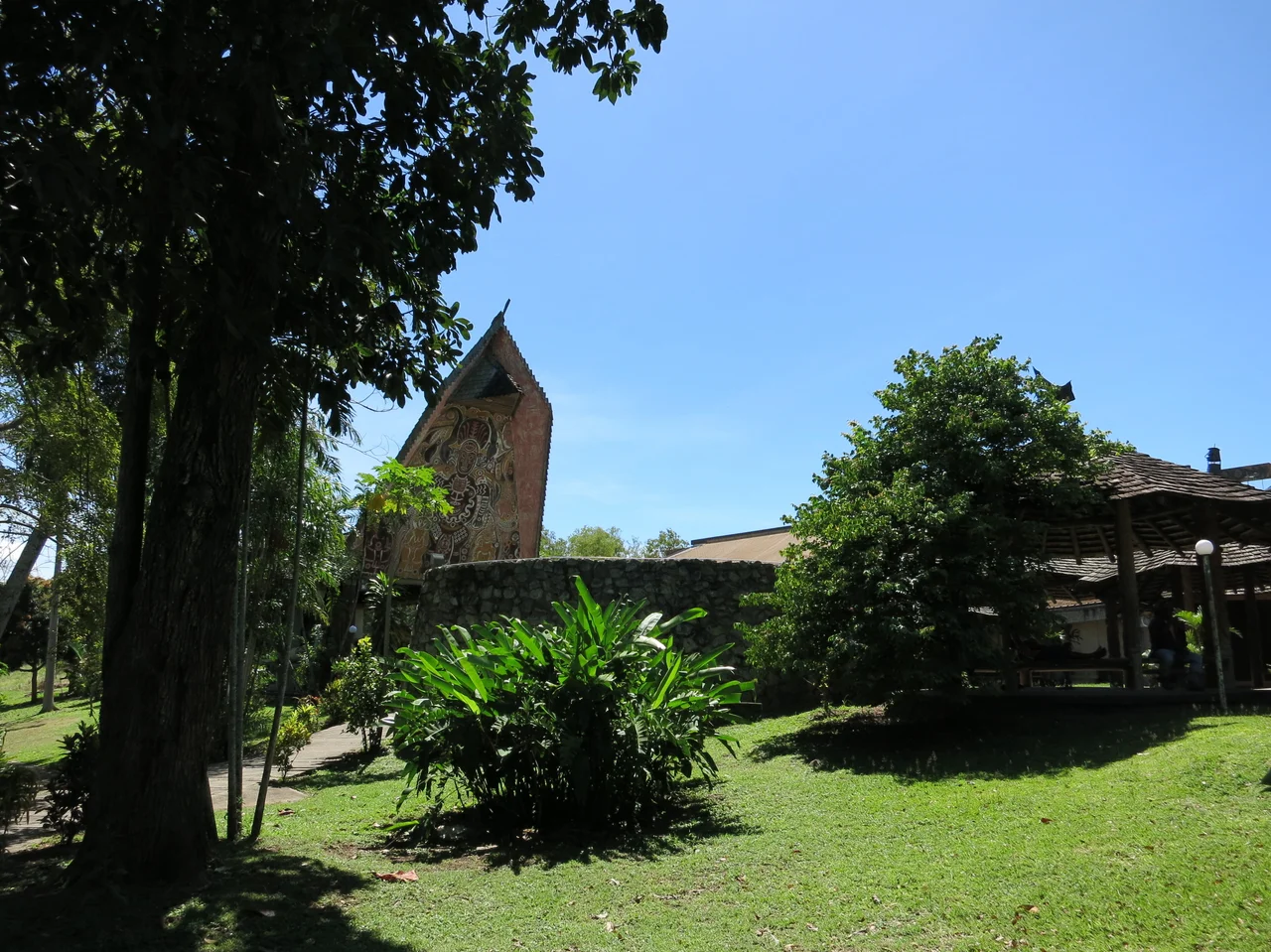

Papua New Guinea National Museum and Art Gallery
"We view our masks and art as living spirits with fixed abodes. It is not right they should be stored in New York, Paris, Bonn or elsewhere." Prime Minister Michael Somare wrote those words in 1974, the year before Papua New Guinea became a nation. A purpose-built museum was rising in Waigani, a suburb of Port Moresby, and Somare was signaling what its walls would stand for. Some of those masks had not been home in nearly a century.
A Collection Scattered, Then Summoned
In 1889, the British governor William MacGregor began gathering natural history specimens and cultural objects from across what was then the British Protectorate of New Guinea. He imagined a museum on the island itself, but the idea lost momentum. The collection dispersed instead - to the Australian Museum, to institutions in Britain, eventually to the Met, the British Museum, the Pitt Rivers, the Field Museum in Chicago. For decades, Papuan masks and kundu drums and Milne Bay outriggers lived in glass cases a world away from the people who made them. In 1953 an Antiquities Ordinance established a new collecting programme, and by 1956 the Public Museums and Art Galleries Ordinance had created a Papua New Guinean institution ready to receive what had been taken. Seventeen MacGregor objects came home at the museum's opening in 1977. The return has continued, piece by piece, ever since.
Tumbuna, Bernard Narokobi, Be Jijimo
Walk into the refurbished museum today and the galleries bear Papuan names: Tumbuna, Susan Karike, Bernard Narokobi, Ian Saem Majnep, Be Jijimo. That naming was deliberate. The 2017 refurbishment, designed by the Australian firm Architectus for the museum's 40th anniversary, treated the renaming as seriously as it treated the structural work. These are not abstractions. Susan Karike wrote the lyrics to the national anthem. Bernard Narokobi articulated a philosophy of Melanesian sovereignty that shaped independent Papua New Guinea. Majnep, a Kalam man, co-authored anthropological studies of his own people's ecological knowledge at a time when such collaboration was rare. The galleries carry their weight.
Kundu and Garamut
The collections span music, ceremony, and navigation - objects meant to be used, not displayed. Kundu drums, shaped like hourglasses and played with the palm, accompany dances across much of the country. Garamut slit drums, hollowed from single logs, carried messages between villages in coded rhythms. A richly decorated Milne Bay outrigger canoe sits in the collection, the kind of vessel that once carried traders across the Louisiade Archipelago and beyond. Body adornments, masks from the Sepik and Highland regions, totem poles - each piece arrived with a context the museum works to preserve. Staff have collaborated with the Smithsonian on projects that record song traditions and ecological knowledge before those knowledge-holders pass on.
The Long Road Home
Repatriation is slow work. Seventeen objects in 1977 was a start, not a conclusion. In 2006, questions arose about the legality of several Melanesian items in San Francisco's de Young Museum, and the conversation about how Papuan material culture ended up in Western institutions grew sharper. Some returns have been voluntary. Some have required negotiation. The museum hosts a display about the American ace Dick Bong - a reminder that the war that brought so many foreign objects onto Papuan soil also brought foreign stories, which the museum now chooses to tell alongside its own. Standing at 9.43 degrees south, 147.19 east, the museum is a short drive from the international airport that was once Jackson Airfield, itself a relic of the war. The building opens on 27 June 1977 feels recent until you remember how many of its objects are older than the nation that now holds them.
From the Air
Located at 9.43 degrees S, 147.19 degrees E, in the Waigani suburb of Port Moresby. The museum sits near the government complex, roughly 4 nautical miles north-northeast of the main port. Jacksons International Airport (AYPY / POM) is 3 nm east-northeast. From cruising altitude the Waigani district appears as a cluster of low-rise government buildings between Jacksons and the Gulf of Papua coastline. Recommended viewing altitude: 3,000-5,000 feet AGL for context of the capital's layout. Tropical weather can bring afternoon cloud buildup; morning flights offer clearest conditions.
Nearby Stories
- First Battle of Eora Creek - Templeton's Crossing 15 km away
- Battle of Mission Ridge-Brigade Hill 28 km away
- Kapa Kapa Trail 45 km away
- Second Battle of Eora Creek - Templeton's Crossing 68 km away
- Strathallan Estate 230 km away
- Gulf of Papua 253 km away
- Milne Bay Province 265 km away
- HMS Pandora (1779) 343 km away