
Battle of Oivi-Gorari
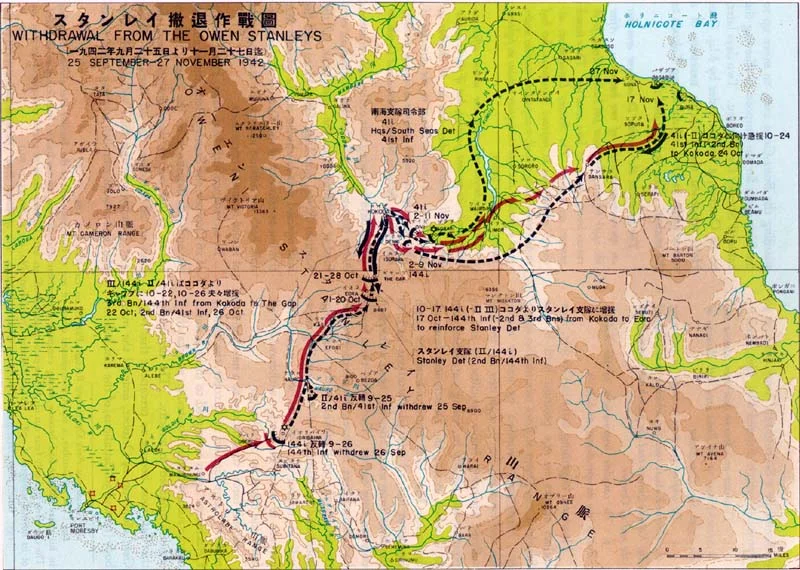
Of all the ways the Kokoda Track campaign could have ended, this was perhaps the least cinematic: a river in flood, a ruined wire bridge, and men who had fought in mountain jungle for months standing on the bank watching their enemy drown. Between 4 and 11 November 1942, the 7th Australian Division trapped the remnants of Major General Tomitaro Horii's South Seas Detachment between two brigades and the Kumusi River. What followed was a rout, a drowning and a pause. The campaign was over. The killing was not.
Why Oivi Mattered
Kokoda had been retaken on 2 November, unopposed, the flag raised by Major General George Vasey in a ceremony on 3 November. Supplies were flying in. Wounded were being evacuated by air for the first time in months. The Kokoda Track, until then a pipeline that leaked ninety per cent of its cargo into the jungle, had become a functioning line of communication. But between the Australians and the Japanese beachheads at Buna and Gona lay one more chance for Horii to buy time. He chose the high ground around Oivi, about twelve kilometres east of Kokoda on the track to Sanananda. His men dug in carefully. They had artillery, something the Australians still mostly did not. They had prepared positions. And they had orders to hold long enough for the beachheads to be reinforced from the sea.
The Frontal Problem
On 4 November, Brigadier John Lloyd's 16th Brigade hit the Oivi position and bounced. Well-sited machine guns and well-dug infantry held off several frontal attacks across three days. It was the same lesson Lloyd had bloodied himself against at Eora Village: in New Guinea jungle, frontal assaults against prepared defences were a way to get infantry killed. Vasey watched the situation and, on 7 November, committed Brigadier Kenneth Eather's 25th Brigade to a flanking move. Eather's battalions, on a parallel track to the south, would bypass Oivi entirely and strike the Japanese depth position at Gorari. The two brigades together numbered 3,700 men. Horii's force was smaller and already badly weakened from the four-month retreat, though exactly how weakened was about to become clear.
Gorari, 10 November
The 25th Brigade made the turn north on 9 November and hit Gorari on the morning of the tenth. What followed was close-quarters work, hand-to-hand in places, with heavy casualties on both sides. The Japanese defenders were surprised, cut off from their own line of retreat, and fighting under the assumption that the main Australian weight was still at Oivi to their west. By the afternoon of 11 November, the battle was over. Some Japanese broke east toward the Kumusi, some were killed in place, and a smaller number managed to slip through the jungle gaps. Australian casualties came to 121 dead and 225 wounded. The battle honour was awarded to the 3rd, 2/1st, 2/2nd, 2/3rd, 2/25th, 2/31st and 2/33rd Infantry Battalions. Lloyd's 16th Brigade, finally able to press forward when Horii's defenders at Oivi began peeling off to save themselves, took the position that had held them for a week.
The Kumusi
The Kumusi River flows out of the Owen Stanleys toward the north coast, crossing the track at a place the Australians called Wairopi, Tok Pisin for wire rope, because of the wire-cable suspension bridge that had once spanned it. Allied bombing had destroyed that bridge weeks earlier. When the broken Japanese force reached the river in the days after Gorari, it was in flood. Survivors described men trying to swim across with weapons and equipment. Many drowned. Major General Horii himself was among the dead, though he is believed to have died further downstream attempting a raft crossing. A significant quantity of Japanese artillery, the mountain guns that had given them the upper hand in every earlier battle, had to be abandoned on the western bank. For four months those guns had bombarded Australians who could not answer; now they sat in the mud while their crews drowned in front of them.
Engineers, Flying Foxes and What Came Next
The Australians crossed the Kumusi between 13 and 16 November using whatever they could improvise. Engineers strung flying foxes (a single-cable zip line) and a narrow footbridge between the banks. Engineering stores were thin, so the 25th Brigade went first, one company at a time, establishing a small bridgehead before the 16th Brigade followed. The ad hoc Chaforce, drawn from the 21st Brigade, arrived as reinforcements. By 16 November the river was behind them. What lay ahead was not relief but Buna and Gona, heavily fortified Japanese beachhead positions that would swallow the next two months in a frontal assault that cost more Australian lives than the whole track campaign put together. For the men at Wairopi, the significance of Oivi-Gorari was less about victory than about something simpler: they had pushed the Japanese off the mountains. For the first time since July, they were advancing into country they could see.
From the Air
Oivi sits at 8.92 degrees south, 147.87 degrees east, on the northern foothills east of Kokoda. Gorari is roughly eight km further east along the Kokoda-Sanananda track. The Wairopi crossing of the Kumusi River lies about 15 km further east again. From altitude, the Kumusi cuts a dark line through the coastal flats between the Owen Stanleys and the north coast. Recommended viewing altitude 6,000 to 10,000 feet AGL. Nearby airports: Kokoda (AYKO) 12 km west of Oivi, Girua (AYGR) near Popondetta 35 km east, Jacksons International Port Moresby (AYPY) 130 km southwest across the Owen Stanleys.
Nearby Stories
- Battle of Mission Ridge-Brigade Hill 19 km away
- Invasion of Buna–Gona 25 km away
- Kokoda Track 27 km away
- Papua New Guinea National Museum and Art Gallery 34 km away
- Wards Airfield 63 km away
- Battle of Wau 156 km away
- Battle of the Bismarck Sea 158 km away
- Japanese Submarine Ro-103 265 km away