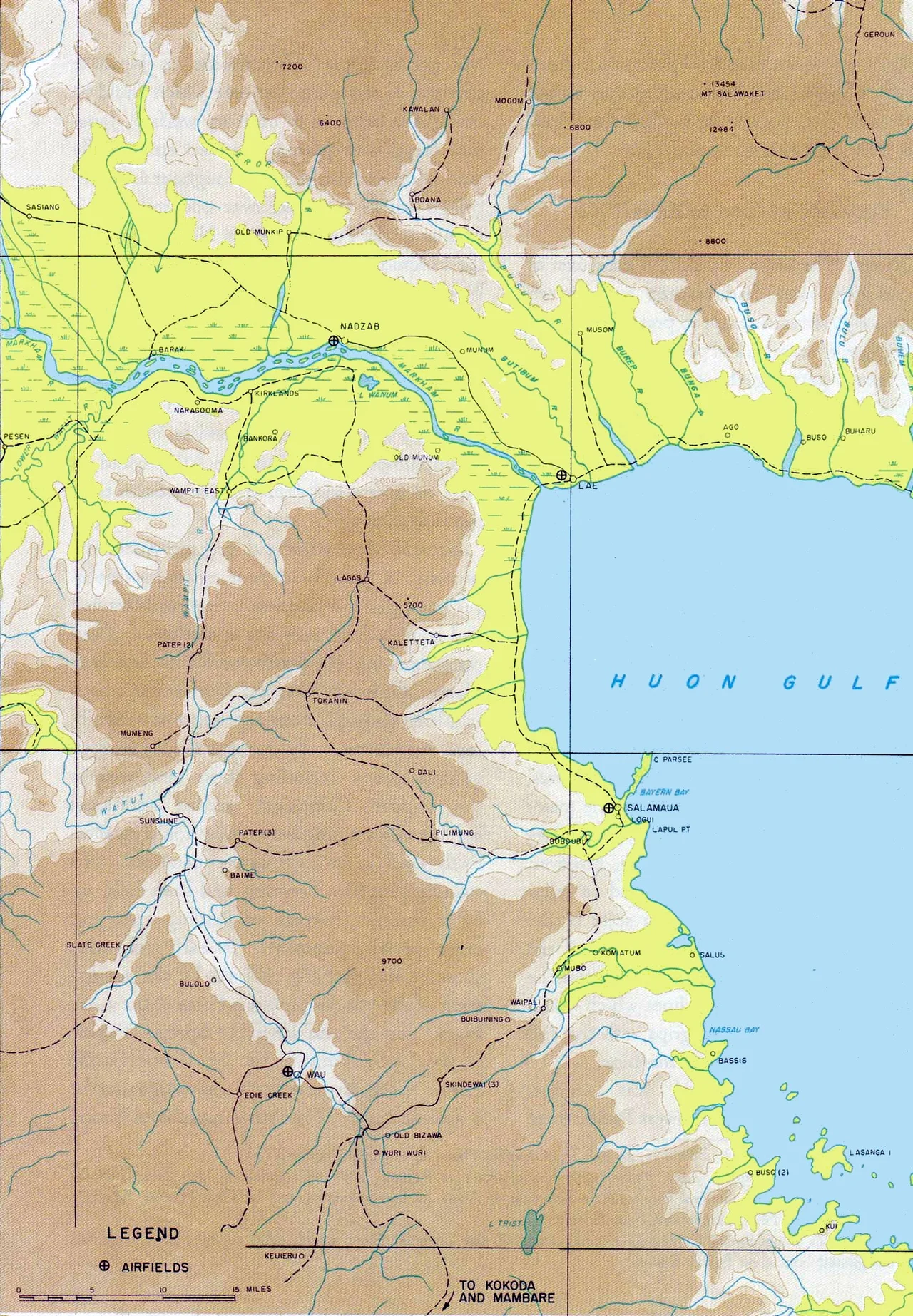

Battle of Wau
The race was absurd on its face. Japanese infantry, loaded with rifles and rations, hacking through jungle-choked mountains toward a mining town held by a few hundred Australians. Australian reinforcements waiting in Port Moresby for the clouds to part, trying to deliver a whole brigade through passes where Dakotas had to dodge "a peak here and a cloud there" and land at high speed on an uphill strip. On 29 January 1943, the Japanese reached Wau. The Australians were still flying in. What happened over the next six days would settle whether the Japanese could strangle Allied operations in eastern New Guinea, or whether a gold-rush airstrip in the Morobe highlands would become the hinge on which the Pacific war turned.
A Town Built by Gold
Wau existed because men chased nuggets. In the 1920s, prospectors landed at Salamaua on the coast and clawed inland along the Black Cat Track, a killing trail of leeches, vertical mud, and malarial creeks. What they found in the Wau-Bulolo Valley justified the suffering: gold, in quantities that built a town out of jungle. Miners cleared ridges, raised houses and workshops, strung an electricity grid, piped water. Most important, they carved out aerodromes at Wau and Bulolo, the only reliable way in or out. On 19 April 1927, Ernest Mustard set his De Havilland DH.37 down at Wau for the first time, and the valley stopped being remote. When Japan entered the war, that same airstrip, sitting at 1,100 meters in a bowl of storm-wracked mountains, became a problem the Imperial Japanese Army could not ignore.
Kanga Force and the Bulldog Track
By mid-1942, Japan held Lae and Salamaua on the coast. Wau was cut off, its civilian evacuation half-finished, some 250 European and Asian men left stranded when fighter escorts became unavailable. They walked out, over the Owen Stanley Range on foot, through Kudjeru and Tekadu to a disused mining settlement called Bulldog, then floated down the Lakekamu River to the sea. That improvised escape route became a lifeline. New Guinea Force pushed a platoon of the 1st Independent Company up the same track in the schooner Royal Endeavour, reinforcing the local New Guinea Volunteer Rifles. On 23 April 1942, Kanga Force was born. The 2/5th Independent Company followed by air in May, the 2/7th in October. From a half-abandoned mining town, Australians began raiding Japanese positions at Salamaua and feeding back intelligence, never quite strong enough to win, always strong enough to worry Tokyo.
The Convoy and the Ultra Intercepts
Lieutenant General Hitoshi Imamura at Rabaul read the situation correctly: Kanga Force was a knife pointed at his supply lines. On 29 December 1942, his subordinate Lieutenant General Hatazo Adachi ordered Major General Toru Okabe and the 102nd Infantry Regiment to take Wau. The convoy left Rabaul on 6 January. But Allied code-breakers had already read the orders. Brigadier General Kenneth Walker led a dawn attack of six B-17s and six B-24s against Rabaul Harbour on 5 January, pressed home at noon through heavy flak, and was shot down. He received the Medal of Honor posthumously. The convoy ran a gauntlet of bombers and fighters across the Solomon Sea. A Catalina of No. 11 Squadron RAAF, flown by Flight Lieutenant David Vernon, bombed the transport Nichiryu Maru by night with four 250-pound bombs and sent all of Okabe's medical supplies to the bottom. Destroyers pulled 739 of 1,100 men from the water. The remaining transports reached Lae on 7 January with roughly 4,000 troops, and Okabe disappeared into the mountains on a seldom-used track parallel to the Black Cat.
Sherlock's Stand
The Australians had been flying in reinforcements since early January. Weather was the worst enemy. Only 28 Dakotas served all of New Guinea in three understrength squadrons, split between the Buna front and Wau. Three of them crashed. Brigadier Murray Moten was turned back twice before reaching Wau on his third attempt. By late January, bad weather had grounded most flights entirely. Standing between Okabe's men and the airstrip was A Company of the 2/6th Infantry Battalion under Captain W. H. Sherlock. On 28 January, Okabe ordered a full attack. Sherlock was driven onto a spur and held through the afternoon against frontal assaults, leading a bayonet charge himself to break up an infiltration. By six in the evening his mortars were empty and his small arms nearly so, Japanese rounds sweeping the position. He held through the night. The next morning, trying to break through to Australian lines, he was killed. His posthumous mention in dispatches reads like understatement for what that one company bought in hours.
The Skies Opened
Then the weather broke. The Buna fighting had ended on 23 January, freeing aircraft, and 52 brand-new Dakotas of the US 317th Troop Carrier Group arrived in Australia, rushed forward at MacArthur's urgent request. Up to 40 aircraft were now available daily. On 29 January, 57 planeloads came into Wau. The next day, 40 aircraft made 66 trips, offloading under small arms fire. Among the cargo: two dismantled 25-pounder guns of the 2/1st Field Regiment and 688 rounds. The guns came off the planes in the morning and were firing before noon, ranging on 300 Japanese troops between Wandumi and Kaisenik. Beaufighters of No. 30 Squadron RAAF worked in close support. When Japanese bombers from Rabaul tried to smash the airstrip, the same storms that had tormented the Allies now hid Wau from them. A Dakota flown by Second Lieutenant Robert M. Schwensen was shot down on approach, all five aboard killed. P-38s and P-40s from Port Moresby tore into the Japanese fighter cover. Japanese attacks that reached the corner of the airstrip on 30 January were crushed by artillery, air, and fresh infantry. The attack collapsed.
The Cost and the Pivot
Kanga Force had lost 30 officers and 319 men since its founding, 52 of those from the 2/6th Battalion that bore the weight of Sherlock's stand. The Australians counted 753 Japanese dead around Wau, and with the 361 lost aboard Nichiryu Maru and airmen downed over the valley, Japanese deaths reached roughly 1,200. Adachi was ordered in June to try again for Wau, and his troops broke themselves building a road to carry the next attempt, but the Allied landings at Nadzab and Lae that September ended the project before it could be finished. Wau itself became a staging point. From the same strip where Dakotas had landed uphill in the rain with dismantled artillery, Australian troops began pushing toward Salamaua and Lae. The gold-rush town had held.
From the Air
Located at 7.34 degrees South, 146.72 degrees East, in the Wau-Bulolo Valley at roughly 1,100 meters elevation. The airstrip sits in a bowl ringed by the Owen Stanley Range, whose storms, updrafts, and mist famously forced Dakota pilots to dodge peaks and clouds while landing uphill at high speed. Nearest airfield is Wau (AYWU), with the modern regional hub Lae Nadzab (AYNZ) about 50 nautical miles northeast. Approach is VFR only; afternoon thunderstorms and valley fog make mornings the best window. From 10,000 feet, the valley's cleared terraces and the scar of the old airstrip remain distinct against jungle-choked ridges.
Nearby Stories
- Morobe Province 25 km away
- Battle of Finschhafen 77 km away
- Ukarumpa 87 km away
- Tami Islands 98 km away
- Kainantu 120 km away
- Strathallan Estate 131 km away
- Battle of Kokoda 154 km away
- Kokoda Track Campaign 181 km away