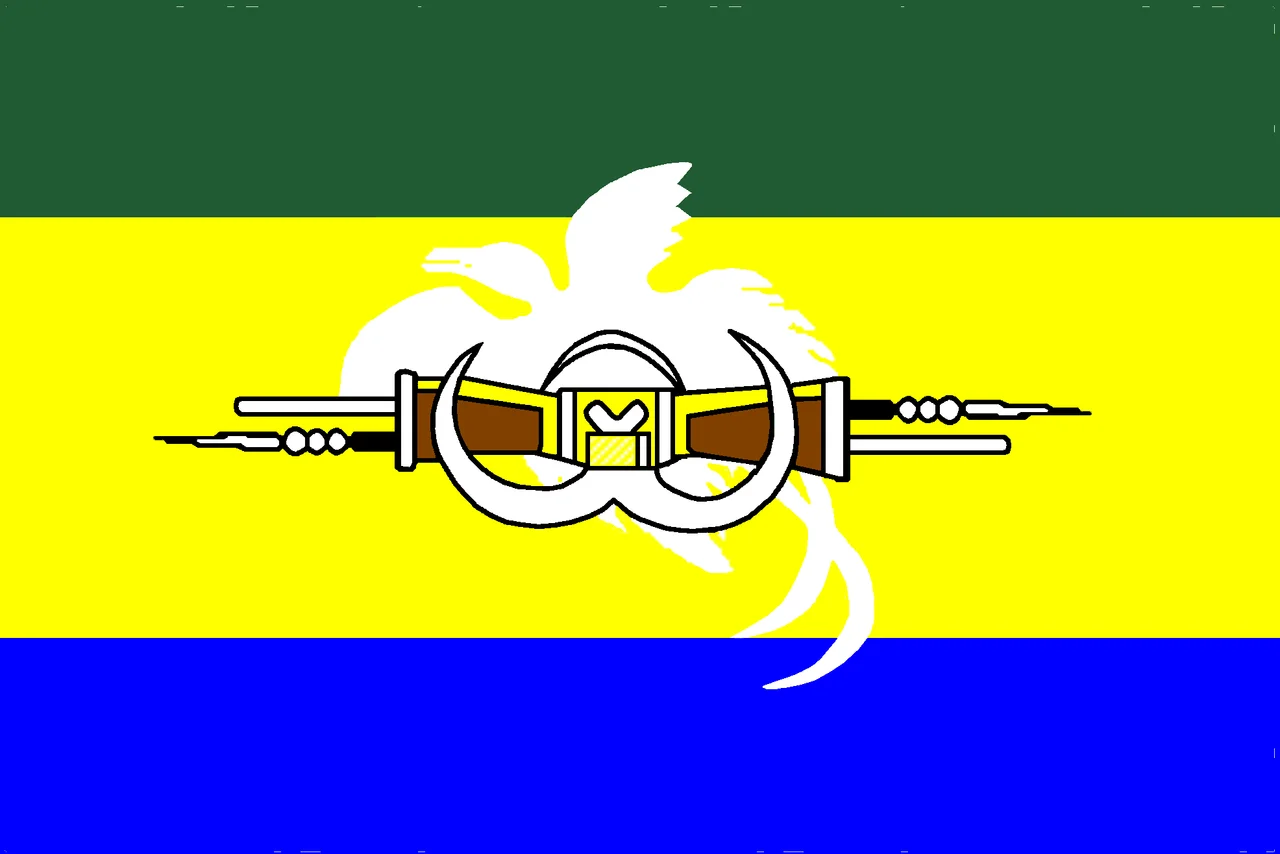

Morobe Province
There are 101 languages spoken in Morobe Province, and that is a conservative count. You can fly from Lae, the provincial capital on the Huon Gulf, up the Markham Valley, and every settlement below you may speak a tongue that will not be understood in the next valley over. The province covers 33,705 square kilometers of coast, delta, mountain range, and jungle, and holds 674,810 people by the 2011 census, making it the most populous province in Papua New Guinea. In the urban centers you will hear English and Tok Pisin. In remote villages near the old German plantations, you will still hear the pidgin traces of German words tangled into the local speech. The map calls it Morobe. The people who live here call it many other things.
Adolfhafen, or Post
The province takes its name from a former German administrative post called Morobe, southeast of Lae. Under German rule in the late nineteenth century, the settlement was Adolfhafen, named for Adolph von Hansemann of the German New Guinea Company and the German word hafen, meaning port. The name meant, flatly, the place of the post. It sat close to the border of British New Guinea and served as one of several Deutsch Neuguinea-Kompagnie outposts along a coast that Germans never fully surveyed. The first European to spend any length of time in the region was not German at all. Russian biologist Nicolai Miklouho-Maclay arrived at Astrolabe Bay in 1871 and stayed fifteen months. He left because the malaria was killing him. Three years later, John Moresby of HMS Basilisk sailed along the Huon Gulf, naming Parsee Point (now Salamaua) and the Markham and Rawlinson Ranges. He wrote that the coastal peoples he met seemed to have encountered white men before.
The Campaign
In 1942 the Japanese took Lae and Salamaua and built them into major supply bases. For the next year and a half, Morobe was the main theater of the New Guinea war. The Salamaua-Lae campaign began on 22 April 1943 with an Australian attack on Japanese positions near Mubo and ended on 16 September 1943 with the fall of Lae in Operation Postern. Between those dates, there was the parachute drop at Nadzab, hand-to-hand fighting at Salamaua, and a thousand smaller actions in ridges too steep for maps to show. It is also where Lyndon B. Johnson, the future 36th President of the United States, saw his only thirteen minutes of combat. Sent as an observer on a Martin B-26 Marauder bombing mission over Lae, he was supposed to have flown on a plane that was shot down with no survivors. Instead he rode along on a different aircraft, returned to brief Roosevelt, and argued that the Pacific theater was under-equipped and under-resourced. The Lae War Cemetery, next to the city's Botanical Gardens, holds between 2,300 and 2,800 burials. Of those, 444 are unidentified.
The Land Remembers
The terrain is why the war took so long and why the province now takes so many languages. The Huon Peninsula juts east into the sea. The Markham River drops from the Finisterre Range 180 kilometers to the Huon Gulf. The Saruwaged Range, rising above 4,000 meters, closes off the peninsula's interior. The Sepik and other great rivers drain the central highlands. Papua New Guinea is part of the Australasian realm, which means its wildlife evolved in isolation from the rest of the world. The flightless cassowary walks the forest floor. Tree-kangaroos climb the canopy. The emperor bird of paradise displays in the high ranges. Morobe alone hosts more than 1,000 bird and mammal species and over 15,000 species of plants. You can dive the coral reefs in the morning, hike alpine moss by afternoon, and sleep in a village that has not seen an outsider in years.
Gold and Coffee
Economy in Morobe has always been about what the land will yield. In 1970, mineral exports made up a mere one percent of Papua New Guinea's total exports. Within two years, that figure had risen to fifty-five percent. The old gold fields at Wau, which birthed the Black Cat Track and its legends, have been joined by newer operations. The Hidden Valley mine, a gold and silver operation, was built by South Africa's Harmony Gold between 2006 and 2009, with Australia's Newcrest buying in to form the Morobe Mining Joint Venture. The larger Wafi-Golpu copper-gold deposit is still being developed. Meanwhile the coastal plains produce cocoa, coffee, copra, sugar, bananas, and coconuts. The roads are bad. The infrastructure is thin. The province's economy has grown at about two percent a year since 2006, slower than the population, which grows at 2.8 percent.
The View From Lae
Stand at the edge of Lae and look up the Markham Valley, and you are looking at the easiest road into the highlands from the eastern coast, which is why armies and prospectors and missionaries have all followed it. Look south and you see the ridges of the Huon Peninsula rising into cloud. Look east across the gulf and you see where Japanese ships once burned. The Australians are gone, except in the cemetery. The Germans are gone, except in the occasional word of pidgin. Even the names on the mountains belong to British admirals of the 1870s. But the emperor birds of paradise still display in the ranges, the cassowaries still walk the forest floor, and people still speak 101 languages in a province that holds more of what the world has lost than most of the world remembers.
From the Air
Morobe Province covers the Huon Peninsula and the Markham Valley on the northeastern coast of Papua New Guinea, centered near 6.83 S, 146.67 E. Recommended viewing altitude 12,000-18,000 feet to see both the coastal plain and the Saruwaged Range (peaks above 4,000 m). Look for Lae on the Huon Gulf, the Markham River running northwest into the highlands, and the peninsula curving east. Nearest airports: Nadzab Airport (AYNZ) serving Lae, Wau Airport (AYWU) in the southern goldfields, and Finschhafen Airport (AYFI) on the coast. Tropical afternoon buildups are typical; morning flights offer the clearest conditions.
Nearby Stories
- Huon Peninsula 23 km away
- Bulolo 24 km away
- Ukarumpa 43 km away
- 2022 Papua New Guinea Earthquake 44 km away
- Battle of Sattelberg 60 km away
- Kainantu 68 km away
- Battle of the Bismarck Sea 107 km away
- Strathallan Estate 150 km away