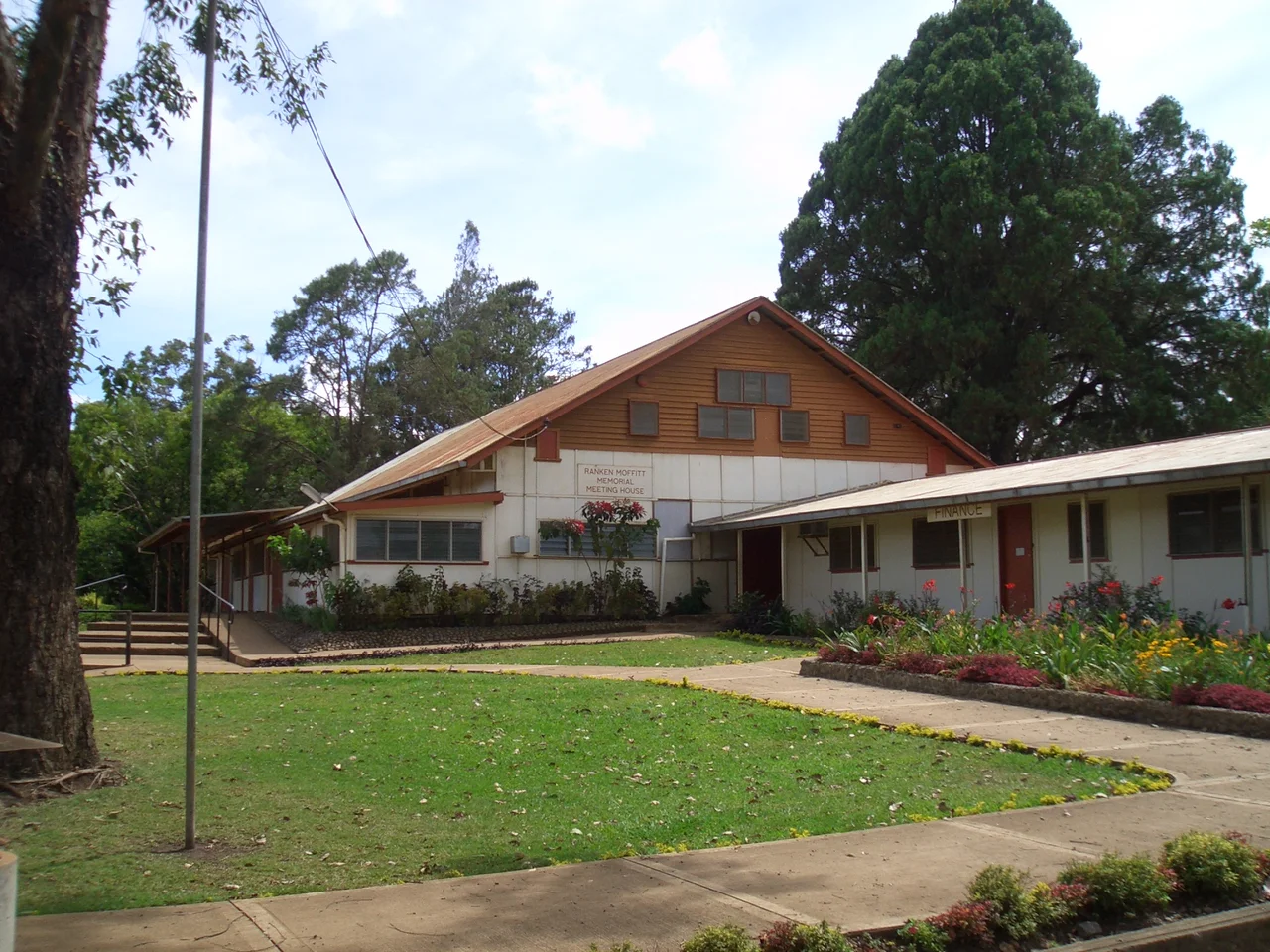

Ukarumpa
On 4 October 1956, Dick Pittman and Dr. James C. Dean signed a 99-year lease for 500 acres in the Aiyura Valley of Papua New Guinea's Eastern Highlands. The land had been the Peacock Plantation, a failed commercial venture. Before that, it had been tribal war grounds - contested country between the Gadsup and the Tairora, who were traditional enemies. Because the land was vacant in the mid-1950s, and only a strip near the Ba'e River was farmable, the Australian colonial administration offered it to the Summer Institute of Linguistics as one of several possible bases. SIL chose it. Seventy years later, Ukarumpa is an intentional international community of roughly 600 people, an airstrip with its own fleet of STOL aircraft, a primary school, a secondary school, and one of the most unusual settlements in Papua New Guinea.
Waist-High Grass with Sharp Edges
When SIL took possession, the land was open kunai - a waist-high grass with leaves sharp enough to cut hands, common across the Highlands where forest has been burned back. Few trees. No development. The founding missionaries built homes and planted trees themselves, turning an open grassland into something that now attracts abundant bird life. Most of Ukarumpa's infrastructure - the houses, the roads, the clinic, the stores - was built by missionary volunteers with financial support from churches and individuals in their home countries. It is, in the most literal sense, a community constructed from donated labor. The Ba'e River runs through it, originating upstream and flowing on through Gadsup country to Kainantu. Altitude is about 1,620 meters. The climate is Equatorial Highland, meaning cool nights, warm days, and afternoon rains from November through March.
Jim Dean's 99-Year Plan
Dr. James C. Jim Dean was the founding Director of the Summer Institute of Linguistics in what was then the United Nations-mandated Australian Trust Territory of New Guinea. He signed the lease, set up the operation, and ran it until the mid-1960s, when he was reassigned to establish SIL operations in India. The 99-year term was chosen deliberately. SIL's work - linguistic research and Bible translation across hundreds of Papua New Guinean languages - was never imagined as a short-term project. Papua New Guinea has more languages than any other country on Earth: roughly 840, many spoken by only a few hundred people each. Translating the Bible into even a fraction of them is generational work. The 99-year lease was a statement of intent: we will still be here. And, broadly speaking, SIL still is.
The Work of Translation
Ukarumpa functions as an operations base for translators, linguists, literacy specialists, teachers, pilots, mechanics, and medical staff. The core mission is Bible translation, but the linguistic work that translation requires spins off into dictionaries, grammars, literacy primers, and the basic recording of languages that might otherwise disappear undocumented. SIL has been criticized over the years - for the religious framing of its research, for the power dynamics of outsider scholars working in indigenous languages, for the durability of its entanglement with global Christian networks. It has also been credited with preserving linguistic knowledge that would have otherwise been lost, and with training generations of Papua New Guinean translators who now carry the work themselves. The legacy is complicated. The productivity is undeniable. SIL PNG publishes materials in hundreds of languages from this single hilltop community.
A Town Built Around an Airstrip
Ukarumpa sits about a mile from its own airstrip, home to a fleet of STOL aircraft - Short Takeoff and Landing planes designed for the rough strips that serve Highland communities. The airstrip formally shows on maps as Aiyura Airport. For much of PNG, SIL's planes are a lifeline: they carry medical patients, deliver supplies, ferry translators into villages too remote for roads. The broader Highlands depend on a similar ecosystem. Mission Aviation Fellowship in Mount Hagen operates about a dozen aircraft. SIL's fleet is smaller but fills the same niche. The skies above the Eastern Highlands are busier than outsiders might expect, filled with single-engine planes threading between valleys, landing on grass strips, and carrying cargo that would otherwise require days of walking.
Schools, Store, Clinic
Inside the compound, Ukarumpa International School runs primary and secondary education for the children of missionaries, diplomats, and contractors. The SIL-run store is the community's main source of food, toiletries, and office supplies - open to members and non-members alike, though members receive a 10 percent discount. There is a medical clinic. Around the compound, flora runs mostly to evergreens: pine, eucalyptus, Casuarina trees planted by the original builders. Coffee plantations cover the nearby hillsides, part of Eastern Highlands Province's long-standing coffee economy. Kunai grass still covers the uncultivated slopes. The community exists as a distinct bubble - an American, Australian, British, Korean, and Papua New Guinean settlement dropped into the middle of Aiyura Valley, functioning partly on its own supply lines and partly on the surrounding local economy.
What a Hilltop Remembers
The Gadsup and Tairora, whose war grounds once occupied this land, still live in the surrounding valleys. Their languages are among those SIL has studied and worked to preserve in writing. The knowledge that the hill where Ukarumpa sits was once too contested for either group to occupy is now a footnote in mission histories, but it is also the kind of historical detail that captures how thoroughly the Highlands have been reshaped in seventy years. Land that was too dangerous for a village became a missionary compound. A missionary compound became a small town. A small town became a linguistic research hub publishing materials in more languages than most universities can handle. The future of the 99-year lease - set to expire in 2055 - has not yet been determined. The community planning for its next chapter has begun.
From the Air
Ukarumpa sits near 6.33 degrees S, 145.90 degrees E, in the Aiyura Valley of the Eastern Highlands Province at approximately 1,620 meters elevation. About 11 km from Kainantu by road. Aiyura Airport serves the community directly - grass strip home to SIL's STOL aircraft fleet. Goroka Airport (AYGA / GKA) is the nearest larger commercial airport, about 85 km west. Recommended viewing altitude 7,000-12,000 feet to see the valley framed by surrounding ridges. Weather: afternoon rains common November-March; mornings typically clearer. The coffee plantations and kunai-covered hillsides are visible signatures of the landscape from altitude.
Nearby Stories
- Madang and Morobe 15 km away
- Kaiser-Wilhelmsland 18 km away
- Goroka 20 km away
- Landing at Nadzab 22 km away
- 1993 Finisterre Earthquakes 30 km away
- Morobe Province 68 km away
- Mount Wilhelm 89 km away
- Strathallan Estate 127 km away