
Landing at Nadzab
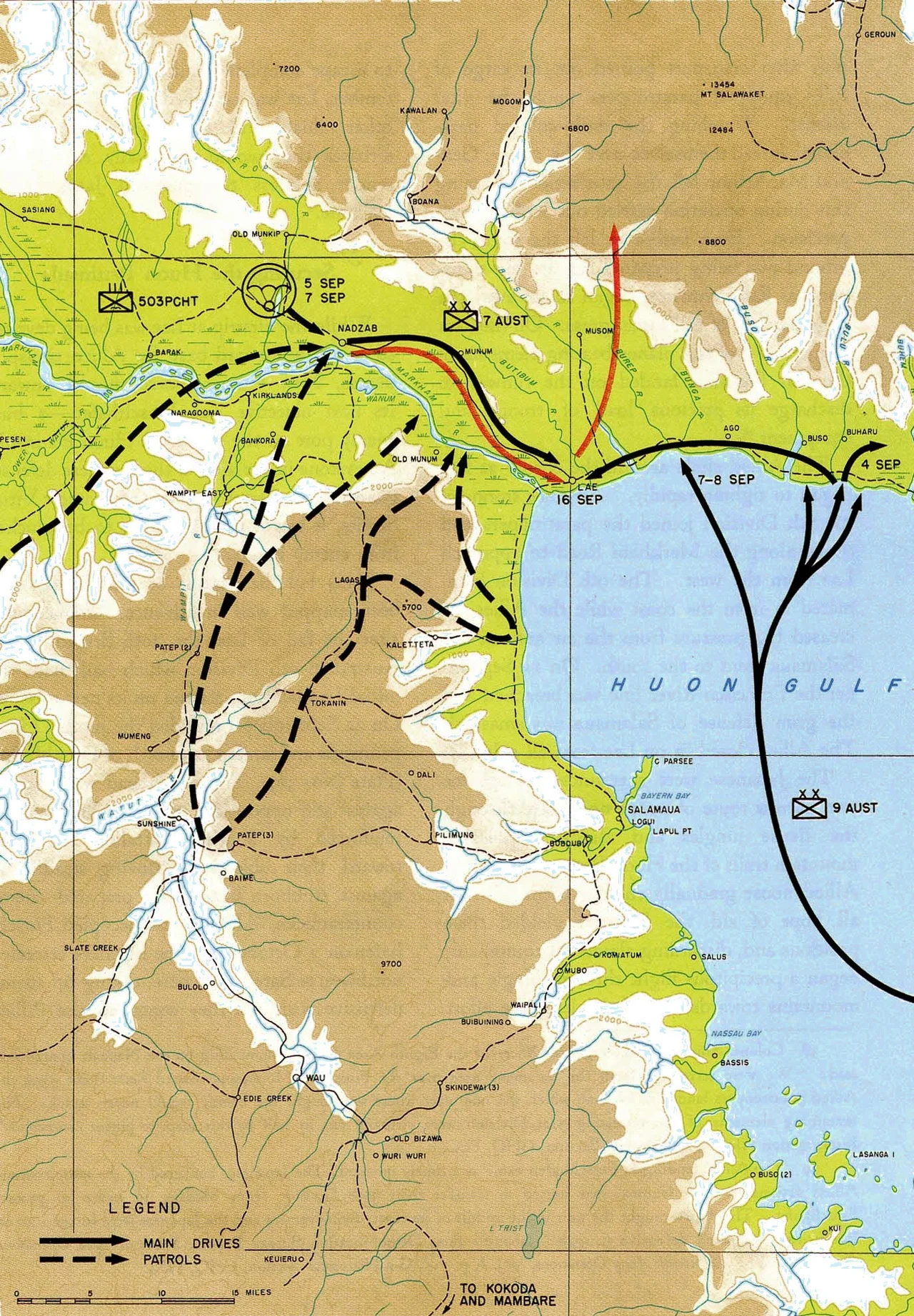
They're my kids, too, said Douglas MacArthur. That was how he got aboard the B-17. General George Kenney had announced he was going to fly over Nadzab on 5 September 1943 to watch the first American airborne combat drop of the war, citing the cost of staying behind a desk. MacArthur reminded him of the orders against commanders flying into combat, the orders Brigadier General Kenneth Walker had ignored and died for. Kenney said the paratroopers were his kids and he meant to see them do their stuff. MacArthur thought it over, then said he would come along. Both of them would watch, in separate B-17s, as 79 C-47 transports dropped the 503rd Parachute Infantry Regiment into a disused grass airstrip in the Markham Valley.
An Airfield Nobody Used
Nadzab was barely anything before that morning. It was a gap in the grass of the Markham Valley, a former emergency landing ground, with no defenders and no runway worth the name. The plan was to take it, clear it, and turn it into the air base that would cut off the Japanese stronghold at Lae from the rear. The overland force - the Australian 2/2nd Pioneer Battalion, the 2/6th Field Company, and B Company of the Papuan Infantry Battalion - had hacked through the jungle and poled down rivers to reach the valley by the same day, and would begin grading the ground as soon as the paratroopers cleared the tall kunai grass. The date had been chosen by splitting the difference between two weather forecasts, one Australian and one American. Kenney told MacArthur they would go at nine in the morning on 5 September. Z-Day dawned with fog and rain over Jackson's and Ward's Fields near Port Moresby, but as the forecasters had promised, by 0730 the fog began to lift.
302 Aircraft Over One Valley
The first C-47 took off at 0820. Seventy-nine transports, each carrying 19 or 20 paratroopers of the 503rd, rose in three flights, one battalion to each. They were escorted by 48 P-38 Lightnings, 12 P-39 Airacobras, and 48 P-47 Thunderbolts. Forty-eight B-25s from the 38th and 345th Bombardment Groups went in ahead to sanitise the drop zones with fragmentation bombs and strafing fire from the eight .50-caliber machine guns mounted in their noses. Seven A-20 Havocs followed. Then the C-47s, dropping altitude for the run. In total, 302 aircraft from eight different airfields made their rendezvous over Tsili Tsili at 10:07, flying through clouds, over passes, down the Watut Valley to the Markham. Kenney later wrote that not a single squadron did any circling or stalling; every unit slid into place like clockwork. The drop commenced at 10:22. Each aircraft unloaded its men in ten seconds. The whole regiment was on the ground in four and a half minutes.
A Quiet Landing
There was no Japanese air opposition. There was almost no opposition at all. Only one C-47 failed to make the drop, when its cargo door blew off in flight and damaged its elevator; it returned to base safely. The three battalions landed in empty grass. The hardest part of the morning was finding each other. The kunai grass was high and the valley was hot, and it took time for the paratroopers to assemble in their designated areas. Five C-47s of the 375th Troop Carrier Group carrying Australian gunners of the 2/4th Field Regiment dropped a bit later. One Australian hurt his shoulder in the jump. The dismantled guns scattered across the landing zone, and it took two and a half hours to assemble enough parts for a single working gun. The other gun took three days to put back together. Five B-17s circling overhead dropped 15 tons of supplies on call from ground panels. Two more B-17s brought in 192 boxes of ammunition at 1515. Some of the ammunition tore free of its parachutes on the way down.
The Cost Came Later
The landing itself was almost bloodless. The larger costs came in the days that followed. The first transport aircraft landed at Nadzab the next morning with reinforcements, but bad weather slowed the Allied buildup. Over the following days the 25th Infantry Brigade of the Australian 7th Division arrived in pieces. An air crash at Jackson's Field during the loading of aircraft bound for Nadzab killed enough men that the accident accounted for about half of all Allied casualties in the battle. Once assembled, the 25th Brigade advanced on Lae, engaging the Japanese at Jensen's Plantation on 11 September and at the larger fight at Heath's Plantation afterward. Private Richard Kelliher won the Victoria Cross at Heath's, charging a machine-gun nest alone. The Japanese chose not to defend Lae itself. Instead they withdrew north, over the Saruwaged Range, a march that became a nightmare of exposure, starvation, and disease. Most of the Japanese soldiers who escaped Lae did not survive the mountains. The 25th Brigade walked into Lae shortly ahead of the 9th Division, which had come in from the coast.
What Nadzab Became
Once the Markham Valley Road was improved enough to bring supplies overland - a process delayed by wet weather until 15 December 1943 - Nadzab became the major Allied air base in New Guinea. By war's end, it had six runways and could handle hundreds of aircraft at a time. Today it is Lae's airport, AYNZ on the aeronautical charts, serving the largest city in Morobe Province. MacArthur, in the years that followed, was awarded the Air Medal for having personally led the American paratroopers and skillfully directed this historic operation. Whether circling at 10,000 feet in a B-17 counts as leading a parachute drop has been debated. What is not debated is that on 5 September 1943, for the first time in the Pacific war, American paratroopers stepped out the door of a C-47 into combat, and in four and a half minutes an entire regiment was on the ground in a grass airfield in the Markham Valley that would go on to change the war.
From the Air
The drop zones lay in the Markham Valley near the modern Lae Nadzab Airport, centered around 6.57 S, 146.72 E. Recommended viewing altitude 8,000-12,000 feet for a view of the broad valley floor, with the Saruwaged Range rising to the north and the Finisterre Range to the west. The old drop zones are now agricultural land and airport facilities. Nearest airports: Lae Nadzab Airport (AYNZ), the modern successor to the wartime strip. Tsili Tsili, the rendezvous point for the 302-aircraft formation, is further west in the valley. Morning flights offer the clearest views before afternoon buildups.
Nearby Stories
- Huon Peninsula 31 km away
- 2022 Papua New Guinea Earthquake 35 km away
- Black Cat Track 37 km away
- Kainantu 43 km away
- Ukarumpa 48 km away
- Battle of the Bismarck Sea 113 km away
- Dampier Strait (Papua New Guinea) 127 km away
- Strathallan Estate 161 km away