.jpg)
Battle of Finschhafen
The briefcase was the giveaway. Australian patrols pushing out from Scarlet Beach in mid-October 1943 stumbled across a Japanese officer's dispatch case still holding its operational orders, and suddenly the defenders knew exactly what was coming. The bulk of the Japanese 20th Division was massing around a mountain mission called Sattelberg. A three-pronged counterattack would roll down toward the beachhead. Twelve thousand enemy soldiers were already in position, waiting for the signal. That signal, when it came on the night of 16 October, was a bonfire blazing from the mountain - deliberately lit, almost theatrical, and visible for miles across the jungle.
Why a Harbor at the End of Nowhere
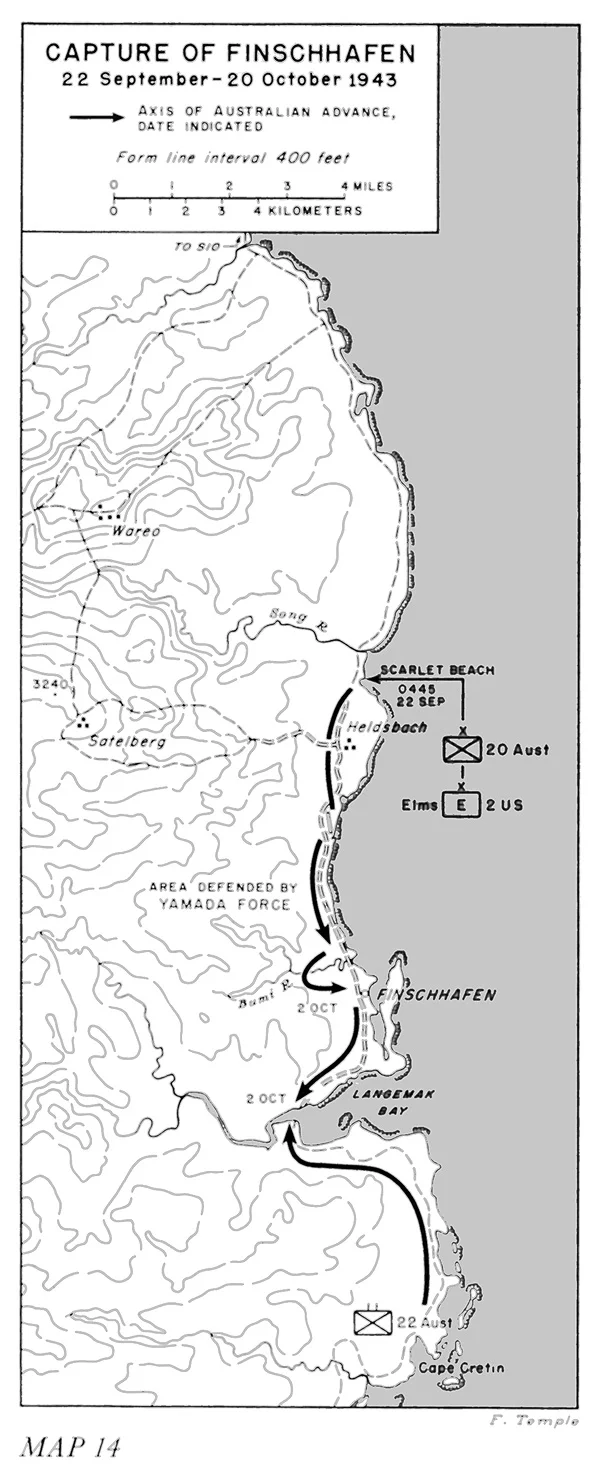
Finschhafen sits on the eastern tip of New Guinea's Huon Peninsula, where the coast curls out toward the narrow Vitiaz Strait separating New Guinea from New Britain. In 1943, that geometry mattered more than the settlement itself. Whoever held Finschhafen could build airfields to dominate the strait, stage forces for the coming assault on Rabaul, and sever Japanese supply lines running south. Major General George Wootten's Australian 9th Division drew the assignment. On 22 September, Brigadier Victor Windeyer's 20th Infantry Brigade waded ashore at Scarlet Beach, about 10 kilometers north of the town. At the same moment, the 22nd Infantry Battalion pushed east from Lae along the coast. The plan was a two-pronged squeeze. The reality was a campaign of ambushes, creek crossings, and jungle so thick that four jeeps per battalion counted as motor transport.
The Bumi River Stand
The drive south stalled at the Bumi River, where roughly 300 Japanese sailors and marines of the 85th Naval Garrison had orders to delay, then withdraw. Their commander ignored the second half. They dug in, held the crossing, and stopped the 20th Brigade cold on 26 September. The 2/15th Battalion finally broke the position by flanking it - a small tactical victory that foreshadowed the larger pattern of the campaign. Meanwhile, Australian intelligence had underestimated the enemy by thousands. Allied planners thought they faced perhaps 2,000 defenders. The actual number was closer to 5,000, with more arriving daily from Madang. When Windeyer requested reinforcements, US naval commanders initially refused, worried about the risks of another amphibious run. The confusion at the top nearly cost the campaign. By 2 October, when Australian troops finally entered Finschhafen itself, 73 Australians were dead and 285 wounded, and the defenders had slipped away into the hills around Sattelberg - still armed, still organized, and now very angry.
The Night the Beach Nearly Fell
The Japanese counterattack came in three parts and came close to working. From the north, a diversion by the 79th Infantry Regiment failed to draw off Australian reserves. From the sea, seven landing craft carrying raiders tried to strike Scarlet Beach directly - and four were sunk in the dark by PT-128 and PT-194 before they ever reached shore. The survivors made it to the beach anyway, and there Private Nathan Van Noy Jr. and Corporal Stephen Popa waited behind a .50-caliber machine gun. When a bugler led a flame-thrower team straight at them, they opened fire and held. A Japanese grenade landed in the pit and shattered one of Van Noy's legs. They kept firing. A second grenade silenced them. Van Noy received the Medal of Honor for those minutes. Inland, the central Japanese thrust jumped off a day early and lost its coherence. When fighting finally ceased on 24 October, at least 679 Japanese soldiers were dead. Australian losses stood at 49 killed and 179 wounded.
Mountain, Machine Guns, and Matildas
After the beachhead held, Wootten prepared the next move: Sattelberg itself, the 975-meter mountain where an abandoned Lutheran mission commanded the entire peninsula. Reinforcements arrived - the 26th Infantry Brigade under David Whitehead, and, crucially, a squadron of Matilda II tanks from the 1st Tank Battalion. The Australians took pains to keep the tanks' arrival secret as long as possible. Heavy rain turned tracks to rivers through early November and forced combat soldiers into the role of porters, carrying ammunition and rations forward on their backs because the jeeps could not move. When the assault on Sattelberg finally came later that month, the Matildas clawed up gradients no one thought a tank could climb, and the mission fell. The advance then continued north to the Wareo plateau and eventually to Sio on the coast.
From Jungle Fight to Fleet Base
What the Australians won at Finschhafen was not really a town. It was a logistics prize. Through 1944, American engineers transformed the captured area into what historian Garth Pratten called one of the largest bases in the Southwest Pacific. Wharves grew along the coast. Tank landing ship ramps lined the harbor. Fighter and bomber airstrips pushed inland, and fuel dumps bloomed among the plantations. From these fields, Allied aircraft struck Rabaul and sealed the Vitiaz and Dampier Straits against Japanese shipping. More quietly, Finschhafen became a supply hub that fed MacArthur's return to the Philippines through 1944 and 1945. In 1961, the Australian Army formally awarded the battle honour "Finschhafen" to the units that had fought there - a short word on a regimental standard for what had been a month of jungle, mud, and very close calls.
From the Air
Located at 6.60S, 147.85E on the east coast of the Huon Peninsula, Papua New Guinea. The battle area stretches from Scarlet Beach about 10 km north of Finschhafen inland to the Sattelberg ridgeline at 975 m. Best viewed at 5,000-8,000 ft for scale. Nearest airport: Lae Nadzab (AYNZ), about 80 km southwest. Finschhafen airfield (AYFI) is on the former battlefield itself. Watch for typical tropical cloud buildup by midday.
Nearby Stories
- Black Cat Track 37 km away
- Lae 37 km away
- Battle of the Bismarck Sea 64 km away
- Dampier Strait (Papua New Guinea) 90 km away
- Battle of Cape Gloucester 98 km away
- Japanese destroyer Ariake (1934) 127 km away
- Invasion of Buna–Gona 200 km away