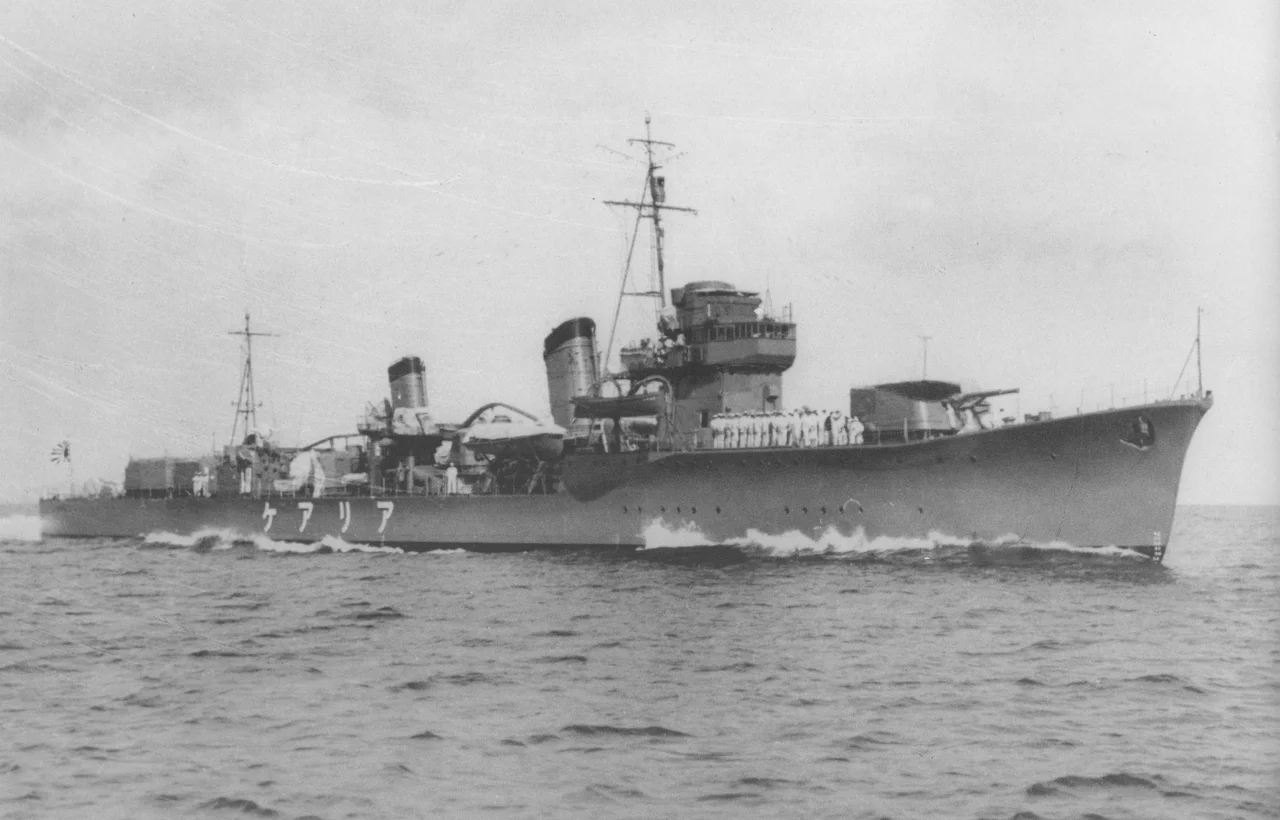

Japanese destroyer Ariake (1934)
She came home to a rescue she could not complete. On the evening of July 27, 1943, the Japanese destroyer *Ariake* had just worked herself off a coral reef near Cape Gloucester, transferred her troops onto another ship, and finished her run to Tuluvu on the New Britain coast. She did not have to go back. Her sister destroyer *Mikazuki*, still grounded on the same reef, could have been scuttled. Her captain, Lieutenant Commander Akifumi Kawahashi, turned *Ariake* around anyway. B-25 Mitchells of the U.S. Army Air Forces caught her the next morning. Seven of her crew died, including Kawahashi.
Born Crooked
*Ariake* was the fifth of six *Hatsuharu*-class destroyers, built for the Imperial Japanese Navy under the Circle One Program - *Maru Ichi Keikaku* in Japanese, a naval expansion scheme authorized in 1931. The design brief was contradictory from the start: make the destroyers smaller and cheaper than their predecessors, but arm them just as heavily. The naval architects could not square that circle. The first three ships of the class turned out dangerously top-heavy, with inherent structural weaknesses that would become notorious across the Japanese fleet. Two events sealed the reputation of the design. The 1934 Tomozuru Incident - in which a torpedo boat of similar heavy-top design capsized in heavy seas, killing most of her crew - triggered wholesale redesign. Then came the 1935 IJN 4th Fleet Incident, when a typhoon caused structural failures in multiple ships. *Ariake* was laid down at Kawasaki Shipyards in Kobe on January 14, 1933, but her construction paused for extensive modifications. She finally launched on September 23, 1934, and was commissioned on March 25, 1935.
Opening Rounds
When the Japanese attacked Pearl Harbor on December 7, 1941, *Ariake* was assigned to Destroyer Division 27 of Destroyer Squadron 1, IJN 1st Fleet, based at Hashirajima in Japan's home waters on anti-submarine patrol. In January 1942 she moved south, escorting aircraft carriers to Palau and Ambon during the Japanese invasion of the Netherlands East Indies. On February 19 she participated in the Darwin air raid - the attack on the northern Australian port that Australians still call their Pearl Harbor, in which 236 people died and the town was effectively destroyed as a military base. From Staring Bay in Sulawesi she ran escort patrols through March. She was refitted at Sasebo, then dispatched to Truk in time to join Admiral Takeo Takagi's force at the Battle of the Coral Sea - the May 1942 engagement that blunted the Japanese advance toward Port Moresby.
The Tokyo Express
The second half of 1942 found *Ariake* in the role that would define her war: running the Tokyo Express. That was the American nickname for the high-speed nighttime supply and reinforcement runs the Japanese used to sustain their forces on Guadalcanal and the other Solomon Islands. Destroyers could make the journey in darkness, dodge American aircraft, and drop troops or supply drums before dawn. *Ariake* carried elements of the Ichiki and Aoba Detachments to Guadalcanal, shelled Henderson Field with her deck guns, and made run after run from Rabaul into the slot between the islands. On August 23 she bombarded Nauru, and three days later a landing party from her crew took possession of the phosphate island as part of Operation RY, holding it until garrison troops arrived on the 30th. Late December brought the first serious damage. While towing a stricken destroyer near Rabaul, *Ariake* was caught by USAAF B-24 Liberators. Six near misses shook the ship hard enough to kill 28 of her crew and wound 40 others, knocking her number two and three gun turrets out of action.
Cape Gloucester
Sasebo's shipyards patched her up through the winter of 1943. By spring she was back escorting convoys between Truk and Rabaul. On July 27, she and *Mikazuki* made a troop transport run to Tuluvu, the Japanese supply base on the north coast of New Britain near Cape Gloucester. Both destroyers grounded on the same reef. *Ariake* worked herself free. *Mikazuki* could not. Captain Kawahashi transferred *Mikazuki*'s troops and the commander of Destroyer Division 30, Captain Orita Tsuneo, onto *Ariake* and finished the delivery to Tuluvu. Then he turned the ship around and headed back toward his grounded sister. The B-25 Mitchells that found *Ariake* the next morning flew out of Dobodura on the mainland, part of the same Fifth Air Force campaign that was systematically destroying Japanese barge traffic in these waters. Their low-altitude skip-bombing tactics were devastatingly effective against ships in coastal shallows. *Ariake* had nowhere to go. Seven men were killed, including her captain.
Underwater
The wreck lies off the Cape Gloucester coast, in waters that were fought over again less than five months later when the 1st Marine Division came ashore at the start of Operation Backhander. Five months after that, the Cape Gloucester airfields would be operating RAAF Kittyhawks as forward air cover. *Ariake* represents a particular kind of service record - five years of near-constant action, from the opening raid on Darwin through Coral Sea, Midway's diversionary force, Guadalcanal, and the long slow bleed of the Solomons. Her crew served where the Japanese Navy was stretched thinnest, and they paid for it. The Fifth Air Force did not give them a second chance.
From the Air
The wreck of *Ariake* lies off Cape Gloucester at roughly 5.45 S, 148.42 E, in the coastal waters between the cape and Tuluvu. Cruising altitude 10,000-12,000 ft offers a view of the reef line where she grounded and the deeper water offshore where she settled after being bombed. Nearest airports: Hoskins (AYHK) about 85 nm east on New Britain's north coast, Madang (AYMD) about 140 nm west on the mainland. Typical Pacific weather applies - morning clear, afternoon convective buildups, particularly during the December-February monsoon. The coastal shallows that trapped *Ariake* on a reef are still well-marked on modern charts.
Nearby Stories
- Vitu Islands 72 km away
- Battle of Wareo 76 km away
- MV Rabaul Queen 100 km away
- Long Island, Madang Province 101 km away
- Battle of Talasea 107 km away
- Bismarck Archipelago 176 km away
- Karkar Island 237 km away
- Japanese Submarine Ro-103 338 km away