
Vitu Islands
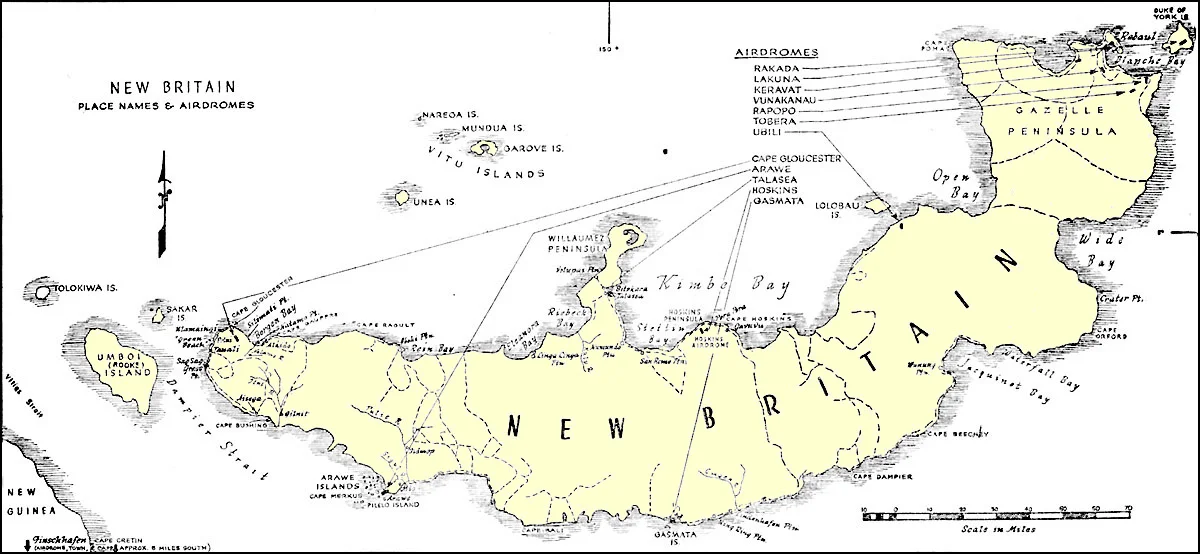
Garove Island is a flooded volcano. Fly over it on a clear morning and the caldera reveals itself immediately - a near-perfect ring of jungled rim enclosing a blue lagoon where the sea pours in through a single narrow passage. The cone blew out sometime in geological memory, and the ocean came in to fill the hole. Today the rim is farmed for cocoa where the ground is flat enough, and a Catholic mission tucked inside the caldera at Peterhafen occupies some of the sheltered water. This is the largest of the Vitu Islands - a group of volcanic ocean peaks in the Bismarck Sea, roughly 96 square kilometers of land scattered off the north coast of New Britain, technically not part of the Bismarck Archipelago but administratively part of Papua New Guinea. Sometimes they are called the Witu Islands. Older maps call them the French Islands.
The Lost Village of Goru
Somewhere around 1892, a volcanic island called Naragé blew apart. Before the eruption it measured 61 hectares. After, only 21 hectares remained - a ragged remnant of rim. The resulting wave, according to accounts collected decades later, reached 100 meters when it crashed into neighboring Ningau. The lowest-lying of Ningau's three villages was called Goru. The tsunami wiped it out completely, killing everyone except two residents who happened to be on Garove that day. The water scoured the coasts of New Britain and pushed well beyond, reshaping communities on multiple islands. Four years earlier, in 1888, the islands had already been hit by another wave - the one generated when Ritter Island collapsed further east. That earlier wave ran 25 feet high when it reached the Vitu group. For a small chain of volcanic outposts, the archipelago has borne an unusual share of tectonic violence.
Queen Emma's Stomping Ground
In the German colonial period, the trading dynasty that dominated this coast was headed by Emma Coe - better known as Queen Emma, an American-Samoan businesswoman who built one of the Pacific's largest private commercial empires from her base at Gunantambu, near Rabaul. The Vitu Islands were the heart of her outer operations. Her plantation headquarters was at Langu, on Garove. Her manager, a Dane named Peter Hansen, ran the copra operations from Meto plantation - and became notorious for keeping a household of twenty-six women who appear in the records as his concubines. After Emma's death and the German defeat in World War I, the Burns Philp trading company took over. Plantations on Garove at Lama, Meto, Ilia, and Langu produced copra for export; the combined Mundua-Naragé holdings operated under the name Ningau. The Dane Edward Hann managed Ningau for roughly 36 years.
The Ship That Hid in the Caldera
The German commerce raider SMS Wolf - a surface combatant that slipped through Allied lines to sink merchant shipping across multiple oceans during World War I - called at Peterhafen inside Garove's caldera to clean her hull and shelter from the weather. The Wolf cruised at an economical eight knots and topped out at eleven. She could not outrun modern Allied warships, so she survived by hiding. Australian Navy vessels, aware of her presence in the area, blockaded the passage outside the caldera entrance, waiting. The Wolf lay behind the entrance island, masts dropped below the horizon, guns ready, hoping the Australians would follow her in. They did not. Eventually she slipped away to continue her raiding. The caldera still holds the memory - a good anchorage is a good anchorage, whether you are a Catholic mission or a commerce raider trying not to die.
The Japanese Occupation and the Coastwatchers
When Japan took New Britain in 1942, the Vitu Islands fell with it. The Burns Philp manager at Ningau, Edward Hann, was on the island when Japanese troops came ashore at one end. He got out the other side and survived the war. The Japanese occupied Vitu for the duration and, by accounts from residents afterward, treated the local population reasonably well - an exception in a war not otherwise marked by Japanese restraint in occupied Pacific territories. The Burns Philp Rabaul store manager was not so fortunate. When the Japanese demanded his keys to the company's enterprises in Rabaul, he refused, and was executed. After the war, Burns Philp ceded the Langu plantation to the Coote family as compensation for that killing. Through all of this, Coastwatchers continued their work. A local guide from Mundua - known by the name Talasea, actual name Tumbuan Tuagolo - assisted the celebrated intelligence officer Eric Feldt in his operations around New Britain.
Copra, Cocoa, and a Caldera Mission
Post-war, the plantations continued. Langu was planted in 1911 and passed through the hands of several owners before Richard "Dick" Doyle acquired full ownership in 1993 - a year before his daughter Tania won Miss PNG in 1994, the kind of local distinction that becomes archipelago lore. Copra remained the main export until prices collapsed, and cocoa took over as the principal crop. In 1952, a Catholic mission was established inside the great caldera of Garove at Johanne Albrecht Harbour, joining the older Peterhafen outpost from the German mission era. The Vitu Islands today are quiet - volcanic peaks lifting out of the Bismarck Sea, ringed by fringing reefs that make the group technically fertile but always dangerous to shipping. The submerged Ottilian Reef and the further-out Whirlwind Reef trail northwest of the main group like the tail of a comet - ghost peaks just below the waterline, waiting.
From the Air
Centered near 4.67°S, 149.30°E in the Bismarck Sea off the north coast of New Britain's Willaumez Peninsula. The nearest major airport is Hoskins (ICAO: AYHK) on New Britain, about 60 nautical miles southeast. Recommended viewing altitude 4,000-8,000 feet reveals Garove's flooded caldera clearly - a distinct ring-lagoon with a narrow passage to the sea. Unea lies about 40 nautical miles to the south. Watch for the submerged Ottilian and Whirlwind Reefs extending northwest; these are navigational hazards to shipping. Expect typical tropical conditions with reliable morning visibility.
Nearby Stories
- Bismarck Archipelago 38 km away
- USS Brownson (DD-518) 56 km away
- Battle of Talasea 72 km away
- Battle of Cape Gloucester 94 km away
- Japanese destroyer Ariake (1934) 108 km away
- New Ireland 214 km away
- New Hanover Island 237 km away
- USS ABSD-4 299 km away