
Battle of Talasea
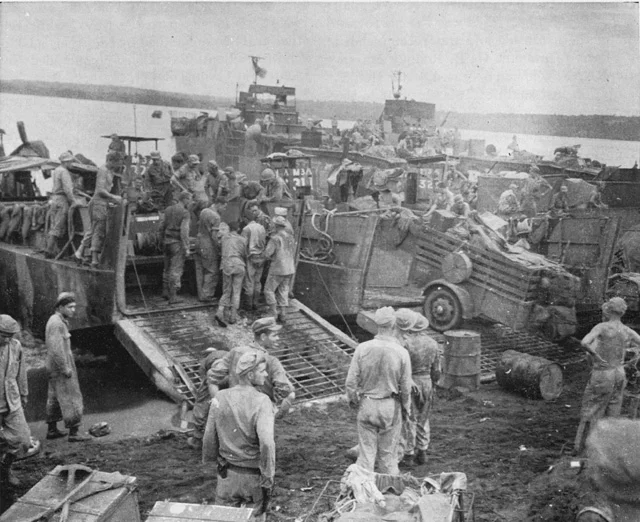
The fighter cover never showed up. For almost half an hour on the morning of 6 March 1944, Colonel Oliver P. Smith watched the sky over the Willaumez Peninsula and waited for the planes the Fifth Air Force had promised. When they still had not appeared, he gave the order anyway - 500 Marines of the 1st Battalion, 5th Marines, crouched in tracked landing vehicles, lurched forward through the coral-studded shallows toward Red Beach. The beach was 350 yards of sand backed by a narrow isthmus, hemmed by swamp to the north and cliffs to the south. A little spotter plane eventually flew over and dropped grenades - improvising, since the fighters never came. That was the air support for Operation Appease.
Why This Beach
New Britain had been Japanese territory since February 1942, when a small Australian garrison at Rabaul was overwhelmed. By early 1944, Allied strategy had shifted: rather than assault Rabaul directly, the plan was to surround it, to choke its supply lines, to make its powerful garrison irrelevant. Landings at Arawe and Cape Gloucester had already secured western New Britain. Now the Matsuda Force was withdrawing east, and American planners wanted to cut them off. A former plantation owner - Flight Lieutenant Rodney Marshland of the Royal Australian Air Force, who had worked this coast before the war - pointed out the narrow neck of the Willaumez Peninsula as an ideal landing zone. Red Beach, at the narrowest point, offered 2.5 miles of relatively flat ground to Garua Harbor on the opposite coast. It was the pinch where the peninsula almost became two islands. Land there, and you could close the door behind the retreating Japanese. That was the idea.
The Landing and What Came Next
The 500-man first wave came ashore almost unopposed, the beach answered by only sporadic fire. But the coral reef forced landing craft into single file, and unloading stalled. Japanese mortar crews on the peninsula found the waterline and began to hit it. Medics and artillerymen suffered most. Four Sherman tanks made it ashore. One bogged immediately in the sand; three others pushed inland along the plantation track. They silenced a Japanese machine gun almost at once. Then Japanese infantry swarmed one tank with magnetic mines - one soldier succeeded in placing his charge and died in the act, temporarily knocking the tank out of action. Fighting pushed through the Volupai Plantation that afternoon, and Marines recovered a defensive map from the body of a Japanese officer, an unexpected intelligence windfall. By nightfall they had dug in at the edge of the plantation, still short of their objectives.
Mount Schleuther and the Slipping Away
The Japanese commander was Captain Kiyamatsu Terunuma, and his mission was not to hold Talasea but to buy time. He had 596 men from the 17th Division against more than 3,000 Marine ground troops. He knew he could not win. He only needed to slow the Americans long enough for Matsuda Force to get past Cape Hoskins toward Rabaul. On 7 March, elements of the 54th Infantry Regiment moved west along high ground, trying to cut off the American advance. Company F of the 2nd Battalion, 5th Marines reached the position first and caught the Japanese moving up the reverse slope. In a one-sided exchange, 40 Japanese soldiers died there. Later the Marines attempted an assault on Mount Schleuther's peak and were driven back with 18 casualties. That night, the Japanese defenders simply slipped away toward Bola, leaving a rearguard of 100 men to bleed the Marines for one more day.
The Tally and the Truth
The Americans counted 17 killed and 114 wounded. The Japanese lost roughly 150 men. On paper, the operation succeeded - Marines occupied Talasea, secured the emergency airstrip, and established a forward base. But the larger purpose failed. Matsuda Force had already gotten past. The delay Terunuma's men bought with their lives was enough; the withdrawal route to Rabaul stayed open. Colonel Smith, who had led the landing and would later command Marines at the Chosin Reservoir in Korea, recommended Talasea be used as a PT boat base to interdict Japanese barge traffic. In April, the US Army's 40th Infantry Division relieved the 1st Marine Division, which by then had lost 310 men killed and 1,083 wounded across the entire New Britain campaign. Against that, Japanese forces had lost 3,868 of their own. The fighting quieted after that - a lull that historian Peter Dennis would later describe as a "tacit truce," with Australian-led indigenous scouts of the Allied Intelligence Bureau carrying on small-scale operations in the no man's land between the two sides.
The Peninsula Today
The Willaumez Peninsula juts north from New Britain like a bent finger, volcanic in origin, its spine of cinder cones rising from dense rainforest. Red Beach is still a beach. Volupai is still a plantation. The emergency airstrip at Talasea no longer sees regular traffic, but the coconut groves and mission buildings around Garua Harbor remain recognizable from 1944 photographs. Mount Schleuther, where Company F caught the Japanese on the reverse slope, is jungle again. What happened here in March 1944 was a tactical success that missed its strategic target - the kind of engagement that gets a paragraph in campaign histories while the names of the men who bought the delay with their lives, on both sides, fade into footnotes.
From the Air
Located at 5.26°S, 149.99°E on the Willaumez Peninsula of northern New Britain, Papua New Guinea. Talasea's former emergency landing strip lies on the eastern coast of the peninsula's narrow neck; Red Beach (the 1944 landing site) faces the western coast at the Volupai area. Hoskins Airport (ICAO: AYHK) is about 40 nautical miles southeast. Recommended viewing altitude 5,000-8,000 feet shows the full peninsula, Garua Harbor, and the volcanic cones that frame the 1944 battlefield. Expect afternoon convective buildups year-round.
Nearby Stories
- Kimbe 27 km away
- Vitu Islands 31 km away
- Ulawun 97 km away
- Battle of Cape Gloucester 110 km away
- USS Brownson (DD-518) 112 km away
- Landing at Jacquinot Bay 115 km away
- Kerevat 185 km away
- New Ireland 231 km away