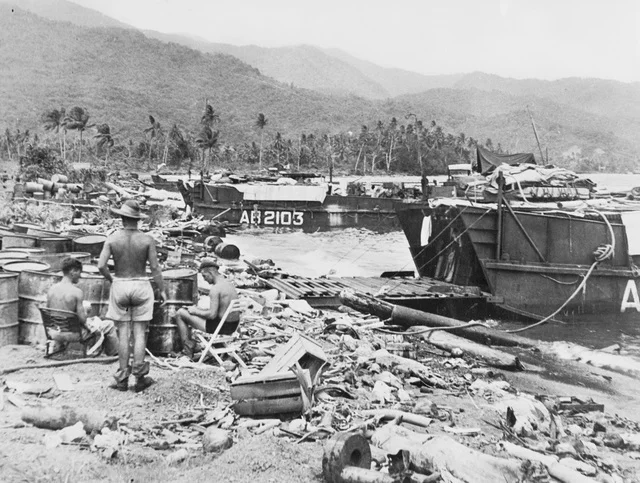

Landing at Jacquinot Bay
The rumor did the fighting. For months before the landing, Australian-led indigenous troops of the Allied Intelligence Bureau had been spreading a deliberate lie through the villages of New Britain's south coast: a large Australian base, they told anyone who would listen, had already been established at Jacquinot Bay. There was no such base. The point was to discourage Japanese patrols from pushing west. When the actual landing came on 4 November 1944, fourteen hundred soldiers of the Australian 14th/32nd Battalion splashed ashore from American landing craft expecting the worst - and found an abandoned coast. Brigadier Raymond Sandover, watching his men secure the bay without a shot fired, drily expressed pleasure at having "nearly reached the war."
A Changing of the Guard
By late 1944, the US Army's 40th Infantry Division - which had held New Britain's western positions at Cape Gloucester, Arawe, and around Talasea-Hoskins - was needed for the invasion of the Philippines. The Australian 5th Division under Major General Alan Ramsay drew the job of replacing them. But the Australians did not intend to hold the same ground. American strategy had settled into what one historian called a "tacit truce" - US troops held the west, the Japanese held the east around Rabaul, and between them ran a no man's land where the AIB fought a quiet guerrilla war. The Australians wanted to close the distance. To do that, they needed a logistics base closer to the Japanese main position than any American base on the island - and Jacquinot Bay, on New Britain's south coast, looked like the right place.
The Bay and the Scouts
Jacquinot Bay lies on New Britain's south coast, east of Gasmata and west of Wide Bay, under the shadow of a densely forested mountain range that rises to 6,000 feet just inland. In the pre-war years, coconut plantations had been scattered around its shores - Cutarp on a northeastern headland, Palmalmal to the southwest, Wunung on the south curve of the bay. A Catholic mission sat at Mal Mal, abandoned by the time the Australians came. The climate was described in Australian planning documents as "hot and humid" - an understatement. July typically brought 36 inches of rain. August brought 46. The southern coast was wetter than the northern, and November, when the landing would come, was still wet enough to turn unpaved ground to slurry.
The Coastwatcher War
Long before the Australians came ashore in force, AIB patrols had been working this coast for months. In mid-April 1944, a platoon of indigenous New Guinean troops led by two Australian officers attacked the Japanese coastwatching station at Jacquinot Bay. Ten Imperial Japanese Navy personnel were stationed there. Five were killed outright. Four survivors were hunted down in the days afterward. One was taken prisoner, along with two more Japanese sailors captured during an attack on a barge nearby. All three were evacuated by an American PT boat. The Japanese naval command responsible for New Britain never learned what had happened to any of them. Throughout the summer of 1944, the AIB destroyed Japanese observation posts across the south coast one by one. Their operations had a second purpose beyond attrition: they gathered intelligence, they cultivated local support, they made Jacquinot Bay empty and ready.
The Landing
On 5 September 1944, a party of 105 Australian personnel - including soldiers of the 2/8th Commando Squadron and Royal Australian Air Force survey specialists - landed secretly at Jacquinot Bay to scout anchorages and beaches. M Special Unit, another Australian intelligence organization, confirmed what the AIB already knew: no Japanese troops remained in the area. Eight weeks later, on the afternoon of 2 November, the 14th/32nd Battalion boarded the transport Cape Alexander at Lae under escort of three Royal Australian Navy warships. A second convoy of American landing craft from the US 594th Engineer Boat and Shore Regiment came from Arawe. On the morning of 4 November, the RAAF air strike was cancelled as unnecessary. The landing went in clean. The battalion began establishing defensive positions while American engineers drove their LCMs onto the sand and began unloading stores. Rain started almost immediately and continued for the first week.
Building the Base
Bulldozers cleared the ground for tents. Stores came off the landing craft onto the beach, were carried by hand to sorting areas, then moved on pallets further inland. A pontoon jetty with rollers went up quickly. By 11-12 November, when the main body of the 5th Base Sub Area arrived with 670 indigenous laborers aboard the transports J. Sterling Moreton and Swartenhondt, 3,400 cubic meters of stores had already been unloaded. A drier December allowed work to begin on major facilities - a large dock, an airstrip, the buildings for the 2/8th General Hospital. The target was to stockpile enough supplies to sustain 13,000 soldiers for 60 days. Then in January 1945, after ten days without rain, the reservoirs ran dry. Wells were dug. The water they produced was not potable. Landing craft had to ferry drinking water from elsewhere for three days while the engineers improvised a solution.
Containment, Not Conquest
The airstrip finished in May 1945. Royal New Zealand Air Force squadrons - Corsair fighters and Ventura patrol aircraft - moved in, taking a slot originally intended for an Australian wing that had been diverted to Borneo. From Jacquinot Bay, Ramsay's 5th Division pushed east in limited brigade-strength operations throughout early 1945. They secured the Waitavalo-Tol area around Henry Reid Bay in late February. Engineer units bridged the Wulwut River. Fighting developed around Mount Sugi, where Japanese defenders held ridges overlooking the bay. Rain and flooding hampered every advance. By April, the Australians had secured Wide Bay and effectively penned the Japanese into the Gazelle Peninsula for the rest of the war. The campaign was never about destroying the Rabaul garrison - it was about making them irrelevant. Australian official historian Gavin Long later noted that it remained unclear why Japanese forces on New Britain accepted containment so passively when, on Bougainville, they fought the Australians hard. Perhaps it was supply. Perhaps it was exhaustion. The Japanese troops around Rabaul were, by late 1944, growing rice and tending gardens to feed themselves, with only 150 barges and two functional aircraft for support. Whatever the reason, the Australians got what they wanted: the war on New Britain ended in stalemate by design.
From the Air
Located at 5.57°S, 151.50°E on the south coast of New Britain, Papua New Guinea. Jacquinot Bay's wartime airstrip, built by 1945, is no longer an active airport; the nearest facilities are Rabaul/Tokua (ICAO: AYTK) to the east and Hoskins (AYHK) to the northwest on the opposite coast. Recommended viewing altitude 5,000-8,000 feet shows the bay's distinctive scooped shape, the headlands that flanked the 1944 landing beaches (Cutarp to the north, Palmalmal to the southwest), and the 6,000-foot central mountain range inland. Exceptionally high rainfall; expect frequent afternoon convective buildups and morning cloud cover over the ranges.
Nearby Stories
- Ulawun 25 km away
- Battle of Wide Bay-Open Bay 31 km away
- Henry Reid Bay 61 km away
- Kimbe 74 km away
- Bismarck Archipelago 85 km away
- Japanese cruiser Sendai 275 km away
- Japanese Submarine Ro-103 282 km away
- Operation Chronicle 314 km away