_exploding_off_Cape_Gloucester_on_26_December_1943_(80-G-240245).jpg)
USS Brownson (DD-518)
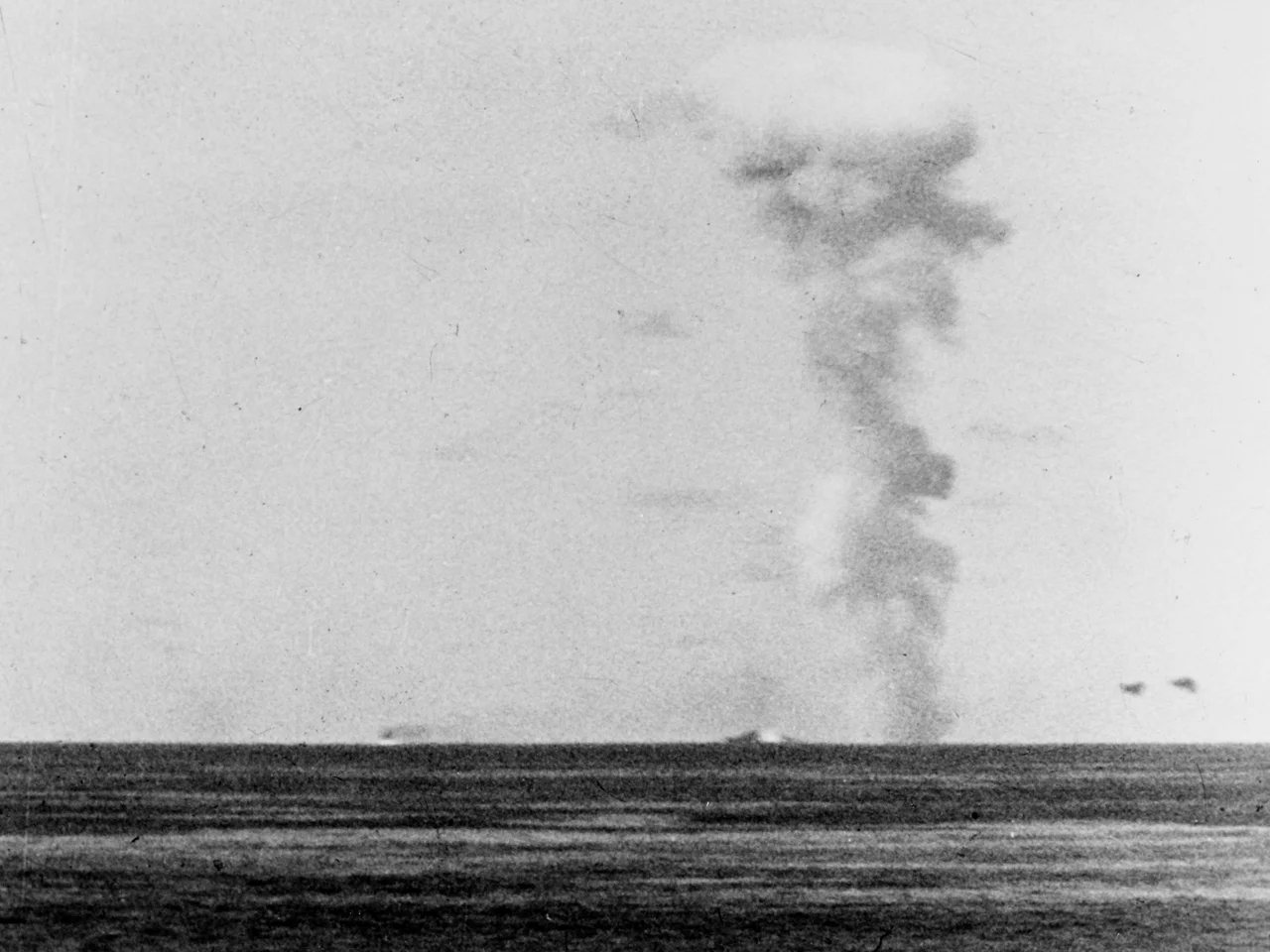
At 14:42 on December 26, 1943, two bombs from a single Japanese dive bomber punched through the main deck of USS *Brownson*. The detonation took out everything above the main deck amidships. Plates, bulkheads, the after stack - gone. She listed ten degrees to starboard, then fifteen, and began settling fast. Eight minutes later, Lieutenant Commander Maher gave the order to abandon ship. Nine minutes after that, she was gone, with 108 of her crew. *Brownson* had been in commission for ten months.
A Square Bridge and a Famous Name
The Navy named her for Rear Admiral Willard H. Brownson, a career officer who had served from 1846 until 1935. She was the first ship to bear his name. She was also a design milestone: the first Fletcher-class destroyer built with a "square-bridge" configuration, replacing the earlier round-bridge design and offering all-around visibility from the bridge wings. Bethlehem Steel launched her on Staten Island on September 24, 1942. Her sponsor, Mrs. Cleland S. Baxter, was Admiral Brownson's granddaughter. Commissioned on February 3, 1943, at the New York Navy Yard in Brooklyn, *Brownson* fitted out among the cranes and cobbled streets of the old yard. Her first mishap came on February 14, when the steamship *Pearson* struck her in Gravesend Bay while she was loading ammunition. The damage was superficial. She sailed for Guantanamo and her shakedown cruise.
An Ocean of Drills
Her first year read like a training manual for an Atlantic destroyer. Shakedown off Cuba. Post-shakedown availability in the yard. Weeks of transit between Cape Cod Bay and Buzzards Bay, Casco Bay in Maine, Norfolk, and Melville, Rhode Island, conducting anti-submarine drills and gunnery exercises. In late April she joined Task Force 67 as anti-submarine escort for convoy UGF-8 to Casablanca. On the way, she helped search for the crew of a capsized Kingfisher floatplane - both men were rescued - and then, in a tragic accident hours later, watched Lieutenant Harry L. Champlain get swept overboard by a snapped fuel-line messenger during an underway replenishment. *Brownson*, *Thatcher*, and the oiler *Merrimack* searched for thirty minutes and found nothing. She continued her escort run to Morocco, brought her convoy back to New York, and in June transited the Panama Canal in company with the small carrier *Independence*.
The Aleutians
The Aleutian campaign was her first combat operation. In August 1943, *Brownson* joined Task Unit 16.4.3 - a bombardment group built around the battleships *Tennessee* and *Pennsylvania* and the light cruiser *Santa Fe* - for the assault on Japanese-held Kiska and Little Kiska. On August 15 she screened *Santa Fe* during two shore bombardments of the Gertrude Cove area. The Japanese, it turned out, had already evacuated Kiska. The assault that followed was one of the strangest Allied operations of the war: an invasion of a deserted island, marred by friendly-fire casualties from troops shooting at shadows. Three days later, at Adak, *Brownson* found herself ferrying Assistant Secretary of War John J. McCloy - the future High Commissioner for Germany - along with Lieutenant General John L. DeWitt of Western Defense Command and Major General George R. Pearkes of the Canadian Army out to the battleship *Pennsylvania* for a conference. She spent the next two months escorting merchant ships through Alaskan waters before heading for Pearl Harbor.
South to New Britain
On December 11, 1943, *Brownson* departed Pearl Harbor for the Southwest Pacific with the destroyer *Bache*. They stopped at Funafuti in the Gilbert Islands, refueled at Espiritu Santo in the New Hebrides on December 19, and reached Milne Bay on December 21 - four days before Christmas. The Seventh Fleet was assembling for Operation Backhander, the Marine landing at Cape Gloucester on New Britain. *Brownson* moved up to Buna Roads on December 23, conducted anti-submarine patrols off Cape Ward Hunt on December 24 and 25, and joined the destroyer screen off Cape Cretin on the morning of December 26. Her job that day was routine: escort the fleet tug *Sonoma* and seven tank landing ships into Borgen Bay while covering the main landing. The Marines hit the beaches at 07:46. By noon, the beachhead was secured. The Japanese air response - diverted earlier to Arawe - finally reached Cape Gloucester around 14:30 in the afternoon.
Seventeen Minutes
The attack came from an Aichi D3A Type 99 dive bomber, the aircraft American sailors called "Val." Two bombs, one near miss, both hits striking to starboard of the centerline near the number two stack. The explosion was catastrophic. The superstructure above the main deck simply ceased to exist. Deck plating tore away. The ship began to settle almost immediately, bow and stern rising as the center collapsed. At 14:50, eight minutes after the first bomb, Lieutenant Commander Maher ordered abandon ship. The wounded went into rafts. At 14:59, a single ripple broke the surface where she had been - survivors compared it to a depth-charge going off underwater - and USS *Brownson* was gone. The destroyers *Daly* and *Lamson* pulled the survivors from the water. *Brownson* lost 108 of her crew. For her work in the Aleutians and the Cape Gloucester landings, she received one battle star. Footage of her sinking appears in the wartime documentary *Attack! The Battle of New Britain*, intercut with images of her wounded being carried aboard rescue ships.
From the Air
USS *Brownson* sank at roughly 5.33 S, 148.42 E in Borgen Bay, off the Cape Gloucester peninsula of New Britain. The wreck lies in the coastal waters northeast of the cape, in an area that saw intense naval and air combat during Operation Backhander. Cruising altitude 10,000-12,000 ft gives a view of the bay, the landing beaches to the south, and the headland itself. Nearest airports: Hoskins (AYHK) about 85 nm east, Madang (AYMD) about 140 nm west on the mainland. Typical tropical Pacific weather, with afternoon convective buildups common over New Britain's mountains. The waters off Cape Gloucester hold multiple wrecks from December 1943 - *Brownson* among them, along with the Japanese destroyers lost months earlier in the same campaign.
Nearby Stories
- Vitu Islands 55 km away
- Battle of Wareo 95 km away
- Long Island, Madang Province 99 km away
- Battle of Talasea 103 km away
- MV Rabaul Queen 116 km away
- Bismarck Archipelago 174 km away
- Karkar Island 232 km away
- Japanese Submarine Ro-103 354 km away