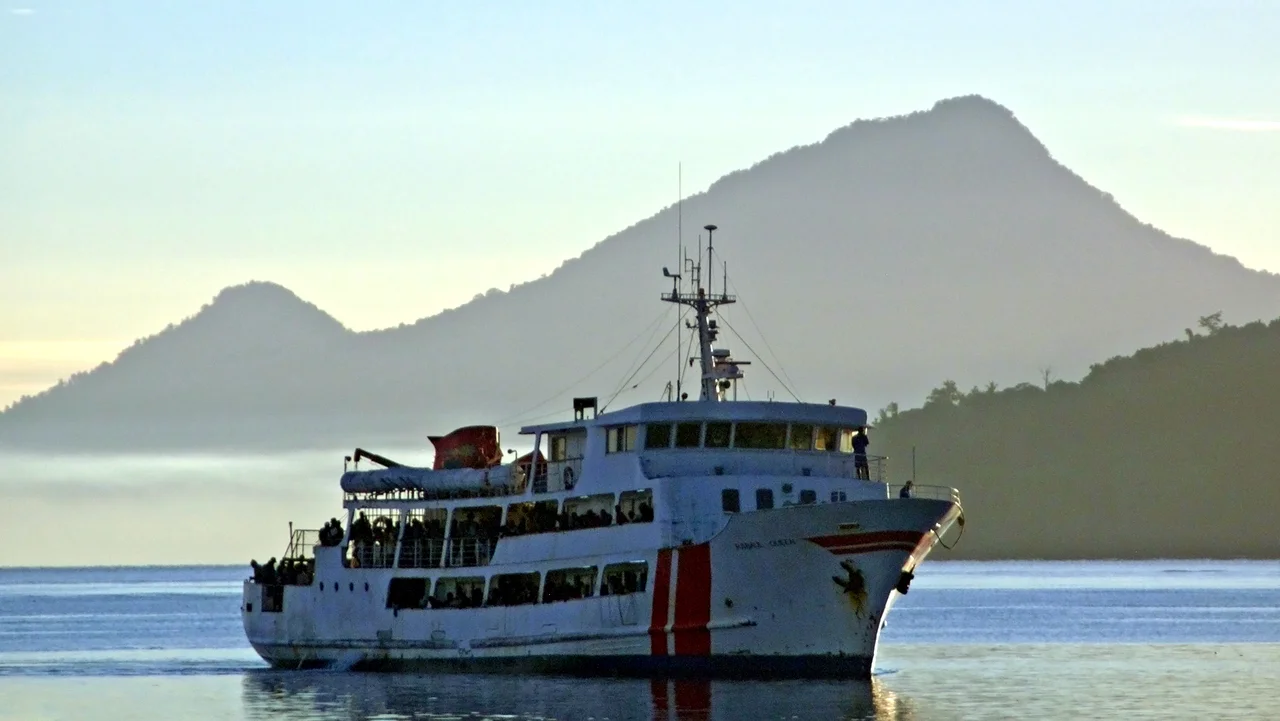

MV Rabaul Queen
One passenger had a cell phone, and that phone had a signal. Two days after the MV Rabaul Queen rolled over in heavy seas off Finschhafen, twenty-seven survivors were still alive on a small uninhabited island, one of them reaching family to say they were breathing. Papua New Guinea's Maritime Safety Authority had already announced, on 5 February 2012, that anyone left alive would have been found. They were wrong. The call changed the rescue calculus but not the math of loss. The ship had been licensed to carry 310 people. The best estimates suggest roughly 558 were aboard when it went down.
A Routine Voyage
The Rabaul Queen was one of the workhorses of Papua New Guinean coastal transport - a 1983-built passenger ferry operated by Rabaul Shipping, running between the port of Kimbe on the island of New Britain and Lae on the mainland. It was a long crossing. Twenty hours of open water across the Solomon Sea, past the tip of the Huon Peninsula. For many passengers it was the ordinary means of getting home, of visiting family, of moving between islands and mainland provinces where flights were expensive and roads did not reach. When the ferry departed Kimbe on 1 February 2012, it carried twelve crew and something between 350 and 500 passengers, depending on which count you believe. By law it should have carried a third of that.
Three Waves
In the early hours of 2 February, with the ferry near the end of its 20-hour run and about nine nautical miles from Finschhafen, three large waves hit in succession. Conditions in the Solomon Sea had turned rough overnight, with wind and swell that made small-boat handling dangerous. The Rabaul Queen did not recover from the third wave. She capsized and, around 6:00 am local time, she sank. The search began quickly once word reached shore. Seven fixed-wing aircraft took part, including a P-3 Orion maritime patrol aircraft from the Royal Australian Air Force flown out of its regional tasking. Three helicopters joined in. Seven vessels joined in. The weather that had capsized the ferry did not relent for the rescuers, and heavy seas and high winds complicated every minute of the effort. By nightfall on 2 February, 246 survivors had been pulled from the water and floating debris.
Counting the Missing
The precise death toll has never been settled, and that in itself tells the story. Because the ferry carried far more passengers than its manifest permitted, no one could confidently say who had been on board. Families came forward to name the missing. A public appeal asked relatives of anyone thought to be aboard to identify them. The Commission of Inquiry that followed - led by Judge Warwick Andrew - worked through those lists rather than a passenger count. The Commission submitted its report to caretaker Prime Minister Peter O'Neill on 28 June 2012. It concluded that Rabaul Shipping's policies had failed the people aboard, and that Papua New Guinea's maritime oversight had failed them too. Despite recommendations from the International Maritime Organization on safety of life at sea, national regulations did not require vessels to hold a safety management plan. The gap was not theoretical. It was the space into which roughly three hundred people vanished.
The Trial That Never Settled
Prosecutors brought 172 counts of manslaughter and one charge of sending an unseaworthy vessel to sea against the ferry's owner Peter Sharp, its captain Tsiau, and others connected to the operation. Charges against a fifth figure, National Maritime Safety Authority manager Joseph Titus Kabiu, were dropped for insufficient evidence. The trial opened in April 2016. By 2017, Sharp and Tsiau had been acquitted of the manslaughter charges after the court ruled the state had failed to prove any risk attached to the ship's normal use. In October 2018, news outlets reported that the public prosecutor had dropped the remaining unseaworthy-vessel charges. Soon after, Attorney General Davis Steven said publicly that he would use his powers to reopen investigations, stating "I assure you that the matter is under scrutiny." For families still waiting for accountability, the reassurance was thin.
What the Sea Took
Some maritime disasters become anchored in memory by their scale or their technology - the Titanic, the Estonia, the Sewol. The Rabaul Queen was smaller and the coverage shorter. But the people who drowned off Finschhafen that February morning were not a statistic. They were workers heading home to Morobe Province. They were families who had saved up for the fare. They were mothers who had put children to sleep on sleeping mats on the deck because there were no more bunks, and fathers who had tied belongings into bundles. They were someone's relatives on someone's Christmas photo. The stretch of the Solomon Sea where the ferry went down is a busy shipping lane now as it was then. Small ports along the Huon Peninsula still see passenger vessels depart overloaded. The Commission's recommendations sit in a filed report. The waves still build when the weather turns.
From the Air
Wreck site approximately 6.52S, 147.99E in the Solomon Sea, about nine nautical miles east-southeast of Finschhafen on the Huon Peninsula. The ferry sank in deep water in February 2012 during rough conditions. From cruising altitude the Huon Gulf and the Vitiaz Strait are visible as a distinct coastal arc on Papua New Guinea's northeast. Nearest airfields: Finschhafen (AYFI) and Lae Nadzab (AYNZ), about 80 km west. Weather in this stretch of sea can change quickly - expect convective buildup and strong afternoon winds.
Nearby Stories
- Black Cat Track 37 km away
- Lae 37 km away
- Battle of the Bismarck Sea 64 km away
- Dampier Strait (Papua New Guinea) 90 km away
- Battle of Cape Gloucester 98 km away
- Japanese destroyer Ariake (1934) 127 km away
- Invasion of Buna–Gona 200 km away