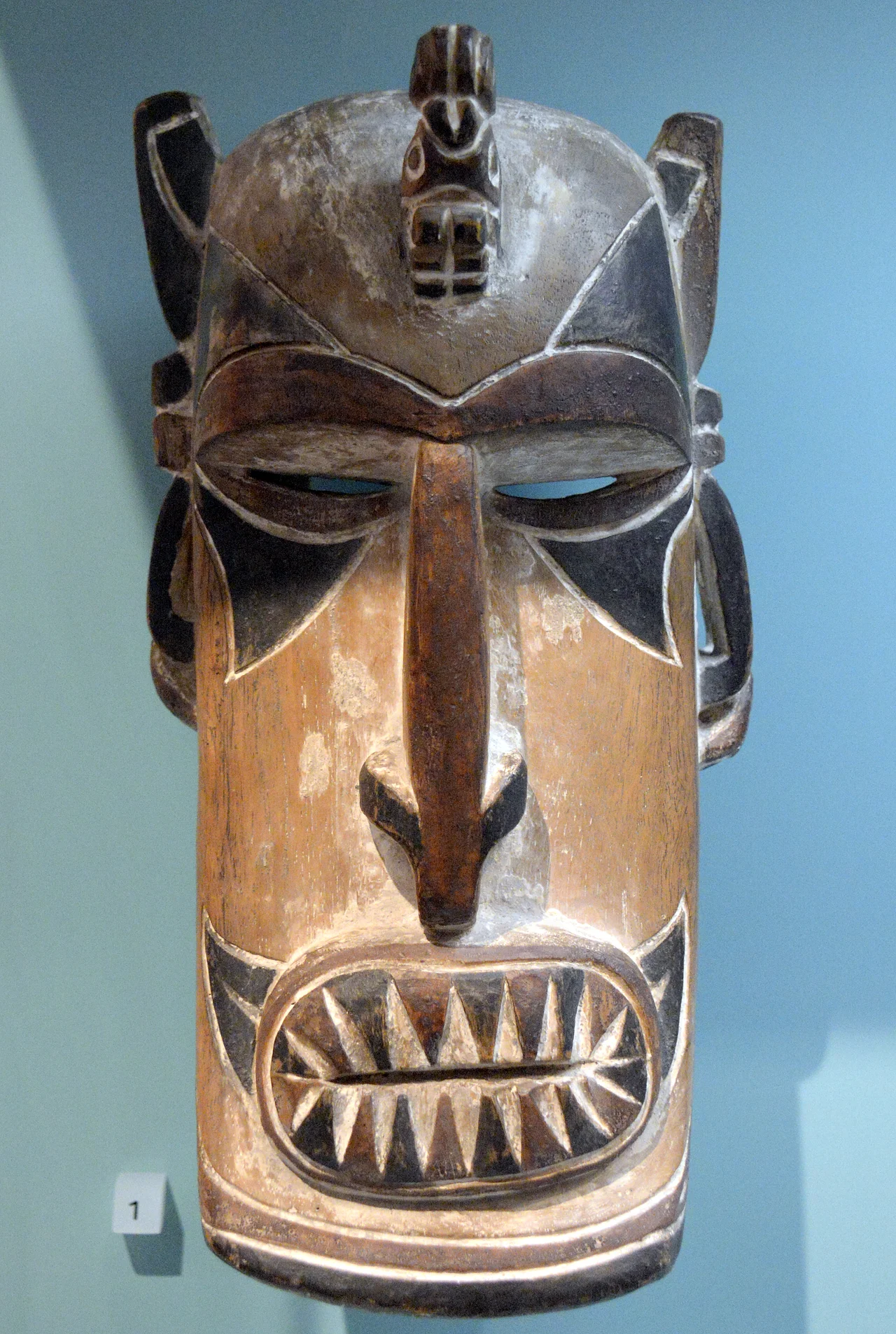

Tami Islands
There is no clay on the Tami Islands. Across Papua New Guinea, that normally means no pottery - the coastal peoples made vessels of fired earth the same way their grandparents had. The Tami carvers made theirs of wood instead, and the switch became an identity. Their bowls - rectangular, incised with animal figures and stylized faces, polished by use and generations - traveled outward in outrigger canoes until they reached the Caroline Islands to the north and the Solomons to the east. Across a 200-mile network of ocean trade, a Tami bowl meant something: it could settle a bride-price, mark a chief, hold the rituals of a feast. The islands themselves are a circle of four small atolls in the Huon Gulf, none more than 80 meters across at their widest point. A whole maritime economy ran out of a place you could walk the length of in under a minute.
A Lagoon Barely Big Enough to Name
The Tami Islands sit 13 kilometers south-southeast of Finschhafen, where the Huon Gulf opens into the Solomon Sea. Four small atolls form a rough ring around a central lagoon 21 meters deep at its heart. Two of the atolls are larger, each home to a village, and the two villages face one another across a volcanic cove. The other two are smaller still - one barely more than a strip of sand that disappears when the tide comes up. Today snorkelers and divers visit from nearby Lae to explore the reefs, where Spanish Dancer jellyfish, blue starfish, and schools of pelagic predators and prey thread around coral heads. The surface area of the largest island runs to about 80 meters, which gives a sense of scale: you can cross it in a short walk, yet it has been inhabited continuously for long enough to build one of the most distinctive art traditions in the western Pacific.
The Bowls That Traveled
Tami carvers specialized in rectangular wooden bowls decorated with incised designs unique to their archipelago. Other Papua New Guinean peoples made round clay pots. The Tami made rectangles from wood, and their absence of clay was a point of pride rather than a limitation. The bowls went outward as bride-wealth across a trading network that stretched up to the Caroline Islands and down toward the Solomons - a 200-mile exchange in outrigger canoes long before outboard motors or compasses. The return flow carried what the islands lacked: sweet potatoes, reeds, pigs, betel nut, bows and arrows, feathers. Dogs' teeth came back for jewelry and for the tiny cutting blades used to carve the next generation of bowls. You can read the trade on the islanders' faces even now - anthropologists have noted that Tami physiognomy resembles that of New Britain islanders several hundred kilometers east, the long genetic residue of exchange voyages. Traditional body paint was blue and pink.
Faces, Masks, and Canoes
The same carving sensibility that shaped the bowls shaped everything else. Tami religious figures stand at full height with their heads set directly on the torso - no neck - and arms held tight at the sides as if at attention. An elaborate headdress usually tops the figure. The eyes are circles placed directly under the forehead. Two incised triangles point inward to the center of the face, a signature detail that tells a collector or curator the piece is Tami before anything else. Masks use the same vocabulary of circles and triangles. Spatulas and hooks and canoe prows carry stylized animals - dog, fish, bird - reduced to essential geometry. The canoes themselves impressed even outsiders. A visitor's description captured one at roughly 30 feet long, carved from a single straight log, ends rising into curved carved heads, sides built up of hand-hewn boards twenty inches wide running the full length, painted in red-and-white shield patterns, and bound together entirely with plant fiber and tree-gum seals. Not a nail in the vessel. Not a mark from a modern tool.
Missionaries and Other Currents
The Lutheran missionary Johann Flierl arrived in the region in the late nineteenth century hoping to win Tami trust and use the islands' trading connections to spread Christianity outward through the same network that carried the bowls. The plan did not unfold as he expected. Instead of the Tami carrying the mission to their partners, the mission carried cash wages to the Tami. Islanders took jobs working for Flierl's Lutheran enterprise, which meant less time for the careful work of bowl carving and the making of religious figures. Production dropped. The Tami style survived, but the trade contracted. In a quiet inversion, Tami catechists traveled to the nearby Siassi Islands to teach there, and the Siassi picked up bowl-making from their former trading partners - a craft tradition transmitted along a missionary circuit rather than a marriage one. Tami canoes, with their uniquely rectangular prows rather than the tapered Milne Bay style, kept sailing.
The War Came and Went
The Japanese occupied the Tami Islands briefly during World War II, and most of the islanders evacuated to the mainland for safety. The Tamis returned in May 1944. In their absence the islands had been raided three times by American aircraft. On 25 November 1942 a B-25 hit a Japanese cruiser off one of the main islands. On 18 September 1943 a flight of A-20s struck installations ashore. On 21 September 1943, a mixed force of A-20s, B-26s, and RAAF aircraft returned - though by then, according to the islanders who came home, the Japanese had already left. Bomb craters pocked the village centers and the betel nut grove, and many palms had been torn apart. The damage healed into the landscape the way tropical damage does: fast at first, then slowly. Today the islands lie within the protections of the Papua New Guinea National Seas Act of 1977. The carving continues. So does the fishing. So, in smaller numbers and more careful hands, does the making of the rectangular wooden bowls that once traveled two hundred miles of open ocean.
From the Air
Located at 6.60S, 147.85E, roughly 13 km south-southeast of Finschhafen in the Huon Gulf. Four small atolls surround a 21-meter-deep lagoon. From cruising altitude the ring shape is visible against the darker deep water of the gulf. Best viewed at 3,000-5,000 ft for detail. Nearest airfields: Finschhafen (AYFI) and Lae Nadzab (AYNZ) about 80 km southwest. Afternoon cumulus often forms over the surrounding warm water; clearest viewing is typically early morning.
Nearby Stories
- Black Cat Track 37 km away
- Lae 37 km away
- Battle of the Bismarck Sea 64 km away
- Dampier Strait (Papua New Guinea) 90 km away
- Battle of Cape Gloucester 98 km away
- Japanese destroyer Ariake (1934) 127 km away
- Invasion of Buna–Gona 200 km away