
Kokoda Track Campaign
Historian Peter Brune called it "one of the most ludicrous orders ever given": build an overland road from Port Moresby to Kokoda. By the end of September 1942, nearly three months after the order was issued, Lieutenant Bert Kienzle's team had completed just over eleven kilometres of it. The rest of the 96-kilometre Kokoda Track remained what it had always been: a foot path threaded through jungle, climbing ridges, dropping into rivers, rising into cloud, then dropping again. Up to 5,000 metres of elevation gain and loss along the way. No wheels. No roads. Everything that fought on that track had to be carried on somebody's back. And somebody meant, overwhelmingly, Papuan men who had been conscripted to carry it.
The Mountains Will Beat Them
When Major General Basil Morris handed over command of New Guinea Force to Lieutenant General Sydney Rowell in August 1942, he offered a blunt summary: "The mountains will beat the Nips and we must be careful they don't beat us." He was right about both halves. Japanese soldiers advancing south from Buna and Gona carried 18 kilograms of rice each, plus ammunition for their guns. The advance took over forty-five days. By the time they reached Ioribaiwa in mid-September, within sight of the lights of Port Moresby, their daily rice ration was down to 180 millilitres and Australian patrols were finding Japanese dead with evidence that some had been reduced to eating wood, grass and roots. On the Australian side, 50 per cent of air-dropped supplies were lost in the jungle. Sometimes the rate was 90 per cent. The Owen Stanley Range did not take sides. It simply punished everyone on it.
The Men Who Carried It
On 15 June 1942, Morris issued the Employment of Natives Order, a document that conscripted Papuan labour under wartime regulations. By August, 1,600 Papuan carriers were supporting Potts's 21st Brigade forward of Myola. Author Paul Ham estimates the total who worked the track at 3,000, with a desertion rate of 30 per cent, which is another way of saying that nearly one in three men disappeared rather than continue. Captain Geoffrey 'Doc' Vernon, a medical officer, wrote of their condition at Eora Creek: "Overwork, overloading... exposure, cold and underfeeding were the common lot. Every evening scores of carriers came in, slung their loads down and lay exhausted on the ground." The Australian wounded they carried back remembered something different. They remembered the care. Stretcher-bearers slept four to a side at night, fetched water, fed patients, built shelters in the rain. Frank Kingsley Norris wrote that the men were tended "with the devotion of a mother and the care of a nurse." The nickname that stuck was "Fuzzy Wuzzy Angels." Both halves of that phrase deserve scrutiny. The gratitude was genuine; the framing belonged to a colonial era still comfortable with reducing Papuans to a hair style and a metaphor. The Japanese, meanwhile, also used conscripted Papuan and Rabaul labour, and treated them brutally. Sick or injured carriers were sometimes murdered. Desertion rates were correspondingly high, and Japanese supply shortfalls deepened.
Fighting Up and Fighting Back
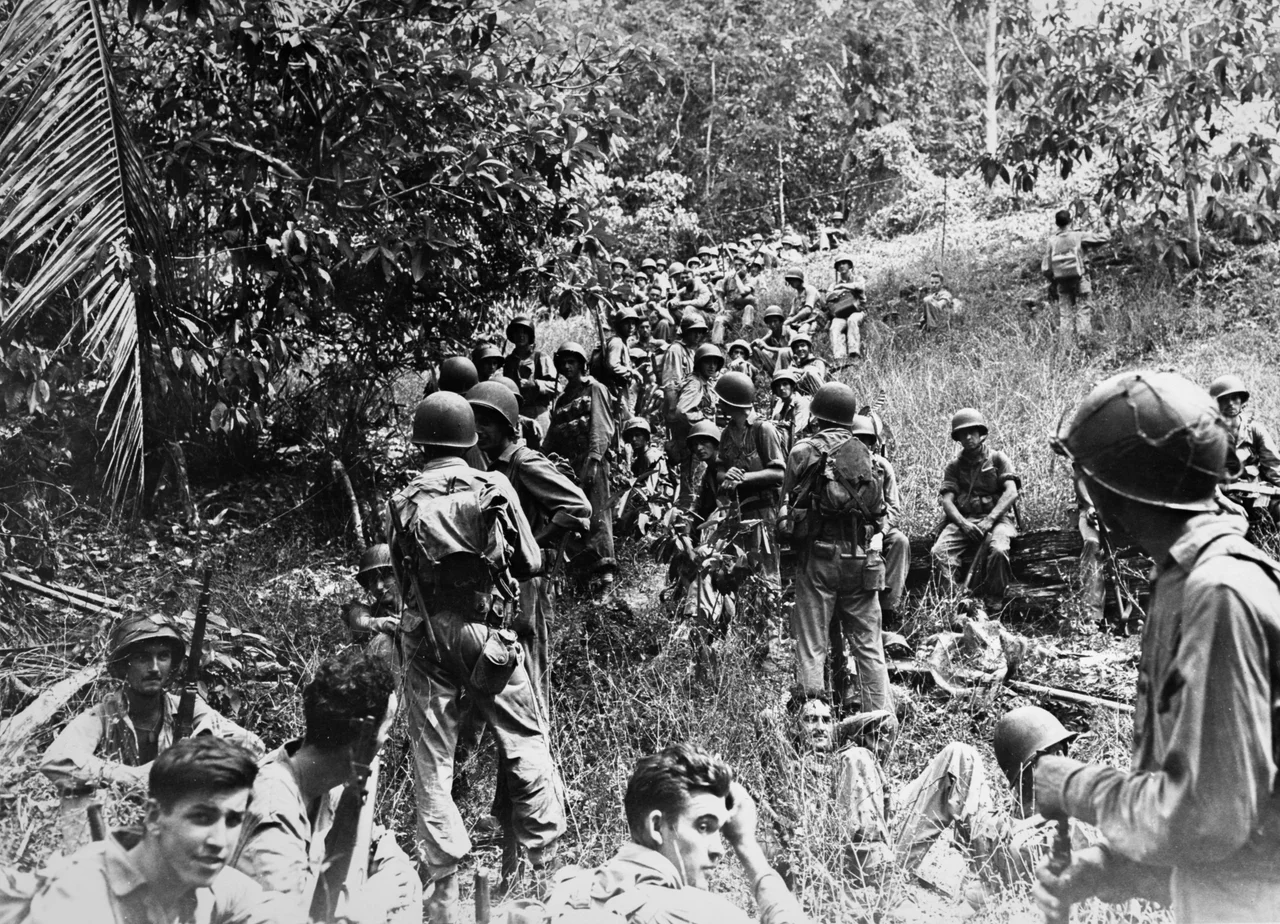
The campaign had two phases, and they mirrored each other. From 21 July, when Japanese forces landed at Gona, through mid-September, the Australians fell back: Awala, Gorari, Oivi, Kokoda, Deniki, Isurava, Eora, Brigade Hill, Ioribaiwa. At each stage, outnumbered militia from the 39th Battalion and then the veteran 21st Brigade fought a delaying action, got outflanked by Japanese who were better fed and better armed with mountain artillery, and pulled back. At Brigade Hill on 6-9 September, the 2/27th Battalion was cut off and presumed lost; its survivors emerged from the jungle three weeks later. Then Guadalcanal saved the campaign. The Japanese Imperial General Headquarters decided it could not support both fronts, ordered Horii to withdraw, and from 26 September the Japanese turned around. The Australians followed cautiously. Templeton's Crossing, Eora Village, Kokoda, Oivi, Gorari. By mid-November, Vasey's 7th Division had crossed the Kumusi River and was headed for the beachheads at Buna and Gona, where the worst fighting of the whole Papuan campaign still lay ahead.
The Generals' War
Behind the men on the track was a wholly separate battle being fought in offices in Brisbane and Port Moresby. General Douglas MacArthur, Supreme Commander Southwest Pacific, had a low opinion of Australian troops and told Washington so. General Sir Thomas Blamey, commander of Allied Land Forces, was under pressure from MacArthur and increasingly willing to push that pressure down the chain. Rowell was relieved of command on 28 September after objecting to Blamey inserting himself into his headquarters. Major General Arthur "Tubby" Allen was sacked as 7th Division commander on 28 October, largely because he would not advance faster than his supply line could sustain. Brigadier Arnold Potts, architect of the fighting withdrawal from Isurava, was sacked too, then delivered the "running rabbits" speech at Koitaki by Blamey that witnesses said nearly provoked a mutiny. Historian David Horner summarised it plainly: "It was errors by men like MacArthur and Blamey which lead to the near disaster in New Guinea. As usual, it was the men in the front line who paid the heaviest price."
A Legend That Needed Editing
Australia has mythologised Kokoda as a Thermopylae, a thin line of young men holding a narrow pass against overwhelming odds. The numbers do not quite support that shape of story. At Isurava, the 2,290 Australian defenders faced 2,130 Japanese attackers; by the time of Brigade Hill and Ioribaiwa, Australian strength roughly matched Japanese strength. What held in the myth is the terrain and the exhaustion, the role of militia battalions like the 39th who fought longer and harder than their pre-war training had prepared them for, and the sheer physical insult of the track itself. What has slowly been edited back into the legend, over the decades, is the role of the Papuan carriers, without whom the Australian force could not have functioned and whom Blamey's army considered so essential that desertion was treated as a military offence. Walk the track today and you cross ground where young men from both armies are still found in fragments. The jungle grows fast. The memorials are small. The altitude still punishes anyone who tries it without acclimatising. Kokoda remains, in the most literal sense, a place where what you know about history depends on whose footprints you follow.
From the Air
The Kokoda Track runs roughly south-southwest from Kokoda village (8.88 degrees south, 147.73 degrees east) to Owers' Corner (9.46 degrees south, 147.38 degrees east) near Port Moresby. Total overland distance 96 km, straight-line distance 60 km. The track reaches a maximum height of 2,190 metres at Mount Bellamy. The "Kokoda Gap" is a roughly 11 km wide saddle in the Owen Stanley Range that can be crossed by aircraft. Key locations along the track include Kokoda, Deniki, Isurava, Eora Creek, Templeton's Crossing, Myola, Efogi, Brigade Hill, Menari, Nauro, Ioribaiwa and Imita Ridge. Recommended viewing altitude 10,000 to 14,000 feet to clear highest ridges. Nearby airports: Jacksons International (AYPY) 60 km southwest of Owers' Corner, Kokoda (AYKO), Girua (AYGR) near Popondetta on the north coast. Weather on the range is frequently poor; cloud often fills the valleys by midday.
Nearby Stories
- Battle of Mission Ridge-Brigade Hill 19 km away
- Invasion of Buna–Gona 25 km away
- Kokoda Track 27 km away
- Papua New Guinea National Museum and Art Gallery 34 km away
- Wards Airfield 63 km away
- Battle of Wau 156 km away
- Battle of the Bismarck Sea 158 km away
- Japanese Submarine Ro-103 265 km away