
Kokoda Track
Before it was a battlefield or a pilgrimage, it was a way home. Koiari and Orokaiva people had crossed the Owen Stanley Range on these paths for centuries, moving between villages on the north and south coasts of what Europeans would later call Papua New Guinea. In the late 1800s, gold prospectors used the same tracks to reach the rivers on the northern side. None of these travelers called it "the Kokoda Track" - that name came from war. For four months in 1942, Australian and Japanese soldiers fought each other along roughly 96 kilometers of mud, root, and rain, from a village called Kokoda in the north to a rise called Imita Ridge in the south. Today, more than 4,000 walkers a year make the same crossing - most of them Australian, many of them crying when they reach the memorial at Isurava.
The Track Is Not One Path
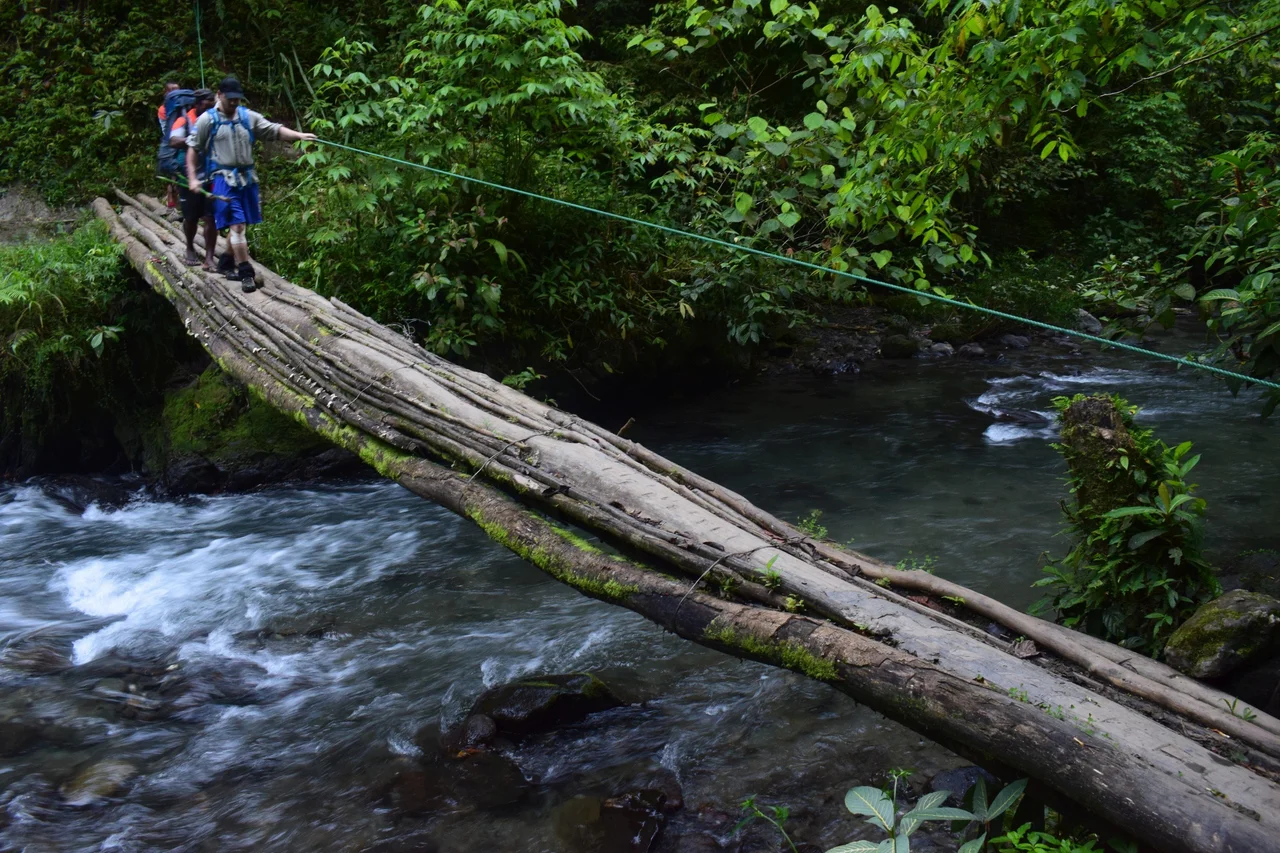
First-time trekkers often assume there is a single Kokoda Track. There is not. Villagers used different routes through different valleys, and modern trekking follows about two-thirds of what was fought over in 1942. The standard northern starting point is the village of Kokoda itself, at the north end of the divide; the standard southern endpoint is Owers' Corner, a road terminus reachable by vehicle from Port Moresby. Between these, the track rises and falls through steep rainforest, crosses streams that wash clothes and soak boots, passes through tiny villages where children wave, and climbs to campsites around 1,900 meters elevation where nights are cold enough to want a fleece. Eight days is standard. Six is punishing. The world record, set by local porter Brendan Buka, is 16 hours 34 minutes 5 seconds - a time that runners from anywhere else on Earth still find hard to believe.
Walking into 1942
On 21 July 1942, Japanese forces landed at Buna and Gona on the north coast. Their objective was Port Moresby on the south coast - a base that, if captured, would threaten mainland Australia. The way to get there was on foot, across this track. What followed was a rolling fighting withdrawal by Australians, many of them militia teenagers initially, reinforced over time by veterans of the Middle East campaigns. They fought at Kokoda, Deniki, Isurava, Eora Creek, Mission Ridge, Ioribaiwa - each a village or ridge that trekkers now walk past. Japanese supply lines stretched to breaking before Port Moresby came within grasp, and by October the Japanese were retreating back north along the same track, pursued by the same Australians. The campaign ended in December 1942 on the north coast. Australians call what happened here a rite of passage on par with Gallipoli. Trekkers walking past the memorial at Isurava - Japanese as well as Australian - often stop without being able to explain why.
Fuzzy Wuzzy Angels
Australian soldiers coined the phrase "fuzzy wuzzy angels" for the Papuan carriers who moved supplies up to the fighting front and brought wounded men back down on stretchers. The name has stuck in Australian memory - affectionate and grateful, and also, viewed from 2026, a reminder of how the colonial gaze flattened the humanity of the people who did the carrying. The carriers were conscripted by ANGAU (Australian New Guinea Administrative Unit) and the Papuan Constabulary. Many had not asked to be part of this war. They came from the villages the track passes through - Menari, Efogi, Alola, Kagi, and others - and they saved countless Australian lives by climbing down muddy ravines with stretchers through the night. Modern trekking companies, many now employing descendants of those carriers as porters and guides, are working to reframe this history from the Papuan side. The people who live along the track today are the living link to what happened here.
The Walk Itself
For a seasoned hiker, the Kokoda is tough but doable; for most people, it is the hardest thing they have ever done. Groups spend about 60 hours over 6 to 12 days on their feet, climbing and descending steep rooted mud with trekking poles. Good boots and a fresh pair of socks every morning are non-negotiable; so are anti-malarial drugs, water purification, sun protection, and insect repellent. Campsites have long-drop toilets with standard green seats, a grassy tent area, and usually a swimming hole or shower. Over 80 trekking operators run the route, most Australian-owned; a handful of Papua New Guinea-owned operators like South Sea Horizons and KoTreks keep money in the country. Costs run AU$3,000 to 5,000 plus flights. Independent trekking is strongly discouraged - the terrain is unforgiving and, as a 2016 attack on unescorted trekkers near Templeton's Crossing showed, not always safe.
Why People Come
ANZAC Day falls on 25 April - a public holiday in Australia and New Zealand that commemorates soldiers lost at Gallipoli in 1915 and, by extension, every war since. It is the busiest time on the track. Walkers arrive for many reasons: some to honor a grandfather who served, some because friends convinced them, some simply to see whether they can. The dry season runs May through October and offers the easier weather, though rain at altitude is possible any month. The actual 1942 campaign was fought from July to November, during the dry season, and most trekking takes place then. Four museums sit along the route - at Efogi, Kokoda, Isurava, and Alola - though whether they are open depends on whether the person with the keys is around. The Bomana War Cemetery outside Port Moresby, where most of those who died on the track are buried, is usually a final stop. By that point, most trekkers do not say much.
From the Air
The Kokoda Track runs roughly north-south across the Owen Stanley Range in southern Papua New Guinea, between about 9.0 degrees south, 147.7 degrees east (north end, Kokoda) and 9.4 degrees south, 147.6 degrees east (south end, Owers' Corner). Jacksons International (AYPY/POM) at Port Moresby serves the southern end; Kokoda airstrip (AYKO) serves the north. Recommended viewing altitude for the whole track is 10,000 to 12,000 feet - the main divide peaks reach around 7,000 feet and cloud buildup over the range is persistent. Charter flights from Port Moresby to Efogi, Kagi, or Manari allow trekkers to start from the middle. Weather along the divide is often socked in by mid-morning.
Nearby Stories
- Battle of Oivi-Gorari 28 km away
- Tufi 29 km away
- Dobodura Airfield Complex 45 km away
- Battle of Mission Ridge-Brigade Hill 47 km away
- Kapa Kapa Trail 56 km away
- Ss Peter and Paul Cathedral, Dogura 121 km away
- Goodenough Island 132 km away
- Milne Bay Province 173 km away