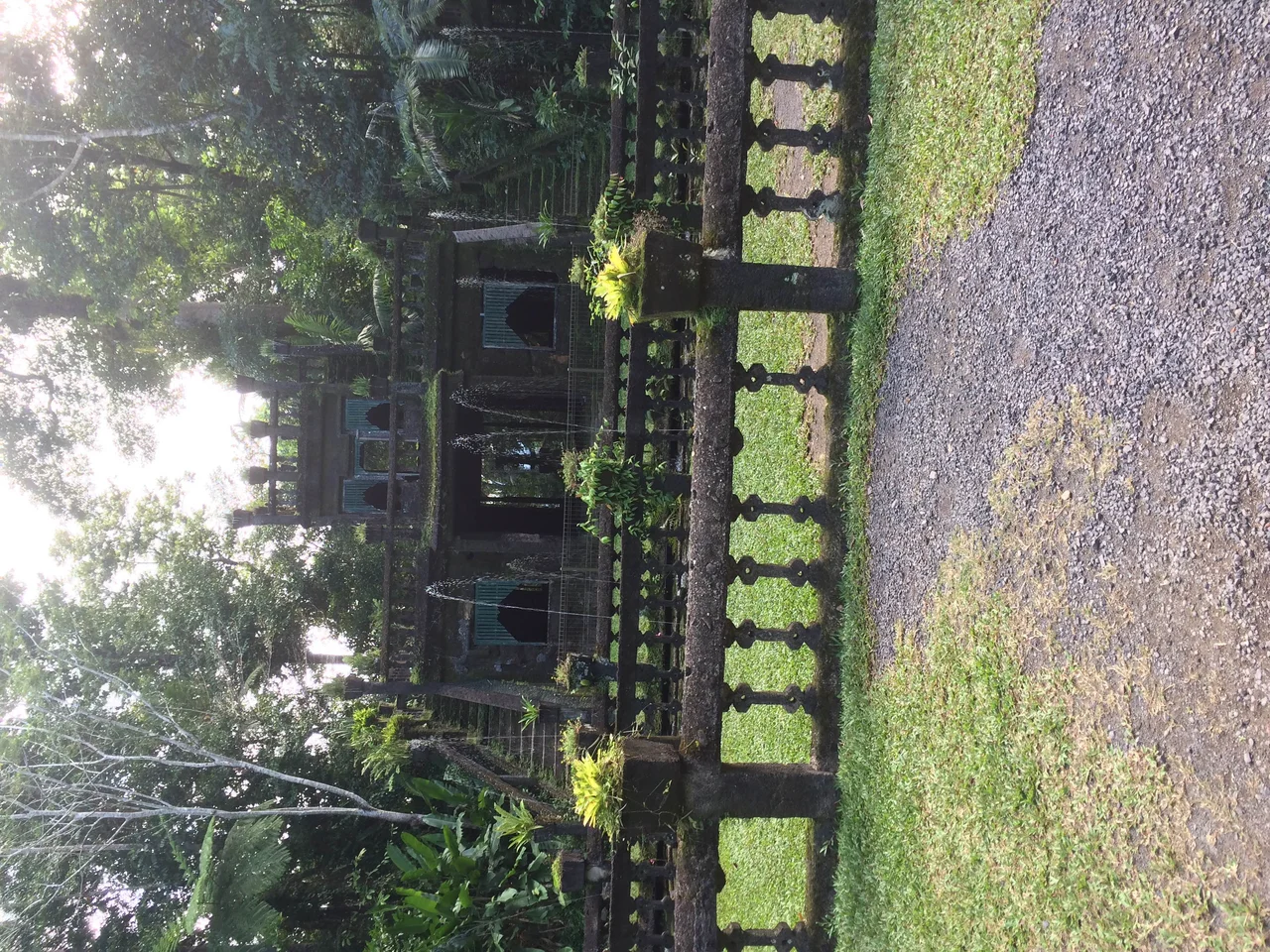

Paronella Park
José Paronella arrived in Queensland in 1913 with almost nothing and a picture in his head: the castles of his native Catalonia, rising out of the green. It took him until the 1930s, and a fortune made and spent on cane farms, to find the place that matched the picture — a patch of rainforest beside a waterfall at Mena Creek, two hours south of Cairns. There, with picks, shovels, a wheelbarrow, and an extraordinary stubbornness, he built a castle. Not a real one — a pleasure garden dressed as one, with turrets and a grand staircase, a ballroom and a fountain, all poured by hand from sand he carried up from the creek. Today the jungle is taking it back, and the ruins are more romantic than the castle ever was.
The Dreamer from Catalonia
He was born José Pedro Enrique Paronella on 26 February 1887 in La Vall de Santa Creu, a hamlet in the province of Girona in north-eastern Catalonia. He sailed for Australia in 1913, became a naturalised citizen in 1921, and spent eleven years in the brutal arithmetic of the frontier — buying scrubland, clearing it into cane farms, selling at a profit, buying more. He ran a mine and lent money at interest. In 1924 he returned to Spain to marry Margarita, and after a long honeymoon the couple came back to Queensland together. He had the money now. What he wanted was the castle — and a place beautiful enough to deserve it.
Built by Hand, Stair by Stair
By 1929 he had bought the land at Mena Creek, waterfall included. He built a stone house for his family first, then a pavilion at the head of the falls that served as both cinema and ballroom. The centrepiece was the Grand Staircase — forty-seven steps cut into the slope, which he used to haul river sand up to mix his concrete before it became a stage for visitors to descend in their finest. Below, beside the lagoon, he laid out stone tables and a balustrade, refreshment and changing rooms, a fountain, tennis courts. He planted thousands of trees, among them an avenue of Kauri pines that still stands. The park opened in 1935 as exactly what he had imagined: a place to swim, dance, picnic, and stroll, deep in the rainforest, lit by his own electricity.
Power from the Falls
Paronella refused to depend on the outside world for so much as a light bulb. In 1934 he built what is regarded as Queensland's first privately owned hydroelectric plant, harnessing Mena Creek Falls. He had no engineering training; he simply walked up to the engineers at the nearby South Johnstone Mill, and they, won over by his sheer determination, helped him design it. Water ran down an aqueduct and dropped some thirty feet onto a turbine spinning a DC generator scrounged from army surplus. From that one falling stream came the park's lights, its pumps, its refrigeration, and the power that ran films in the ballroom — a self-made castle, running on its own waterfall.
What the Jungle Reclaimed
Tropical Queensland is hard on dreams. In 1946 a cyclone sent logs tumbling down the falls and into the refreshment rooms; Paronella repaired, replanted, and reopened within six months. He died in 1948, leaving the park to Margarita and their children. The family held it until 1977, and not long after, fire gutted the cinema and ballroom, leaving only a shell. Flood and Cyclone Winifred came through in the 1980s. By the time new owners bought it in 1993 and began the long work of restoration, the rainforest had wrapped its roots around the towers and fed on the staircase. That is precisely its magic now: a Spanish castle being gently, beautifully consumed by the jungle. Heritage-listed and eco-certified, it has stood in for a ruined hotel in the 1993 film *Sniper* and featured in the 2018 film *Celeste* — a folly that became, in the end, more haunting than any castle Paronella ever saw in Spain.
From the Air
Paronella Park sits at 17.65°S, 145.96°E, beside Mena Creek Falls on the coastal plain south of Innisfail, roughly 120 km south of Cairns. From the air, look for the bright green of cane fields broken by a denser knot of rainforest along the creek; the falls and the grey stone ruins lie within it. Nearest airfields are Innisfail (YIFL) about 25 km north-east and Cairns International (YBCS) roughly 100 km north. The wet season (December–April) brings cloud, downpours, and the full thunder of the falls; the dry winter offers clearer skies. A low pass at 1,500–2,500 ft best reveals how completely the jungle has folded itself around the structures.
Nearby Stories
- Golden Gumboot 16 km away
- Rocky Creek World War Two Hospital Complex 26 km away
- Mount Bartle Frere 27 km away
- The Great Barrier Reef: The Living Structure Visible from Space - Now Dying 43 km away
- Cyclone Yasi 53 km away
- Mbabaram language 69 km away
- Undara Volcanic National Park 105 km away
- Fort Complex, Magnetic Island 165 km away