.jpg)
Rocky Creek World War Two Hospital Complex
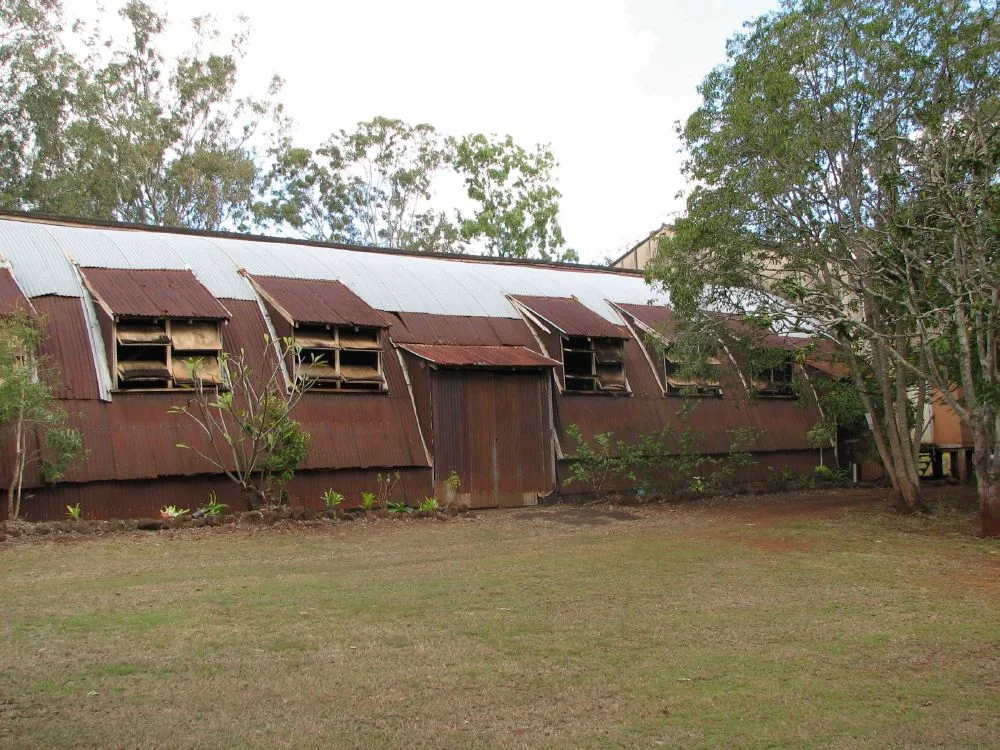
Walk the cane country near Tolga today and you keep stepping onto concrete. A slab here, a drain there, the ghost of a ward floor with bolt-holes and the scratched word "Hooks" still legible in the cement. Eighty years ago this quiet corner of the Atherton Tableland was one of the busiest places in northern Australia: a military hospital city of seventy-three buildings and seventeen hundred beds, where soldiers carried out of the New Guinea jungle came to be put back together. Some thirty thousand of them passed through Rocky Creek in three years. The wards are gone, auctioned and carted off after the war, but the slabs remember, and so does a strange curved building of tin that the men called the Igloo.
Why Here, on the Tableland
The choice was deliberate. As the war with Japan swept across the Pacific and the bombs fell on Darwin and Townsville in 1942, the Australian Army needed somewhere to treat the men fighting in Papua New Guinea — and the Atherton Tableland was nearly perfect. It was close to the New Guinea front and to the port of Cairns, where casualties came ashore. It was high enough to be cool, a relief after the equatorial heat. And crucially, it was largely free of malaria, the disease filling the wards faster than any bullet. Building began on 6 October 1942. The first patients arrived two weeks later, and a small cluster of tents on the south-eastern side of Rocky Creek began swelling into something vast.
A Hospital City
By 1943 two great units anchored the site — the 2/2nd and the 2/6th Australian General Hospitals, the latter just back from two hard years in Greece, Crete, and the Middle East. Each grew toward twelve hundred beds and beyond. The complex sprawled across 763 acres: forty wards apiece, laundries, a convalescent depot, stores and offices. The earliest wards had floors of bare earth, watered daily to keep the dust down, with a strip of rattan matting up the middle; later ones rose onto concrete slabs with wood stoves and kerosene refrigerators. Casualties came in from Cairns three times a week aboard the 4th Australian Hospital Ambulance Train. By late 1944 the daily average had climbed to 1,760 patients — a small city of the wounded and the sick, run in large part by the nursing sisters and the women of the Australian Army Medical Women's Service.
The Malaria Ward
Malaria was killing the Pacific war as surely as the enemy, and Rocky Creek became one of the places Australia fought back. One ward of the 2/2nd was given over to malaria experiments: small groups of volunteers, five or six at a time, were deliberately infected with parasites drawn from Anopheles mosquitoes, then treated with the drugs the army was racing to perfect. Every volunteer signed a statement releasing the army and its doctors from responsibility for whatever followed. It was grim, deliberate, and consequential work — the kind of research that turned malaria from a force that could lose battles into one the troops could survive. The men who lay in that ward took the disease on purpose, so that thousands of others would not have to.
The Igloo
Even a hospital this size needed somewhere to forget the war for an evening. In 1943 the men built the Entertainment Igloo — a long hall with a curved roof of corrugated iron arched over ten timber trusses, each cut from native hardwood and pinned at the apex. A truck with a projector mounted on its back would reverse up a ramp until the beam pointed at the screen, and the wards emptied for the picture show; there were concerts and dances too, and bingo before the main feature. When the war ended and the hospital was auctioned off, almost everything was dismantled — but the Igloo survived because a family moved in. Frank and Ellen Frazer bought it in 1947, converted the stage into a home, and raised eleven children inside the old theatre while Frank built cane furniture in the auditorium where soldiers had once watched films.
What Remains
The Igloo and its land were eventually given to the local council, and in 1995, for the fiftieth anniversary of victory in the Pacific, residents built a memorial park on the site of the old laundry administration area. Anzac Day services are held there now. Out along Frazer Road the bush has half-swallowed the rest: the cross-shaped slabs of the psychiatric and isolation wards, the morgue's drains, a scatter of glass and ceramic and the occasional drug bottle working up through the soil. This is high, old country — the traditional lands of Aboriginal peoples of the Atherton Tableland long before any hospital or cane farm — and the war that filled it for three years left mostly silence behind, broken by the slabs underfoot and the long tin roof of a theatre that a family turned into a home.
From the Air
The site lies at 17.19°S, 145.46°E, beside the Kennedy Highway about five kilometres north of Tolga on the Atherton Tableland, between Atherton and Mareeba. From the air it is high, open tableland — cool green farmland and cane, very different from the coastal rainforest — and the long curved roof of the Entertainment Igloo is the one obvious landmark, with the memorial park and the faint grid of ward slabs along Frazer Road nearby. Nearest airfields are Mareeba (YMBA) and Atherton (YATN) on the plateau itself, with Cairns International (YBCS) roughly 60 km north-east beyond the Great Dividing Range escarpment. The dry winter (May–September) offers the clearest tableland flying. A viewing altitude of 1,500–2,500 ft picks out the Igloo and the slab remnants among the fields.
Nearby Stories
- Ngarrabullgan 10 km away
- Djabugay 15 km away
- Green Island (Queensland) 15 km away
- Paronella Park 29 km away
- Chillagoe Smelters 34 km away
- HMS Mermaid (1817) 42 km away
- Golden Gumboot 84 km away
- Undara Volcanic National Park 93 km away