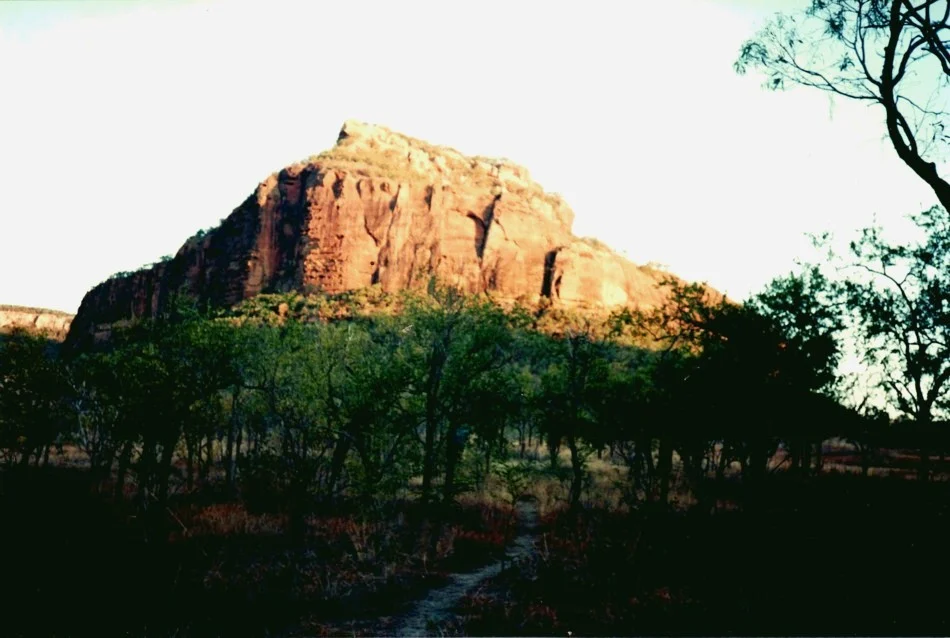

Ngarrabullgan
The Djungan people knew not to sleep here. Ngarrabullgan, the great tabletop mountain the State calls Mount Mulligan, rises west of Cairns as a wall of sandstone eighteen kilometres long, its cliffs falling as much as 400 metres to the plains below. It is a place of power and of danger, home in Djungan understanding to a spirit named Eekoo who can throw sickness into a person, hooks and stones and slivers of wood that leave no mark on the skin. And so for generations the Djungan approached the summit with caution and did not camp upon it. What makes this extraordinary is that the earth itself remembers the same thing.
Among the Oldest Places
On top of the mesa lie two of the oldest known Aboriginal sites in Queensland, Nonda Rock and Ngarrabullgan Cave, where cultural deposits have been dated by radiocarbon and by optically stimulated luminescence to more than 40,000 years ago. Human hands worked stone here while ice still gripped much of the planet. Other rockshelters across the mountain reach back to the close of the last ice age, and together the caves and shelters of Ngarrabullgan form the densest concentration of ancient sites known anywhere in Queensland. To stand among them is to stand inside one of the longest unbroken human stories on Earth, told not in writing but in hearth-ash, ochre, and worked stone.
The Mountain Left to Eekoo
Then, around six hundred years ago, the archaeological record on the summit falls silent. People stopped camping there. For a long time this puzzled researchers, until they recognised that the excavated evidence and Djungan tradition were describing the very same event: a deliberate withdrawal from a place understood to be too dangerous to inhabit. The Djungan tell that Eekoo, to save his own life, drew up the waters of Lake Koongarra on the summit and sheltered within them, and that the lake and the mountain's brooding form are a standing reminder of him. Science and story do not compete here. They confirm one another, an archaeology of the spirit written in stone and in living memory alike.
A World on the Tabletop
Geologically, Ngarrabullgan is an accident of deep time. The land first cracked open along a narrow rift, which filled with Permian coal, then conglomerate, then Triassic sandstone; over millions of years the softer rock around it wore away, leaving this hard massif standing alone above the Hodgkinson Basin. The plateau on top holds its own private world. Wet sclerophyll forest of bloodwood eucalypts crowns the summit, in sharp contrast to the open dry woodland on the plains below. Surveys across thirteen distinct land units have found ten rare or threatened plant species, eight of which grow nowhere else, alongside eight kinds of frog, fifty-five reptiles, ninety-nine birds, and twenty mammal species. Twenty-two of these carry special conservation significance under Queensland or national law. It is a refuge raised above the country around it, an island of cool wet forest floating on a sea of dry savanna woodland.
Gold, Grief, and Recognition
The Hodgkinson River gold rush of 1876 brought catastrophe to the Djungan. As miners and police poured into the district, the local population was decimated, and survivors were pushed to the fringes of settlements at Thornborough and Mount Mulligan. The Djungan remember grandparents fleeing on foot, scaling Ngarrabullgan's escarpments because horses could not follow, and they remember a cave on the mountain's southern side where many of their people were killed and hidden. This grief is part of the mountain too. Today Ngarrabullgan is recognised on the National Heritage List and registered as an Aboriginal cultural heritage area, and the Djungan have long sought to see it declared a national park under their own management, the country once more in the hands of those who have always belonged to it.
From the Air
Located at approximately 16.87°S, 144.75°E, about 100 kilometres west of Cairns. Ngarrabullgan is one of the most striking terrain features in the region: a flat-topped sandstone mesa roughly 18 km by 6.5 km, its sheer escarpments rising up to 400 metres above the surrounding plain. It is unmistakable from the air and a superb visual landmark. Note that the separate 1921 Mount Mulligan coal-mine disaster, which killed 75 men, occurred at the mountain's foot, not on the sacred summit. This is a place of profound cultural significance to the Djungan people; treat it with respect. Nearest major airport is Cairns (YBCS / CNS) to the east; Mareeba (YMBA) lies between. Expect mountain weather, turbulence near the escarpments, and afternoon storm buildup in the Wet.
Nearby Stories
- James Venture Mulligan's Grave 18 km away
- Chillagoe Smelters 19 km away
- Daintree National Park 25 km away
- Rocky Creek World War Two Hospital Complex 32 km away
- Byerstown 55 km away
- Palmer River Gold Company Dredge 95 km away
- The Etheridge Line: The Town That Took a Train Hostage 149 km away
- Georgetown: The Piece of North America in the Outback 180 km away