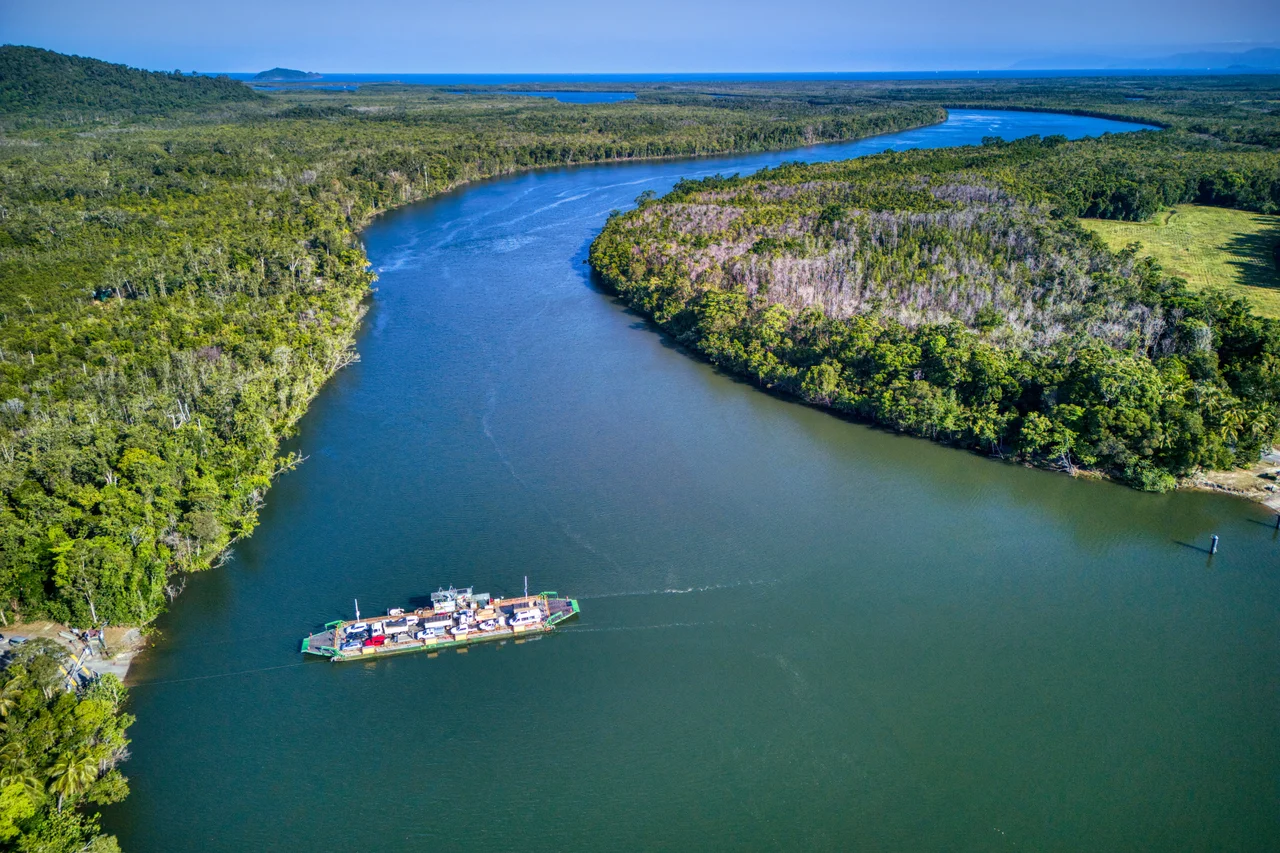

Daintree National Park
There is one coast on Earth where the world's oldest rainforest runs straight into the world's largest reef, and this is it. Daintree National Park drapes the steep green flanks of the Great Dividing Range as it crowds the Coral Sea north of Cairns, a place of such extravagant life that an early explorer predicted it would become 'the gem of Australia.' But the deeper story here is older than any park boundary or colonial survey. This is the country of the Eastern Kuku Yalanji, the Bama, who have lived in and cared for this rainforest for thousands of generations - and who, in 2021, became its legal owners once more.
Country of the Bama
Long before it was a national park, this was - and remains - Eastern Kuku Yalanji country. The Bama people have read this rainforest for millennia: which plants heal, which fruits feed, where the rivers run and the cassowaries pass. At Mossman Gorge, Kuku Yalanji guides lead visitors on Ngadiku Dreamtime walks - 'Ngadiku' meaning stories and legends from long ago - beginning with a smoking ceremony and moving through forest their families have known forever. In September 2021, after years of negotiation, the Queensland government returned roughly 160,000 hectares, including the Daintree, to the Eastern Kuku Yalanji through their Jabalbina Yalanji corporation. It was the first time in Australia that Traditional Owners simultaneously took ownership and joint management of a UNESCO World Heritage Area. Elders wept as country came home.
Two Halves of a Forest
The park comes in two distinct pieces, split by a settled valley of cane farms around the towns of Mossman and Daintree Village. To the south lies Mossman Gorge, the accessible face: a visitor centre, a shuttle bus, and clear cool water tumbling over granite boulders where the brave plunge in. To the north, beyond the cable ferry across the Daintree River, lies the Cape Tribulation section - wilder, harder to reach, and for many the true heart of the rainforest. Here boardwalks thread through lowland jungle, fan palms and mangroves, and the forest tumbles down to empty beaches. Most of the park is steep, trackless rainforest and mountain woodland, left deliberately to itself, a wilderness more glimpsed than entered.
A Cape Named for Trouble
Cape Tribulation carries one of the bluntest place names on the Australian coast, and it came from a very bad night. On 10 June 1770, James Cook's Endeavour scraped a reef off this headland, and hours later ran hard aground on what is now Endeavour Reef, very nearly sinking. Cook named the point Cape Tribulation, he wrote, 'because here begun all our troubles.' The surveyors who followed a century later saw only abundance. George Elphinstone Dalrymple, exploring the coast in 1873, named the Daintree River for his friend the geologist Richard Daintree, and the expedition's botanist Walter Hill pronounced the soil 'first class' and identified a new species of coconut palm. Where the navigator saw peril, the colonists saw a future empire of sugar and farms.
A Refuge of Deep Time
The Daintree is a survivor of staggering antiquity, and that is no accident of luck alone. Its lineage reaches back to the supercontinent Gondwana; as the landmass broke apart, one fragment drifted south to become frozen Antarctica while Australia carried its ancient forests north, and here, in this narrow wet strip, the old climate and the old trees held on. Plants thought long extinct have been rediscovered growing in the gloom. The park shelters more than 430 bird species, among them the wompoo fruit-dove and five other pigeons, alongside Boyd's forest dragon, the giant amethystine python, and a chorus of frogs. Watching mist rise off the canopy at dawn, you are looking at a scene very close to what dinosaurs once moved through - a living window into the deep past of the planet.
From the Air
Daintree National Park spreads around 16.30 degrees south, 145.20 degrees east, along the Coral Sea coast north of the Daintree River, roughly 100 km northwest of Cairns. The nearest major airport is Cairns International (ICAO YBCS), a hub for scenic helicopter and small-plane flights over the reef and rainforest; Mareeba (ICAO YMBA) lies inland to the southwest. From the air the park is unmistakable: a wall of dense green rainforest cloaking steep ranges that fall directly into turquoise water, with the Daintree River winding through and the ribbons of the Great Barrier Reef offshore - the rainforest and the reef meeting in a single frame. Fly the dry season, May to September, for clear skies; the wet brings heavy cloud, downpours and cyclone risk.
Nearby Stories
- Wujal Wujal Aboriginal Shire 7.8 km away
- James Venture Mulligan's Grave 19 km away
- Green Island (Queensland) 28 km away
- Byerstown 29 km away
- Ngarrabullgan 39 km away
- Quinkan Rock Art 50 km away
- HMS Mermaid (1817) 112 km away
- Kapa Kapa Trail 711 km away