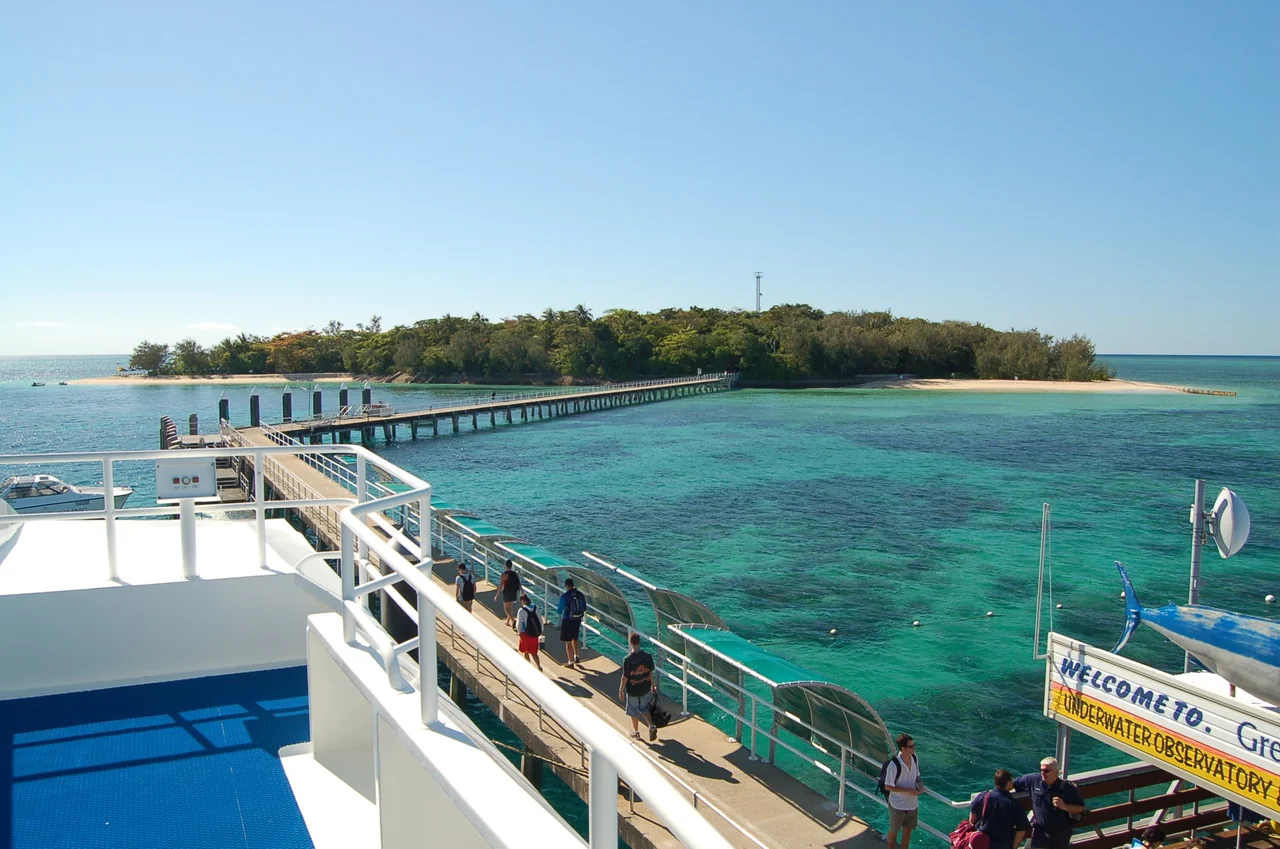

Green Island (Queensland)
Out of roughly three hundred coral cays scattered across the Great Barrier Reef, only one grows a rainforest. Green Island, fifteen hectares of white coral sand and dense green canopy, sits about 27 kilometres off Cairns, and as the catamaran slows on approach the improbability of it comes into focus: a tangle of forest rising from a sandbar in the middle of a turquoise reef. The island is around 6,000 years old, built grain by grain from the broken skeletons of the corals around it, then colonised by seeds carried in on the wind, the water and the feet of birds until a true rainforest took hold. To the Gunggandji people, whose sea country this is, the island is Wunyami - the Place of Spirits.
Where the Reef Built an Island
Green Island is a coral cay, which means it is a creation of the reef itself. For thousands of years, waves ground coral skeletons into sand and piled it on the reef flat until a permanent island emerged, just high enough above the tide to hold soil and roots. What makes it singular is the forest. While the Reef's other cays stay low and scrubby, Green Island grew a closed vine-thicket rainforest dense enough to swallow its boardwalks in shade - the only rainforested cay among all 300. It sits on the northwestern edge of its reef flat, ringed by an inshore patch reef, so the two great ecosystems of tropical Queensland, rainforest and coral reef, meet on a single speck of land you can walk around in 45 minutes.
Wunyami, Place of Spirits
Green Island has carried meaning for far longer than it has carried tourists. The Gunggandji people of the Yarrabah coast have known it as Wunyami for thousands of years, visiting the low cay on sea journeys as a place to rest, to gather, and to reconnect with Country. The name - the Place of Spirits - signals that this was never merely a resource but a place of significance within Gunggandji sea country, the network of reefs, waters and coastlines they have maintained custodianship over for generations. When Europeans arrived, including James Cook who noted the island as he sailed past in June 1770, they were passing a place that was already named, already known, and already woven into a culture that endures.
Reef Within Reach
Green Island's great gift is access. You do not need a boat, a licence or even the ability to swim to meet the Reef here. You can wade off the white sand straight onto coral, where green turtles graze the seagrass meadows that fringe the cay. For those who want to stay dry, the choices are remarkable: a glass-bottom boat that floats over the coral, or the semi-submarine that glides over the reef for those who prefer not to get wet. There is Seawalker helmet diving, where a guide walks you four metres down to the seafloor with a helmet feeding you air, glasses still on and hair still dry. The Reef, usually so hard to reach, is laid out here for anyone.
A Cay That Has Given a Lot
Green Island wears its popularity honestly. It has hosted day-trippers for so many decades that the coral immediately off the main beach has taken a beating, worn by generations of feet and fins - a candid reminder that even paradise has a carrying capacity. Yet the island remains a national park, and step back from the busiest sand and it still delivers: over 120 native plant species crowd the forest, and around 55 species of birds are regularly seen, from seabirds wheeling offshore to the residents of the canopy. The boardwalks lead deep into the vine thicket, away from the resort and the crowds, into a green hush that feels worlds away from the deck chairs a few hundred metres back.
When the Last Ferry Leaves
Green Island has two distinct lives, divided by the ferry timetable. By day it is an adventure playground - snorkellers off the beach, parasailers behind power boats, divers heading to offshore sites, families spreading out across the sand with an esky. Then the last catamaran loads up for the 45-minute run back to Cairns, and the island exhales. The crowds vanish, the few overnight guests have the place largely to themselves, and the cay returns to something closer to what the Gunggandji knew: a small forested island on a vast reef, the water going from turquoise to gold as the sun drops, the birds settling into the trees. The spirits, you imagine, prefer it this way.
From the Air
Green Island lies at roughly 16.76°S, 145.97°E, about 27 km east-northeast of Cairns on the inner Great Barrier Reef. From the air it is unmistakable: a small, near-circular green island set in a pale reef flat, the dark rainforest canopy ringed by white sand and then by the luminous blues and greens of shallow coral water - one of the most photogenic sights on the inner Reef. Best appreciated at 1,000-3,000 ft for the colour gradients of the surrounding reef. Cairns Airport (YBCS / CNS) is about 27 km west on the mainland; seaplane and helicopter scenic flights operate to the island, though landings are limited because it is a national park. Conditions are usually clear, but afternoon sea breezes and wet-season storms (November-April) can reduce visibility and roughen the water.
Nearby Stories
- Djabugay 7.2 km away
- Port Douglas 9.8 km away
- Rocky Creek World War Two Hospital Complex 18 km away
- HMS Mermaid (1817) 28 km away
- Cyclone Yasi 66 km away
- The Great Barrier Reef: The Living Structure Visible from Space - Now Dying 141 km away
- Kapa Kapa Trail 754 km away