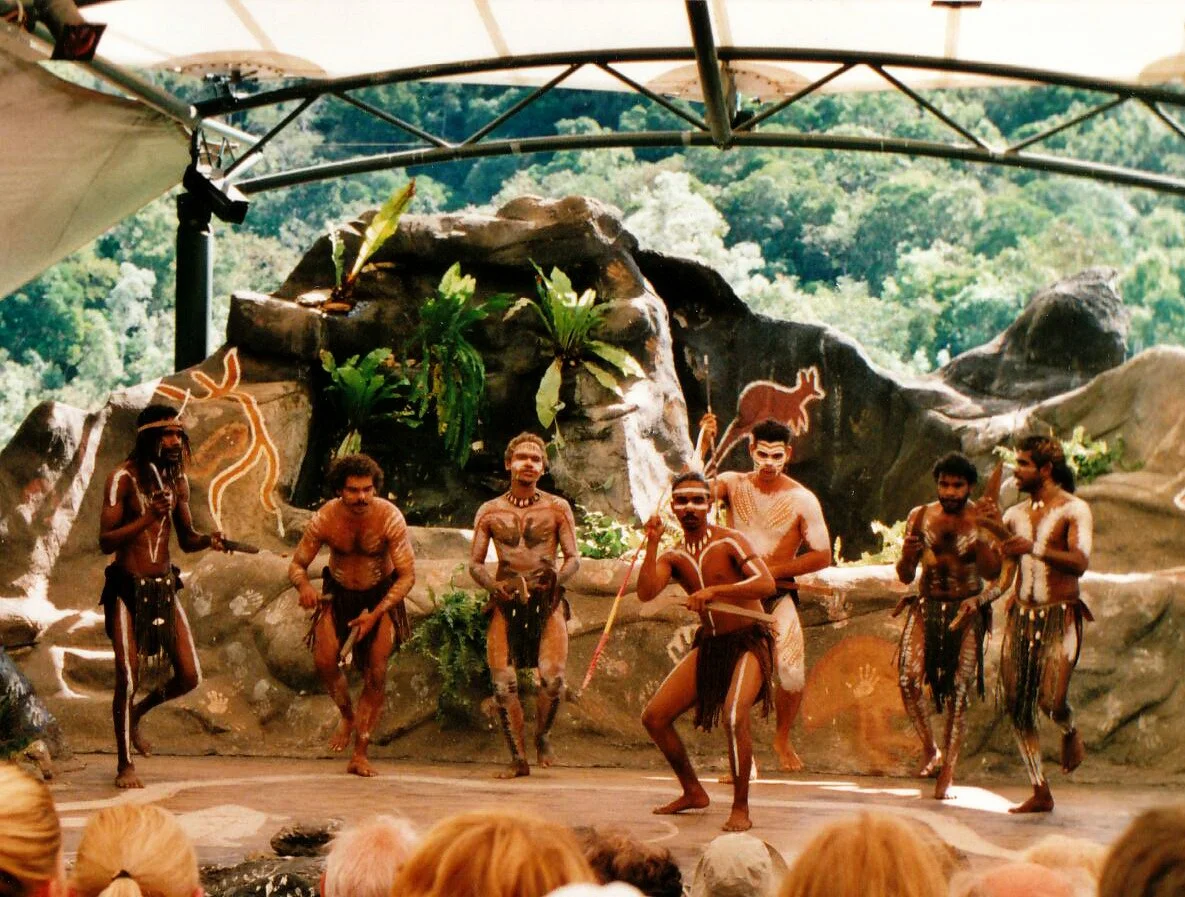

Djabugay
Look at the curve of the Barron River as it winds through the Redlynch Valley below Kuranda, and you are looking at a body. To the Djabugay, those contours are Damarri lying on his back, one of the ancestral brothers who shaped this country at the beginning of things. This is not metaphor. For the Djabugay people, the rainforest of the Barron Gorge is the work and the proof of the ancestral beings, and the land is the law made visible.
The Time Called Bulurru
The Djabugay word for the ancestral times is bulurru. In bulurru the Rainbow Serpent Gudju Gudju moved through the country in the form of a great carpet snake, Budadji, trading with families along the way, dilly bags for coastal shells, and his body carving the landscape as he went, from the Crystal Cascades to Kuranda, down to the coast at Port Douglas, finally coming to rest at Double Island. In one account he was killed by emu men at Din Din, the Barron Falls, and the act unleashed the monsoon rains that drench the region still. The two brothers Damarri and Guyala laid down the contours, made the plant foods, and set the customary law and the marriage system that orders Djabugay society. The land is their record, and the Djabugay read it fluently.
A Language of the Rainforest
Djabugay belongs to the Yidinic branch of the great Pama-Nyungan language family, closely related to neighbouring Yidiny. It carries an unusual distinction: it is one of only three Aboriginal languages, alongside Bandjalang and Maung, known to lack a grammatical dual form. The last speaker with deep command of the language, Gilpin Banning, has passed, but Djabugay is not silent. It survives in place-names that map the gorge, in cultural work around Kuranda, and in the voices of descendants reclaiming words their grandparents spoke. The Djabugay call themselves Bama, the people, of the coastal rainforest, and that name still holds.
The Land Taken
The coming of the settlers was catastrophic. From the late 1870s, parties moved into Djabugay country clearing land for gold and tin, and the colonial record uses the word dispersal, a euphemism that hid the killing of Aboriginal people behind a clean bureaucratic term. There were dispersals at Smithfield in 1878 and near Kuranda and Mareeba in the early 1880s. When the railway pushed up from Cairns in 1886, laid in places over Djabugay walking tracks, the people resisted, spearing bullocks and confronting the newcomers as their hunting grounds were seized. The reprisals were brutal, culminating in the Speewah massacre of 1890, when the pastoralist John Atherton sent native troopers against the Djabugay to avenge the killing of a single bullock. Many survivors were then forced onto the Mona Mona mission, barred from hunting, fishing, or moving freely across their own country, and their numbers collapsed at the turn of the century.
Holding the Country
And yet the Djabugay endured. The musician David Hudson, a Djabugay man of Kuranda, carried Djabugay sound and the didgeridoo to audiences around the world. The deepest vindication came on 17 December 2004, when the Federal Court recognised that native title still existed for the Djabugay over the Barron Gorge National Park, the first national park in Queensland to be returned in this way. The judge, weighing the claim, paused over the concept of bulurru and accepted that for the Djabugay the storyplaces and storywaters of the gorge are tangible proof of an inalienable bond between people, ancestral beings, and land. The court had reached, in its own legal language, the truth the Djabugay had held all along: this country is theirs, and always has been.
From the Air
Djabugay country covers the rainforested ranges of the Great Dividing Range around Kuranda and the Barron Gorge in the Wet Tropics of Far North Queensland, centred near 16.83 degrees S, 145.50 degrees E, just inland and northwest of Cairns. From the air the signature landmark is the Barron Gorge itself, with the Barron Falls plunging through dense green rainforest, and the Barron River winding through the Redlynch Valley toward the coast. The Wet Tropics see heavy cloud and rain, especially the November-to-April wet season; clearest flying is May to September, though gorge mist is common at dawn. Cairns Airport (YBCS) sits about 15 to 20 km east, making this one of the most accessible Aboriginal cultural landscapes in tropical Queensland; the historic Kuranda Scenic Railway and Skyrail cross the gorge below.
Nearby Stories
- Green Island (Queensland) 8.5 km away
- St Mary's by the Sea, Port Douglas 11 km away
- Ngarrabullgan 13 km away
- Rocky Creek World War Two Hospital Complex 18 km away
- Chillagoe Smelters 36 km away
- HMS Mermaid (1817) 45 km away
- Byerstown 56 km away
- Kapa Kapa Trail 768 km away