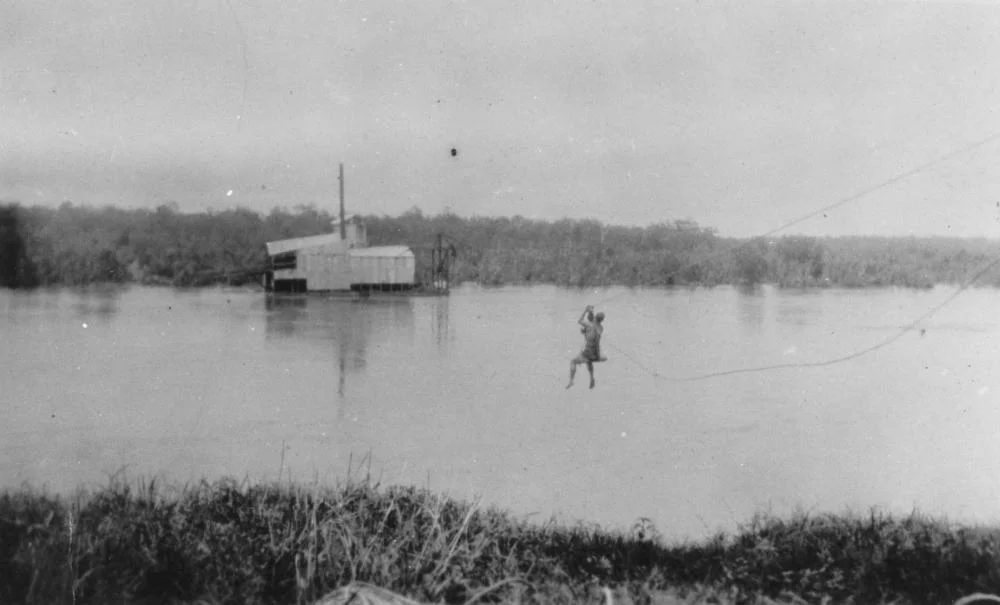

Palmer River Gold Company Dredge
Somewhere in the middle of the Palmer River, where the channel spreads more than 400 metres wide, a steel ghost rises from a sandbar. It is the skeleton of a gold dredge, its bucket ladder and stacker still recognisable, its pontoon corroding quietly at the waterline after more than ninety wet seasons. Getting it here in the first place was an act of stubborn engineering: 350 tons of machinery shipped to Cooktown, railed to Laura, then trucked 133 kilometres over the Great Dividing Range on six-wheeled Morris and Thornycroft lorries, much of the road built by the company itself just to deliver the thing.
A Calculated Gamble
By the 1920s the wild alluvial rushes of the Palmer were long over, but the Cairns-based Palmer River Gold Company believed there was still treasure in the gravel. The company took up ground between Frome and Strathleven and estimated some 2.6 million cubic metres of auriferous material waited in the riverbed, gold locked in rock and sand. It was the kind of figure that raised capital and built dredges. The reality, as it so often is in mining, proved harsher than the prospectus. After four years of grinding work the yields came in at less than a quarter of what had been promised. In all, between 1926 and 1935 the operation won just 3,584 ounces of gold from the river it had fought so hard to reach, a fraction of the fortune the prospectus had imagined. It was, in the end, a very expensive way to learn how little gold the gravel still held.
Built in the River
The dredge was an all-steel bucket machine, fabricated by Chas. Ruwolt of Richmond in Victoria and assembled on site under consulting engineer William Condron and general manager Walter Baker. It was a serious piece of equipment: a 37-metre length from the head of the bucket ladder to the tail of the stacker, a chain of thirty-one buckets each holding five cubic feet, and a rated appetite of 50,000 cubic yards of gravel a month. Steam drove the whole apparatus, a twin-cylinder engine turning the cog-train that hauled the endless chain of buckets up out of the riverbed to be washed and sorted. Dredging began at the end of December 1930, the machine biting into the Palmer just as the wet season closed in around it.
The River Wins
On a river like the Palmer, the wet season is not a hazard to be managed but a force to be survived. A photograph from 1932 in the John Oxley Library tells the story plainly: the dredge sits partly submerged, swamped and battered by floodwaters. The exact date it stopped working and was finally abandoned was never recorded, simply left to the river. The Palmer reclaimed it slowly, burying the boiler and much of the hull beneath a high sandbar, scattering a winch drum, a camshaft, a chimney section, and thirteen of its buckets across the riverbed and the eastern bank. Five hundred metres upstream, the company's old campsite still marks where the crew once lived.
The Oldest of Its Kind
What makes this rusting hulk worth protecting is precisely that it endured. It is the earliest surviving steam dredge in Queensland, and possibly in all of Australia, a rare physical record of how alluvial gold was chased in the 1920s before diesel and electricity changed everything. Heritage assessors note that its survival, after more than sixty years of annual flooding by the full force of the wet, is itself a testament to how it was built. The maker's marks endure on the steel: a W. H. Allen gravel pump from Bedford, England, stamped Conqueror 14; superstructure beams from Dorman Long of Middlesbrough. The dredge failed at its only job, yet it has outlasted nearly everything built to outlive it.
From the Air
Located at approximately 15.90°S, 143.53°E on the Palmer River near Strathleven, Shire of Cook, west of Cooktown. The dredge sits mid-channel in a river over 400 metres wide; from low altitude look for the broad sandy braided riverbed cutting through dry savanna and ranges. The wreck is partly buried and best seen in the Dry when sandbars are exposed. Nearest major airport is Cairns (YBCS / CNS) well to the southeast; Cooktown (YCKN / CTN) lies to the northeast, with the small airstrip at Laura the nearest ground reference inland. Expect remote terrain, sparse landmarks, and flooded river country in the Wet (roughly December to April).
Nearby Stories
- Laura to Maytown Coach Road 20 km away
- Old Laura Homestead 47 km away
- OK Mine & Smelter 49 km away
- Cape York Peninsula 72 km away
- Musgrave Telegraph Station 97 km away
- Mungana Archaeological Area 133 km away
- Aboriginal Shire of Kowanyama 152 km away
- Delta Downs Station 210 km away