_(2003).jpg)
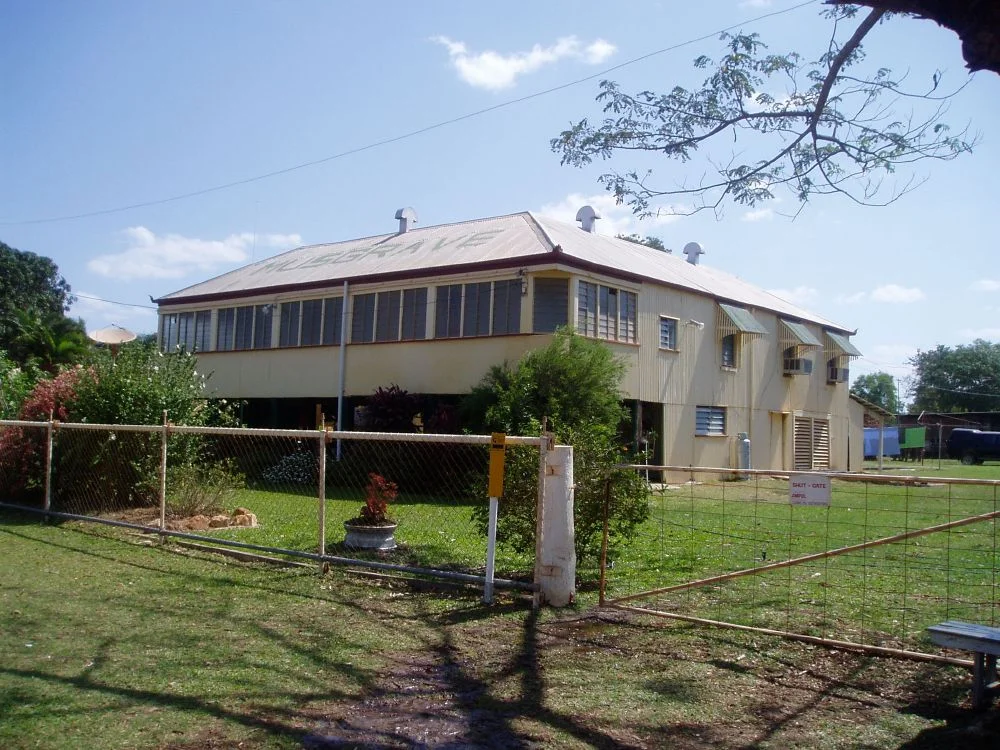
Musgrave Telegraph Station
The word MUSGRAVE is still painted in faded green across the roof, large enough to read from a passing aircraft, which was once the point. For travellers grinding north up the Peninsula Developmental Road, the high-set timber building with the mango tree out front means fuel, a cold drink, and the first roof in a hundred kilometres. It is the Musgrave Roadhouse now. But this corrugated-iron building was once a link in a thin copper thread that ran more than five hundred kilometres up the spine of Cape York Peninsula, and of the seven stations built to keep that thread alive, it is the only one left standing.
The Wire to the Top of Australia
In the 1880s, Queensland decided to run a telegraph line to the very tip of the continent. The Cape York Telegraph Line was surveyed in 1883 and pushed north from Laura toward Thursday Island in the Torres Strait, one of the outstanding feats of the colony's communications era. The first 200-mile section, Laura to Mein, was finished in October 1886; a further 192 miles to Paterson followed in 1887. The line itself was almost absurdly simple for the distance it covered: a single galvanised-iron wire strung along the apex of steel poles imported from England. Through it, isolated camps and missions on the peninsula could suddenly reach Cooktown and the southern capitals in minutes instead of weeks. It tied the far north into Brisbane's reach, carried messages toward British New Guinea and the Torres Strait, and in time was judged vital to the colony's defence.
Built for a Frontier War
Between 1884 and 1887 the colonial government erected seven near-identical timber telegraph offices along the route, pre-cut in Brisbane and assembled on site at Fairview, Musgrave, Coen, Mein, Moreton, McDonnell, and Paterson. Musgrave, named for the serving governor Sir Anthony Musgrave, opened on 23 December 1886. These were not ordinary post offices. They were designed for a frontier in which the colonists expected armed conflict with the Aboriginal people whose land the line crossed, and the design said so plainly: sliding shutters over the verandah windows, the living quarters set behind an internal verandah, the building raised high on stumps, a corrugated-iron fence around the yard, and gun posts at two diagonal corners. The chamfered northeast corner of the surviving verandah still marks where one of those gun posts stood. Years later, when the colonists no longer feared attack, the posts were turned into bathrooms or pulled down, the architecture of a frontier quietly repurposed once the frontier had moved on.
Two Graves Under the Mango Tree
Like every remote station, Musgrave kept its own dead close. Two graves lie near the great mango tree that now serves as the roadhouse's entrance marker. One belongs to Sam Thompson, the lineman in charge here, killed in a fall from a horse around the turn of 1918 into 1919 and buried beneath the tree. Nearby, in an unmarked patch of raised gravel, lies Billy Beirne, a mail contractor and pack-horseman who retired to Musgrave and died there. Both were local identities, the kind of men who made a remote line work by knowing every mile of it. The mango tree and the graves are themselves listed as heritage, small human anchors in an enormous, empty landscape.
The Last One Standing
The telegraph era ended quietly. On 22 June 1929 the offices at Musgrave, Mein, and McDonnell were closed, the operators withdrawn, and the buildings sold off. Musgrave stayed where it stood and became a station homestead, then the roadhouse it is today, halfway between Cairns and Weipa and 136 kilometres north of Laura. Every other office on the Cape York line has been demolished. Musgrave alone remains, the single surviving witness to the wire that first connected the top of Australia, its route still legible in the long red line of the Peninsula Developmental Road that now follows much the same path the poles once did.
From the Air
Musgrave Telegraph Station sits at 14.783 degrees south, 143.485 degrees east, deep in central Cape York Peninsula on the Peninsula Developmental Road at the Lilyvale Road junction, roughly 136 km north of Laura and about halfway between Cairns and Weipa. From the air it is a tiny cluster of buildings beside the unmistakable straight cut of the peninsula road, with a cleared strip alongside that doubles as an airstrip; the MUSGRAVE name on the roof is a navigation aid in itself. The station has its own airstrip, and the nearest sizeable airfields are at Coen (ICAO YCOE) to the north and, far to the south, Cairns (YBCS). This is genuinely remote country with minimal services; fly it in the dry season, May to October, when the unsealed roads and airstrips are usable and the wet-season storms have cleared.
Nearby Stories
- Cape York Peninsula 19 km away
- Old Laura Homestead 42 km away
- Bathurst Bay 45 km away
- Princess Charlotte Bay 46 km away
- Cape Melville 85 km away
- Palmer River Gold Company Dredge 87 km away
- Aboriginal Shire of Kowanyama 150 km away
- Wenlock Goldfield 168 km away