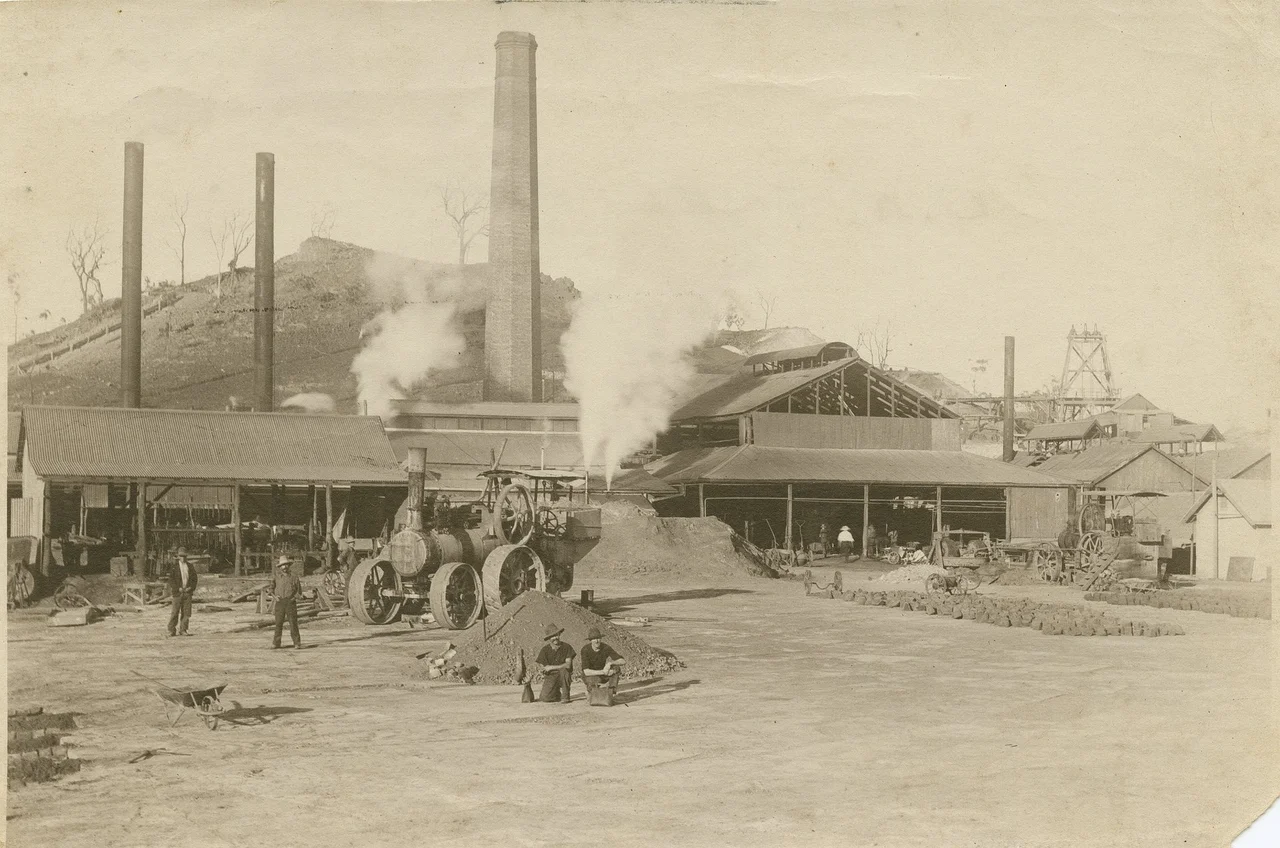
OK Mine & Smelter
The name came from an empty jam tin. When prospector John Munro struck rich copper carbonates on a low hill north of the Chillagoe field in September 1901, he reached for the closest label he could find and christened the place OK. It was an offhand christening for what became, briefly, one of the most important copper operations in North Queensland. More than a century later the bush has nearly swallowed it, but an octagonal brick chimney still stands against the sky, and beside it lies a vast, eerily symmetrical heap of black slag, the frozen residue of furnaces that ran hot for less than a decade.
First to Pay
Munro had assayed his ore at an extraordinary 34 percent copper, and the OK Copper Mines Development Syndicate moved fast. By 1905 the company achieved something no copper outfit in North Queensland had managed before: it declared a dividend, five shillings a share, the first of its kind on the entire Walsh and Tinaroo field. The secret was discipline. Rather than overbuild on optimism, the syndicate carefully matched its spending on smelters and machinery to the ore it could actually prove underground. By 1906, with two new Babcock and Wilcox boilers, fresh winding gear, and 250 men on the payroll, OK looked like the future of copper in the north.
The Chimney and the Furnace
Smelting copper is filthy, poisonous work, and in 1907 the company built the octagonal brick chimney that still defines the site, raising it tall to carry the harmful fumes up and away from the men below. That same year the English engineer Keith Maitland-Gibson, seasoned by American experience, drove a major expansion: a water-jacket furnace, a Bessemerising converter, and doubled boiler capacity that pushed the smelter to ninety tons. The reward was blister copper, almost pure, poured from the heart of the works. The technology was state of the art for its moment, and the surviving slag dump stretching 120 metres toward the creek is its monument, one of the most intact in North Queensland.
The Ore Runs Thin
Copper mining lives and dies by two numbers: the world price and the grade in the ground. Both turned against OK almost at once. The boom prices of 1906 and 1907 collapsed within months, and below 150 feet the rich carbonates simply gave out. Output sagged, strikes flared over wages, and a bruising contract dispute with the German firm Aaron Hirsch and Sons ended in a Brisbane court judgment against the company. The smelters went cold in June 1910, and the town went with them. In its final year of full operation, the works had to wring gold and silver as well as copper from the ore just to stay viable, smelting more than 14,000 tons for a thinning return. An attempt to revive the operation in 1912 failed because the flooded shafts could not be pumped dry. The traction engines were sold off and scattered across the Atherton Tableland to haul timber and ore for other men, and in 1920 a cyclone tore through what was left of the mine and store buildings.
What the Bush Keeps
Mining never quite lets go. The First World War sent copper prices soaring again, and in 1930 the OK mine reopened to feed the state smelters at Chillagoe before closing for good in 1942. What survives now is a study in industrial archaeology: four terraces cut into the hillside and held by stone walls, copper converter vessels and hoods resting on the copper floor, and a hulking Aveling and Porter steam traction engine left where it stood, a monument to the sheer difficulty of moving ore through this country. An intact Pooley and Sons weighbridge still sits beside the slag. The octagonal stack, scarred near the top by lightning, remains one of only three such chimneys recorded in the north.
From the Air
Located at approximately 16.60°S, 144.25°E in the Chillagoe district hinterland, Shire of Mareeba, west of Cairns. The site sits in dry tropical savanna woodland at the base of a low hill; the most visible landmark from low altitude is the tall octagonal brick chimney and the dark slag dump beside it. Nearest major airport is Cairns (YBCS / CNS) to the east; smaller strips serve Chillagoe and Mareeba (YMBA). Expect hot, hazy conditions and savanna smoke in the Dry, and thunderstorm activity in the Wet. Terrain is gentle but remote, with few ground references and limited services.
Nearby Stories
- Mungana Archaeological Area 26 km away
- Mount Mulligan Mine Disaster 27 km away
- Maytown 33 km away
- Daintree National Park 38 km away
- Mbabaram language 54 km away
- Palmer River Gold Company Dredge 57 km away
- Georgetown: The Piece of North America in the Outback 161 km away
- Cape York Peninsula 198 km away