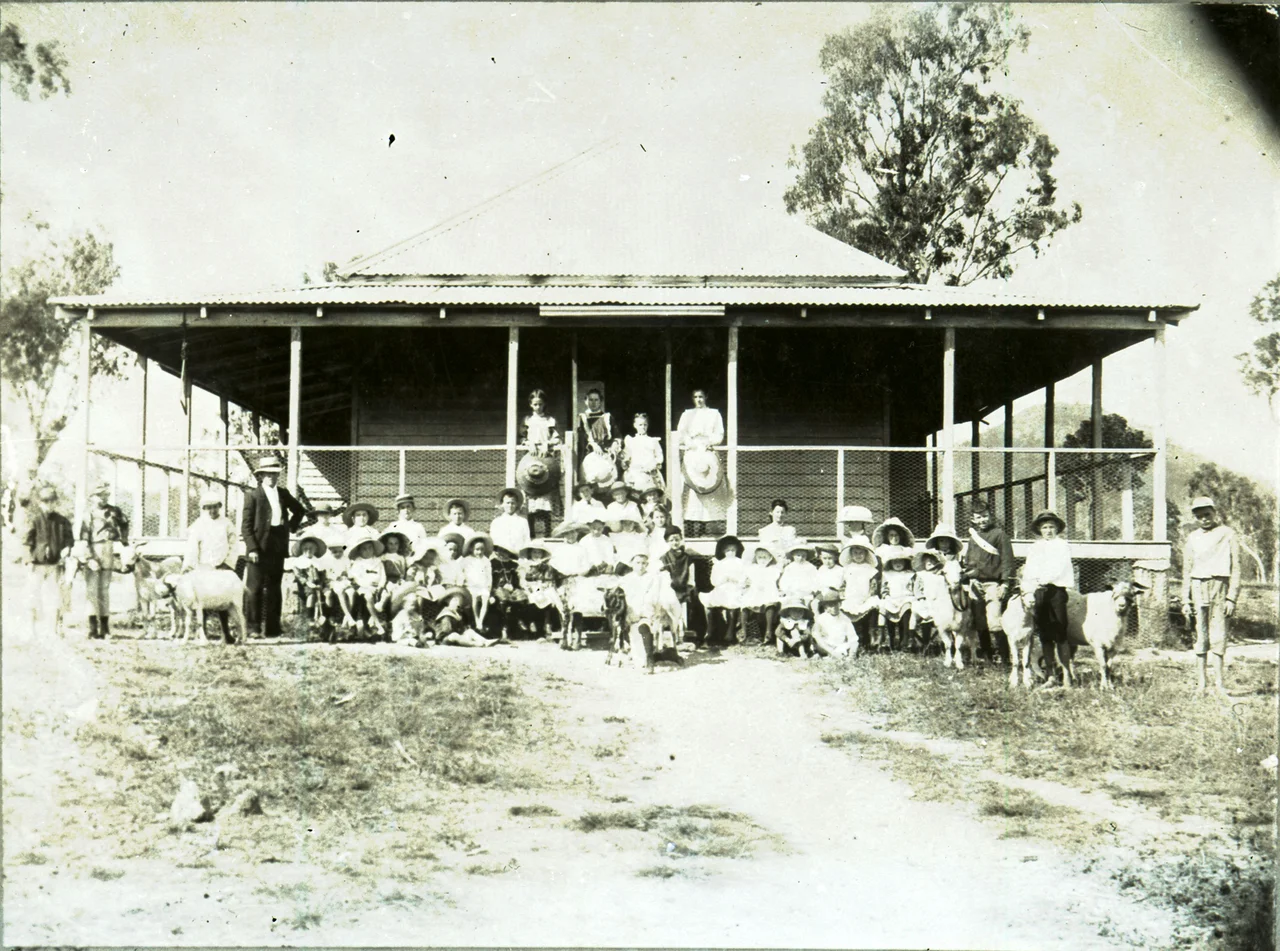

Maytown
In May 1877 there were nearly twenty thousand people on the Palmer River goldfield, and Maytown was its beating heart. Twelve hotels lined its streets, along with stores and bakers and tobacconists, a lemonade factory, a surgeon, and a Chinese temple but no Christian church. Today there is almost nothing. Maytown is a ghost town, reachable only by a punishing four-wheel-drive track, its grand main street reduced to flagstone footings and bush. The gold that built it has long since washed away, but the human story it left behind is one of the most charged on the Australian frontier.
The Rush
It began in August 1873, when the prospector James Venture Mulligan brought word of rich gold on the Palmer River. The news detonated. Within months, somewhere between twenty and thirty thousand people were making their way north toward the field or the new port of Cooktown. The Palmer was hailed as a 'poor man's diggings', a field where a digger with no capital and little experience might still strike it rich on the alluvial gold lying loose in the gravel. Most lived in shifting canvas camps that sprang up and vanished along the river. Maytown, surveyed in 1875, was the camp that stuck, becoming the administrative and commercial centre of the whole goldfield.
This Was Always Kuku-Yalanji Country
The diggers arrived on land that already belonged to the Kuku-Yalanji and neighbouring peoples, who had lived along these rivers for thousands of years. The gold rush was, from the other side, an invasion, and the Kuku-Yalanji met it with fierce and sustained resistance, fighting a campaign across the ranges that contemporaries likened to guerrilla warfare. Frontier accounts dwelt on the danger Aboriginal people posed to miners, yet the records tell a quieter truth: a digger was far more likely to die of drowning, snakebite, or a fall from a horse than at Aboriginal hands. The violence ran hardest the other way, against people defending the country that had always been theirs.
The Chinese on the Palmer
From 1874 the goldfield drew one of the largest Chinese populations in Australian history. Within a few years more than twenty thousand Chinese immigrants had arrived on the Palmer, most from Guangdong in southern China, reworking ground the Europeans had abandoned with a patience and skill that often turned a profit where others had walked away. They built their own community, with stores, gardens, and the temple that stood where no church did. They also faced suspicion and hostility from European diggers and the colonial state, caught in a frontier where three peoples, Aboriginal, European, and Chinese, collided along a single river. By 1900, when Maytown had dwindled to 674 souls, 422 of them were Chinese and only 252 European.
What the Bush Took Back
Maytown's fortune was always built on movement, not permanence. Even at its height, with money pouring through the commercial houses, almost nothing was invested in lasting buildings. The mining warden Philip Frederic Sellheim, a settled family man, despaired of the lack of institutions and pushed for a hospital, a school, and a Miners' Institute library, but these arrived only in the 1880s, by which time most of the population had already drifted away to the next strike. By the turn of the century a few institutions had finally taken root: a savings bank, a state school, a courthouse, a hospital, and eight stores, four of them Chinese-run. But it was a long fade. By the 1920s the town was finished. The reefs that fed it gave out, the people scattered, and the bush moved back in. All that remains now are stone footings, flagstone floors, and the long, rough Laura to Maytown coach road that once carried a whole world to its door.
From the Air
Located at approximately 16.05°S, 144.28°E on the Palmer River goldfield, Shire of Cook, southwest of Cooktown and inland from Laura. The ghost town site sits in rugged dry savanna and broken ranges along the upper Palmer River; there are few visible structures from the air, but the river channels, old coach road, and surrounding gold-country ridges provide reference. Nearest major airport is Cairns (YBCS / CNS) to the south-southeast; Cooktown (YCKN / CTN) lies to the northeast, with the small strip at Laura the closest ground landmark. The area is extremely remote, accessible by ground only via rough four-wheel-drive tracks in the Dry. Expect savanna haze in the Dry season and flooded, impassable country in the Wet.
Nearby Stories
- Quinkan Rock Art 11 km away
- Nuggety Gully Water Race and Chinese Camp 15 km away
- OK Mine & Smelter 30 km away
- Palmer River Gold Company Dredge 34 km away
- Kalkajaka National Park 45 km away
- Mount Mulligan Mine Disaster 56 km away
- Musgrave Telegraph Station 120 km away
- Georgetown: The Piece of North America in the Outback 219 km away