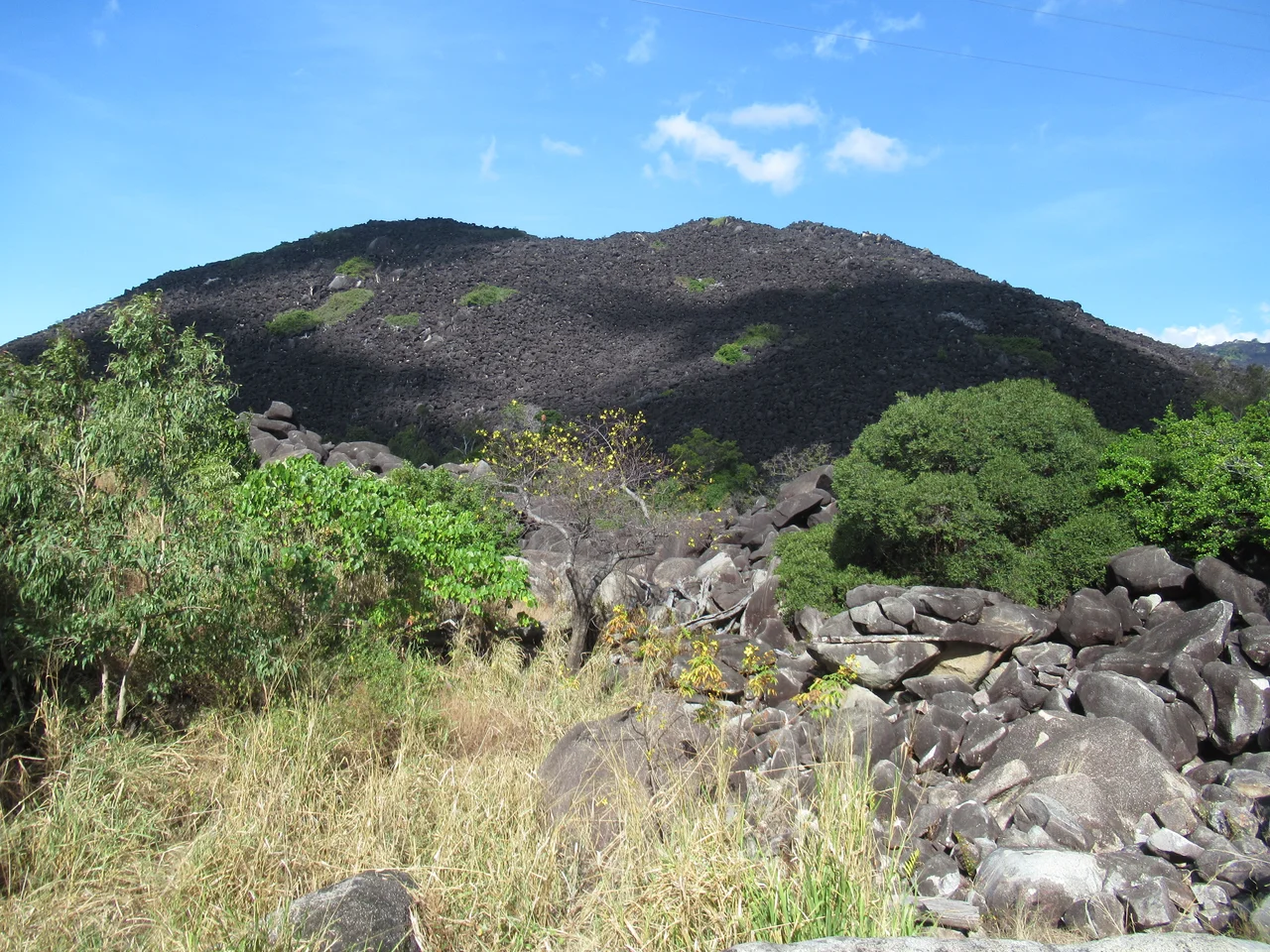

Kalkajaka National Park
Most mountains are green here. This one is black. South of Cooktown, where the surrounding ranges wear the dense forest of the wet tropics, Kalkajaka rises as a vast heap of dark granite boulders — some the size of houses — stacked into a brooding pyramid that seems to absorb the light. The blackness is alive: a film of algae and lichen coating grey stone, darkening in the heat. To the Kuku Yalanji, whose country this is, the name means "place of the spear," and the mountain is not a curiosity or a backdrop. It is one of the most spiritually powerful places in their world, and it asks to be understood on their terms.
A Place of Deep Law
For the Eastern Kuku Yalanji, Kalkajaka is sacred ground and a source of many Dreaming stories — a place where powerful ancestral beings reside and where the country's law is felt at full strength. The mountain holds named sites of profound significance. Kambi is a great rock with a cave where flying-foxes gather. Julbanu is a boulder shaped like a grey kangaroo, gazing toward Cooktown. Birmba faces toward Helenvale. And Yirrmbal, near the foot of the range, is a taboo place — somewhere the law says you do not go. These are not scenic features with quaint legends attached. They are part of a living spiritual landscape, cared for and respected by the people who have belonged to this country since the Dreaming, and that belonging continues today.
Why the Mountain Is Feared and Honoured
Outsiders have long fixed on the stories of people who entered the boulders and never came out — travellers, stock, and those who went searching for the missing, all said to have vanished. Told as ghost-story entertainment, those tales miss the point entirely. To the Kuku Yalanji, the danger of Kalkajaka is real because the place is sacred and powerful, charged with the presence of ancestral beings and bound by law that governs who may approach and how. The fear and the reverence are the same thing. This is a mountain that commands respect, not a haunted house to be dared. The honest response to Kalkajaka is the one its custodians model: keep your distance, lower your voice, and recognise that some places hold a power that was never yours to test.
A World Made of Stone
The geology is genuinely strange. Beneath the dark skin, this is grey granite, shouldered up and weathered over hundreds of millions of years into a chaos of stacked boulders with almost no soil between them. The gaps form a maze of passages and voids running deep into the mountain, and on a hot day the exposed rock can become searingly hot to the touch. The boulders are dangerously unstable — rain can cause them to fracture and shift, sometimes splitting with the crack of a gunshot. There are no walking tracks, no picnic grounds, and camping is not permitted; the park is experienced from a viewing platform with interpretive displays, which is exactly as close as a place this sacred and this physically perilous should be approached.
The Mountain's Own Creatures
Life that adapted to this furnace of black stone exists nowhere else on the planet. Kalkajaka is the sole home of three remarkable species, each found only in these boulders. The Black Mountain boulderfrog shelters deep in the cool, moist crevices, riding out the heat in the dark heart of the rock. The Black Mountain skink — slender and long-limbed, black in shadow but glinting green in sunlight, a golden stripe down its spine — darts across the burning surfaces. And the Black Mountain gecko, mottled purple-brown and large-eyed, emerges only at night to hunt across the stone with uncanny agility. They are the mountain's true residents: tiny, vulnerable, and perfectly fitted to a place almost nothing else can endure.
From the Air
Kalkajaka (Black Mountain) lies at 15.67°S, 145.23°E, roughly 25 km south of Cooktown and visible from the Mulligan Highway. It is unmistakable from the air: a dark, almost black mass of bare granite boulders standing out sharply against the surrounding green ranges and woodland — one of the most distinctive natural landmarks in the region. The 781-hectare park has no facilities beyond a roadside viewing platform. Nearest airport is Cooktown (YCKN, runway 11/29), the regional Cape York gateway just to the north; Cairns (YBCS, international) lies well to the south. Clearest views are in the dry season; wet-season cloud and haze can mute the mountain's striking contrast. This is a profoundly sacred Kuku Yalanji site — observe from altitude and a distance, with respect.
Nearby Stories
- Mount Pieter Botte 8.4 km away
- Grassy Hill Light 13 km away
- Byerstown 14 km away
- Old Laura Homestead 44 km away
- Quinkan Rock Art 47 km away
- Green Island (Queensland) 85 km away
- HMS Mermaid (1817) 168 km away
- Kapa Kapa Trail 654 km away