.jpg)
Casa Grande, Mount Isa
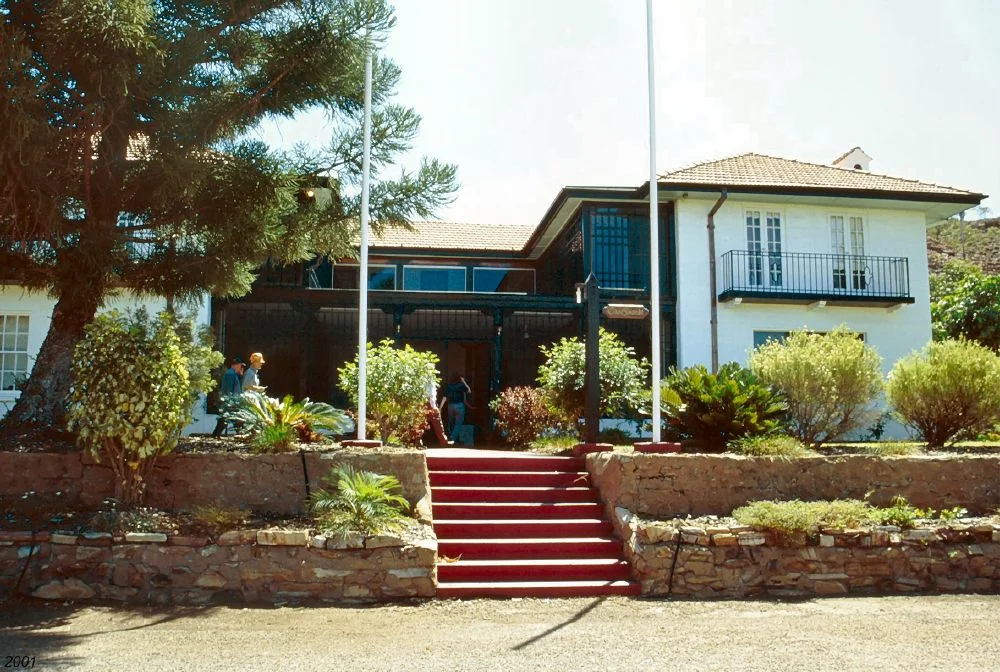
The name says everything. Casa Grande - 'big house' - is the phrase miners in Arizona and New Mexico used for the home of the boss, and the man who built it on this rise above Mount Isa had spent years in exactly that country. White stuccoed walls, terracotta tiles, balconies and a shaded courtyard: a piece of the American Southwest set down on a baking ridge in northwest Queensland, looking out over the mine that paid for it. In a company town, a house can be an argument about who matters, and Casa Grande makes its case in stucco and cedar.
The Manager's House
Work began in 1949 on a home for Julius Kruttschnitt II, then General Manager of Mount Isa Mines. He had come to the struggling field back in 1930, an American steeped in his country's mining industry, charged with reviving a venture that could barely meet its bills - and over two decades he had helped turn it around. The grand house was his reward and his statement. He brought in the prominent Brisbane firm of Donoghue, Cusick and Edwards, but the design carried the imprint of his own years in Arizona and Mexico: Spanish Mission style, built of six-inch Denaro bricks, U-shaped around a courtyard ringed by verandahs on roughly hewn timber posts. An annual New Year's Eve punchbowl party was one of the rituals the Kruttschnitts hosted within these walls.
A Symbol on the Hill
Casa Grande was never meant to blend in. It stands on a rise, deliberately, a landmark overlooking the mine and the modest houses of the Mineside settlement clustered below. Around it spread well-kept grounds, an encircling drive, a tennis court, and gardens so luxuriant they seemed almost an affront to the arid country all around - greenery as a display of what the company could summon in a place where water was precious. The contrast was the point. The grandeur and elevation announced the social standing of the man who ran the mine, the distance, in every sense, between the manager on the hill and the workers in the valley.
Fit for a Queen
When Kruttschnitt resigned as Chairman of Directors in 1952 he did not go home to America but settled in Brisbane, in another house he called Casa Ita. George Fisher succeeded him and lived at Casa Grande with his family until 1966, refurnishing the place - and much of that furniture remains today. After 1966 the house became a guest residence for visiting company directors and VIPs. The grandest guest came in 1970, when Queen Elizabeth II visited Mount Isa: a suite was redecorated and refurnished for her, and the company commissioned a dining table whose top was cut from a single piece of cedar. The 'big house' had risen, briefly, to host a monarch.
What the House Remembers
Casa Grande was built at a turning point. It went up just as Mount Isa Mines paid its first dividend, the company emerging from years of struggle into real prosperity; by 1955 MIM was the largest mining company in Australia, with an international reputation. The house froze that moment in stucco. Added to the Queensland Heritage Register on 28 May 1999, it survives in excellent condition, its later additions mostly sympathetic to the original design. To walk its grounds now is to read the social order of a vanished company town - the careful hierarchy of a place where the mine was everything, and where the man who ran it lived, quite literally, above it all.
From the Air
Casa Grande sits at roughly 20.74 degrees south, 139.48 degrees east, on Nettle Street in Mount Isa, perched on a rise overlooking the Mount Isa Mines lease in northwest Queensland. From the air, look for a white, U-shaped, two-storey villa with a red terracotta roof and green gardens standing out sharply against the surrounding red ridges and the industrial sprawl of the mine to its south. Mount Isa Airport (ICAO YBMA, elevation 342 m / 1,121 ft) lies a short distance west of the city. The terrain is rugged and arid; visibility is typically excellent in the dry season, with summer storms and smelter haze the main considerations.
Nearby Stories
- Mary Kathleen, Queensland 16 km away
- Quamby 38 km away
- Mount Cuthbert Township and Smelter 71 km away
- Kuridala Township site 73 km away
- Moonah Creek Hanging Tree 82 km away
- Camooweal Caves National Park 82 km away
- Community Hall, Camooweal 113 km away
- Glenormiston Station 222 km away