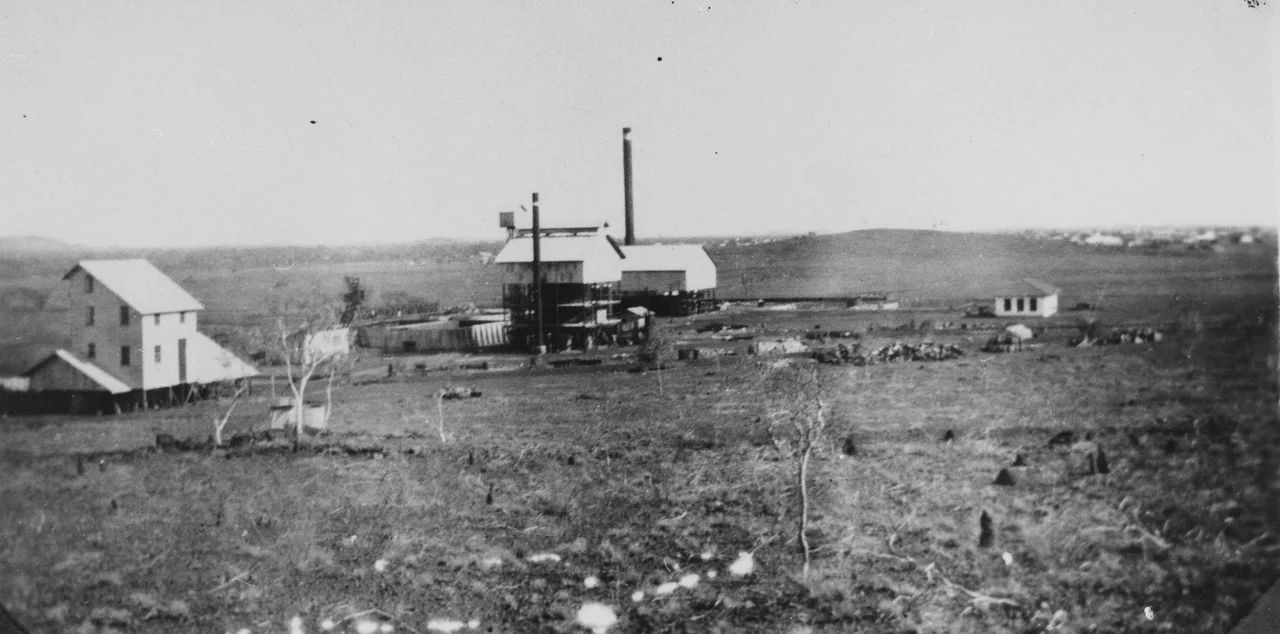
Mount Elliott Company Metallurgical Plant and Mill
It was finished in April 1927, the first plant of its kind anywhere on Earth, and it never produced a gram of copper. On the outskirts of Cloncurry, beside the Great Northern railway, the Mount Elliott Company had just completed an experimental electrolytic treatment works built to a process no one had ever tried at scale. The crushers were ready, the roasting furnace stood waiting, the lead-lined electrolytic cells were plumbed and primed. Then a cable arrived from London. Shut it down, it said, without even a trial run. The numbers no longer worked. And so the boldest metallurgical gamble in the Cloncurry copper field went cold before its first day of work.
Corbould's Vision, Twenty Years Late
The plant was the last act of a long corporate drama. Back in 1909, the metallurgist William Henry Corbould had imagined consolidating the scattered, squabbling mines of the Cloncurry field under a single rational operation. It took until 1926 for that dream to arrive, when the Mount Elliott Company finally absorbed its old rival Hampden Cloncurry and gained control of virtually the entire copper field. But the victory was hollow. Funds were exhausted and copper prices had slumped. To squeeze value from the district's low-grade ores, the company staked everything on an untested idea: a new form of electrolytic smelting invented by Henry Squarebrigs Mackay, who came out from London to supervise construction himself.
A Machine Made of Concrete and Lead
What rose at Cloncurry was less a building than an industrial experiment cast in concrete and steel. A six-metre Mackay wedge furnace, fed gas by a Wilson pressure producer, roasted the crushed ore across seven hearths inside a steel shed twelve metres high. Beside it sat reinforced-concrete leaching vats and solution tanks, where chemistry rather than fire would coax the copper from the rock. The heart of the works was a two-storey steel hall holding twenty-four wooden tanks, each lined with lead and packed with electrolytic cells, cathodes, and anode bars. It was meant to start small, a thousand long tons a year, then grow into the centralised plant that would finally serve every mine Corbould had gathered.
Killed by Arithmetic
The plant died for the most ordinary of reasons: it cost too much and promised too little. Construction had run over budget, and the directors in London concluded that a thousand-ton capacity could never turn a profit. The order to abandon the works arrived before commissioning, and a facility that had absorbed the company's last reserves was simply switched off. There is a particular cruelty in machinery built and never used, in a gamble lost not on the factory floor but in a ledger an ocean away. The Cloncurry field, which had drawn fortunes and broken them for sixty years, claimed one final ambition without ever letting it begin.
What the Bush Kept
What remains is the only known surviving evidence of an early electrolytic copper plant anywhere in Queensland, which is why it joined the state's Heritage Register in 2003. Spread across the ground near Sheaffe Street are five clusters of ruins: the crusher and ore-dump foundations, the roasting furnace with its iron chimney base, a vast concrete leaching vat twenty metres square buttressed against collapse, four circular vats, and the slabs of the electrolytic works. Strangest and most fragile of all are the remnants of the laboratory, its walls built from ant-bed adobe, mud raised by termites and pressed into brick. A high-tech plant for its era, undone by economics, now slowly returning to the red earth it was meant to refine.
From the Air
The plant ruins lie on the edge of Cloncurry at roughly 20.72 degrees south, 140.50 degrees east, immediately south of the Cloncurry to Mount Isa railway near Sheaffe Street. From low altitude the site reads as pale concrete geometry against red ground, the square leaching vat and circular tanks the clearest forms; the iron chimney bases and slab foundations are harder to pick out. Cloncurry township and the Cloncurry River lie just to the north-east. Nearest field is Cloncurry Airport (ICAO YCCY), only a few kilometres away; Mount Isa Airport (YBMA) is about 120 km west. Heat haze builds quickly over the plains on summer afternoons, so morning light gives the sharpest definition of the structures. Recommended viewing altitude 1,500 to 3,000 feet AGL to make out individual vats and foundations.
Nearby Stories
- Eloise Copper Mine 3.9 km away
- Quamby 18 km away
- Lake Moondarra 38 km away
- Kuridala Township site 41 km away
- Mount Cuthbert Township and Smelter 45 km away
- Millungera Station 85 km away
- Moonah Creek Hanging Tree 123 km away
- Combo Waterhole 155 km away