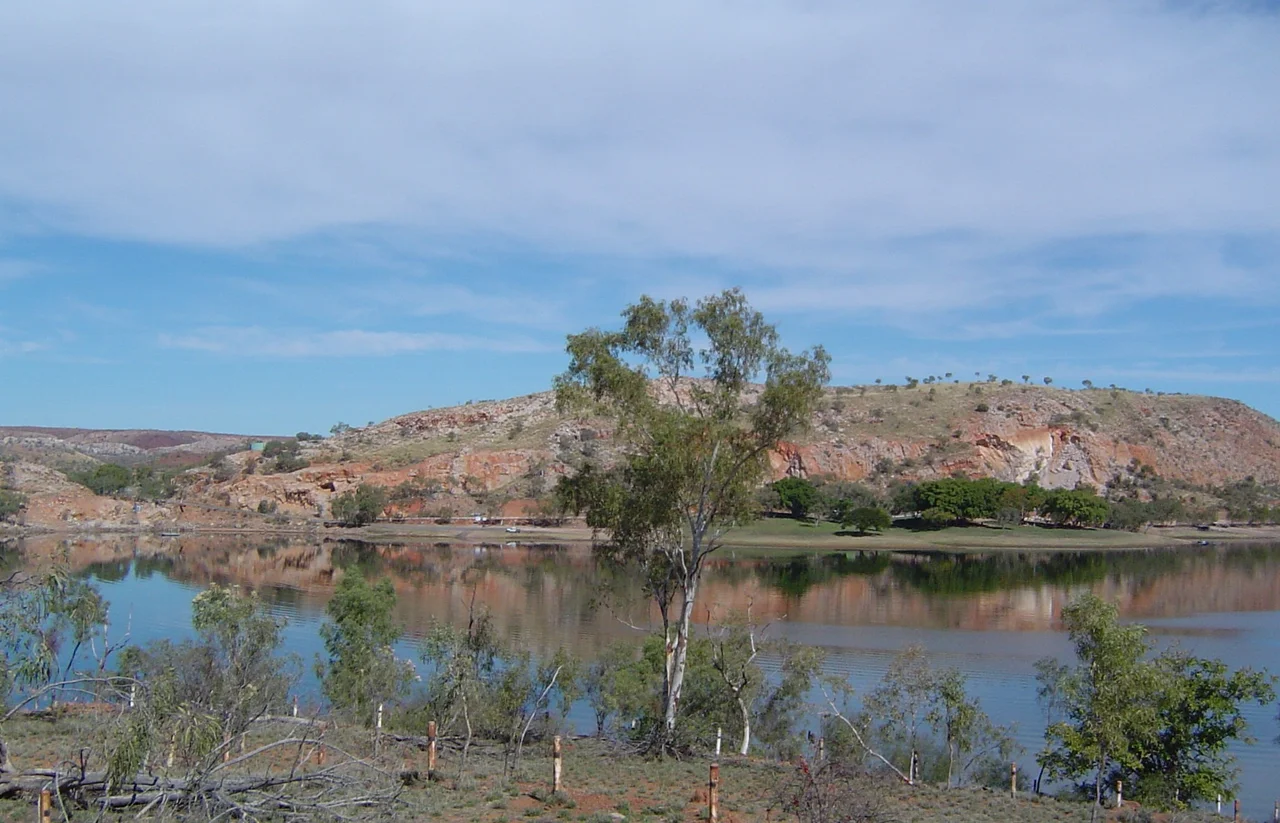

Lake Moondarra
Moondarra, the old name is said to mean: plenty of rain, also thunder. It is a hopeful name for a place this dry. Sixteen kilometres downstream of Mount Isa, the Leichhardt River was pinched shut by a dam in the 1950s, and the water that backed up behind it became something the desert city could not live without - and, almost as an afterthought, the place it goes to play. Out here, where the country runs to red rock and spinifex, a sheet of open blue water is close to a miracle.
Water for a Thirsty City
Mount Isa was built on ore, but it survives on water, and for years water was the field's great anxiety. The answer was the Leichhardt Dam, begun in 1956 and completed on 6 November 1958 at a cost of 1.7 million pounds. It was, at the time, the largest water scheme in Australia financed by private enterprise - paid for by Mount Isa Mines to supply both the city and its sprawling mining lease. The American Utah Construction Company started the work; the Australian firm Thiess Brothers finished it. In 1961 a competition to name the new reservoir was won by a local, Danny Driscoll, and the dam officially became Lake Moondarra.
Older Than the Dam
Long before any engineer studied this stretch of river, people gathered here for a different reason. This was the site of one of Australia's largest stone axe quarries, on the traditional country of the Kalkadoon people. The stone worked here was prized, and the finished axes travelled astonishing distances - traded hand to hand across as much as a thousand kilometres of the continent. It is a reminder that the lake's banks were a centre of industry and exchange for countless generations before the mine arrived, that this was a meeting place and a workplace long before it was a reservoir.
A Beach in the Desert
Lake Moondarra is where Mount Isa comes to breathe. There are picnic areas and pontoons, a ski jump and water-sports facilities; sailors and birdwatchers and anglers share the shoreline. One stretch is called Transport Bay for a frankly outback reason - the company's trucks hauled in tonnes of sand to build an actual beach on the lake's edge, a slice of seaside conjured up a thousand kilometres from any ocean. Since 1999 the Lake Moondarra Fishing Classic has drawn crowds, and for good cause: the lake is stocked with around 10,000 fingerlings a year, and barramundi and sooty grunter swim among the 22 freshwater species that fill it. Anglers here have pulled in barramundi of genuinely startling size.
The Weevil and the Weed
Not every story here is about people. In the late twentieth century the lake faced an invasion - Salvinia molesta, a floating fern that can blanket a waterway, choking out light and life beneath. The remedy was almost absurdly small. A species of weevil, a beetle that feeds on the weed, was released here from 1980 onward in one of the world's landmark experiments in biological pest control. The tiny insects did what bulldozers could not, destroying tens of thousands of tonnes of Salvinia and clearing the water again. It is a quiet outback parable: the smallest creature, given the right job, saving a whole lake.
From the Air
Lake Moondarra lies at roughly 20.58 degrees south, 139.57 degrees east, on the Leichhardt River about 16 km north (downstream) of Mount Isa in northwest Queensland. From the air it is one of the few large bodies of open water for a great distance - an irregular blue sheet set into red, rocky, sparsely vegetated terrain, with the dam wall visible at its southern end and the engineered sand 'beach' along one bay. The lake is an obvious visual landmark on any approach to Mount Isa Airport (ICAO YBMA, elevation 342 m / 1,121 ft), which lies just south. Expect excellent dry-season visibility; summer brings the wet, when the lake can rise and storms build quickly.
Nearby Stories
- Mary Kathleen, Queensland 16 km away
- Quamby 38 km away
- Mount Cuthbert Township and Smelter 71 km away
- Kuridala Township site 73 km away
- Moonah Creek Hanging Tree 82 km away
- Camooweal Caves National Park 82 km away
- Community Hall, Camooweal 113 km away
- Glenormiston Station 222 km away