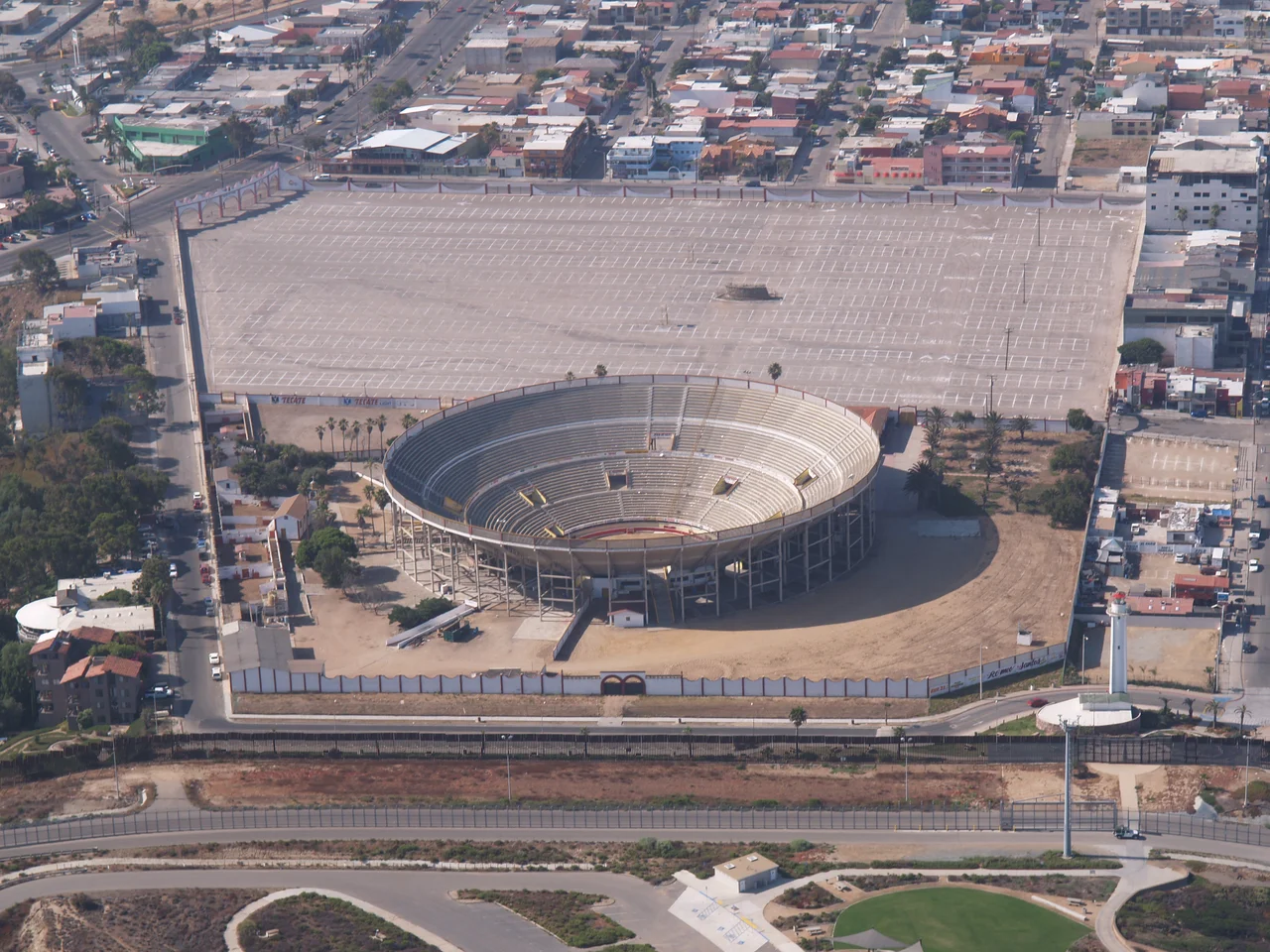

Bullring by the Sea
From the air, the border between the United States and Mexico cuts a clean line along the bluffs above the Pacific. To the north: the quiet beach community of Imperial Beach, California. To the south, just 60 meters past that line: a bullring. The Plaza Monumental de Tijuana, known in English as the Bullring by the Sea, holds 21,621 people and has been part of Tijuana's identity since it opened on June 26, 1960. It is an arena in which two cultures collide not metaphorically but architecturally, a structure that could only exist exactly where it does.
Built in 90 Days
The speed of the Plaza Monumental's construction was itself a story. Owner Salvatore Hurtado contracted with Raymundo Muzquiz Ayala, who accomplished the task in 90 days by using prefabricated concrete blocks manufactured in San Diego and assembled across the border in Tijuana. The arrangement was efficient and characteristically binational — American materials, Mexican labor, on Mexican soil. The result was a bullring with a circular concrete grandstand that could accommodate tens of thousands of spectators, positioned on the Playas de Tijuana neighborhood's Pacific-facing bluffs. The Pacific Ocean is visible from the stands. The border fence is closer than the end zone of a football field.
Bullfighting Across the Dial
During the 1960s and 1970s, bullfights at the Plaza Monumental were broadcast in Spanish to audiences in Los Angeles. The sport had significant cultural resonance in Southern California's large Mexican and Mexican-American communities. American bullfighter Sidney Franklin — one of the few non-Iberian bullfighters ever to achieve major status in the corrida — provided English-language commentary in the 1960s, with bullfighting expert Syd Love continuing that role in the 1970s via FM simulcast. This cross-border broadcast life gave the bullring an audience well beyond its physical geography, reaching north through the airwaves into the car radios of a region that contained multitudes.
The Tijuana Pop Festival of 1968
On October 13, 1968 — exactly eleven days after the Tlatelolco massacre in Mexico City — promoters attempted to stage the Tijuana Pop Festival at the bullring. The lineup was ambitious: the Animals, Iron Butterfly, Chicago Transit Authority, and others. The Animals and Iron Butterfly never played. The festival was plagued by rumors of cancellation, long gaps between acts, police presence at the border and at the ring, and the political weight of the Tlatelolco massacre hanging over everything. Roger B. Stovold of the San Diego underground newspaper Teaspoon Door called it "one of the biggest fiascos in pop festival history" and concluded that it "left enough of a black mark that any future pop festival in Mexico is unlikely." The festival's failure said as much about the political and cultural moment as about logistical incompetence.
The Arena Today
The Plaza Monumental continues to host bullfighting as well as boxing matches, concerts, and cultural events. Tijuana's bullring sits in a city that has changed enormously since 1960 — from a border town defined by day-trippers seeking inexpensive entertainment to a complex metropolis of over two million people with a dynamic cultural scene and significant manufacturing economy. The bullring remains part of Tijuana's identity even as the city has grown around it, still drawing crowds to a sport that has declined in popularity across much of Mexico but retains a dedicated following. Sitting in its upper tiers, you can watch the corrida with the Pacific at your back and the United States visible just over the border fence.
From the Air
Plaza Monumental de Tijuana is located at approximately 32.53°N, 117.12°W in the Playas de Tijuana neighborhood, immediately south of the U.S.–Mexico border and adjacent to the Pacific Ocean. The circular bullring structure is visible from low altitude south of the border. San Diego International Airport (KSAN) is approximately 20 km north. The border fence and Friendship Park are visible nearby. The area is within Class B airspace for KSAN.
Nearby Stories
- Ché Cafe 0.7 km away
- Border 32 Fire 1.2 km away
- Cuyamaca Peak 14 km away
- Spanish Missions in Baja California 36 km away
- San Clemente Island 68 km away
- USS Atlanta (CL-104) 75 km away
- Off-roading in Baja 212 km away
- Guadalupe Island Biosphere Reserve 369 km away