
Caacupé
For most of the year, Caacupé is a calm provincial town in the green hills east of Asunción, its name a piece of Guaraní geography: Ka'akupe, "behind the mount." Then December comes. On the eighth, the roads fill with walkers, some of whom have traveled for days on foot, and a town of modest size receives close to a million people. They come for a wooden statue barely half a meter tall. They come for the Virgin of Caacupé, patron saint of Paraguay, in what has become one of the largest pilgrimages in all of Latin America.
The Tree That Saved a Carver
The story begins, as the faithful tell it, in the sixteenth century with a Guaraní convert named José. Fleeing hostile warriors through the forest, he hid inside the trunk of an enormous tree and prayed to the Virgin Mary, vowing that if he lived, he would carve her image from its wood. He survived. From that protective trunk he carved a small figure of the Virgin, an ex-voto to the promise he had kept, and built a humble chapel to house it. That chapel, completed in 1770, is counted as the founding of the town, though settlement here reaches back into the previous century. A grenadier named Carlos Murphy, serving the Spanish crown, is also credited in the town's founding.
The Miracle of the Flood
A second story sealed the statue's fame. When a great flood swept the region, the little wooden Virgin is said to have been carried off by the waters and then found, intact, floating safely, delivered as if by the same providence that once saved her carver. From that survival grew her devotional title, Our Lady of the Miracles, and a long catalog of further miracles the faithful have attributed to her ever since. Carved with a delicate oval face and a sky-blue mantle, she is also known affectionately as the Blue Virgin of Paraguay. For a nation that has weathered war, isolation, and hardship, an image that survives the flood carries a meaning that needs no explaining.
A Basilica for a Nation's Faith
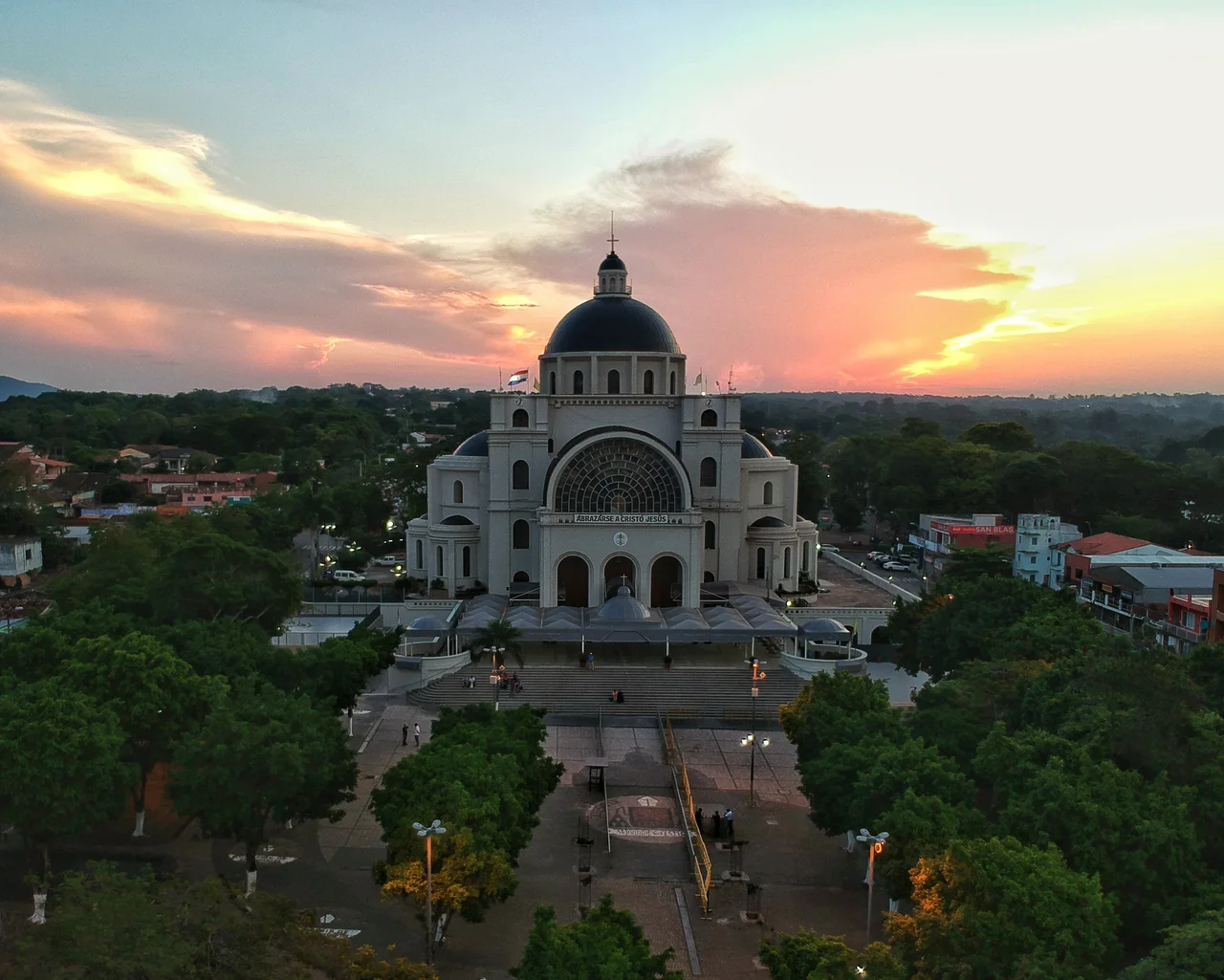
The shrine grew with the devotion. The grand church that dominates Caacupé today, the Basilica of Our Lady of Miracles, was begun in 1945, its great dome rising over the town center as the focal point for a country's faith. In 2015, Pope Francis raised it to the status of minor basilica, formal recognition of what Paraguayans had long known: that this was their most sacred place. The town is the seat of its own Roman Catholic diocese. Inside, beneath the soaring dome, the small wooden Virgin keeps her place at the center of it all, the original humble carving still drawing the eyes of every pilgrim who reaches her.
The Eighth of December
To witness the pilgrimage is to grasp the scale of Paraguayan devotion. From a nation of roughly seven million, close to a million converge on Caacupé for the feast on December 8. Many walk through the night along the highway from Asunción, families and friends moving together in the dark, candles in hand, arriving footsore at dawn. Some cover the final stretch on their knees. The town becomes a sea of the faithful, an enormous outdoor gathering of prayer, music, and shared purpose. For one day each year, a quiet hill town becomes the spiritual heart of an entire country, and the road to it becomes a moving river of belief.
Behind the Mount
The rest of the year, Caacupé returns to itself, a tranquil seat of the Cordillera department with a park and the easy rhythm of provincial life. But the name still tells the truth of the place. Ka'akupe, "behind the mount," describes a town tucked into the folds of Paraguay's green hill country, the kind of sheltered place where, the legends say, a frightened carver once found refuge and kept a promise. The mountains that gave Caacupé its name still rise around it, and the small Virgin carved so long ago still draws a nation back, year after year, to the place behind the hills.
From the Air
Caacupé sits at roughly 25.39°S, 57.14°W, about 50 km east of Asunción in the hills of the Cordillera department. The unmistakable landmark from the air is the great domed Basilica of Our Lady of Miracles at the town center, conspicuous against the surrounding low green hills, with Lake Ypacaraí lying to the west between Caacupé and the capital. A viewing altitude of 2,500–4,500 feet frames the basilica, the town, and the wooded ridgelines that give the place its name. The nearest major airport is Silvio Pettirossi International (ICAO: SGAS) at Luque, roughly 45 km west. Visibility is best in the dry season; expect heavy ground traffic and crowds in early December around the December 8 pilgrimage, when the highway from Asunción fills with walkers.
Nearby Stories
- Pilcomayo River 5.2 km away
- New Australia 5.2 km away
- Villarrica, Paraguay 19 km away
- La Colmena, Paraguay 38 km away
- Villa Hayes 41 km away
- Río Pilcomayo National Park 49 km away
- Pilar, Paraguay 148 km away
- Laguna Blanca (Paraguay) 150 km away