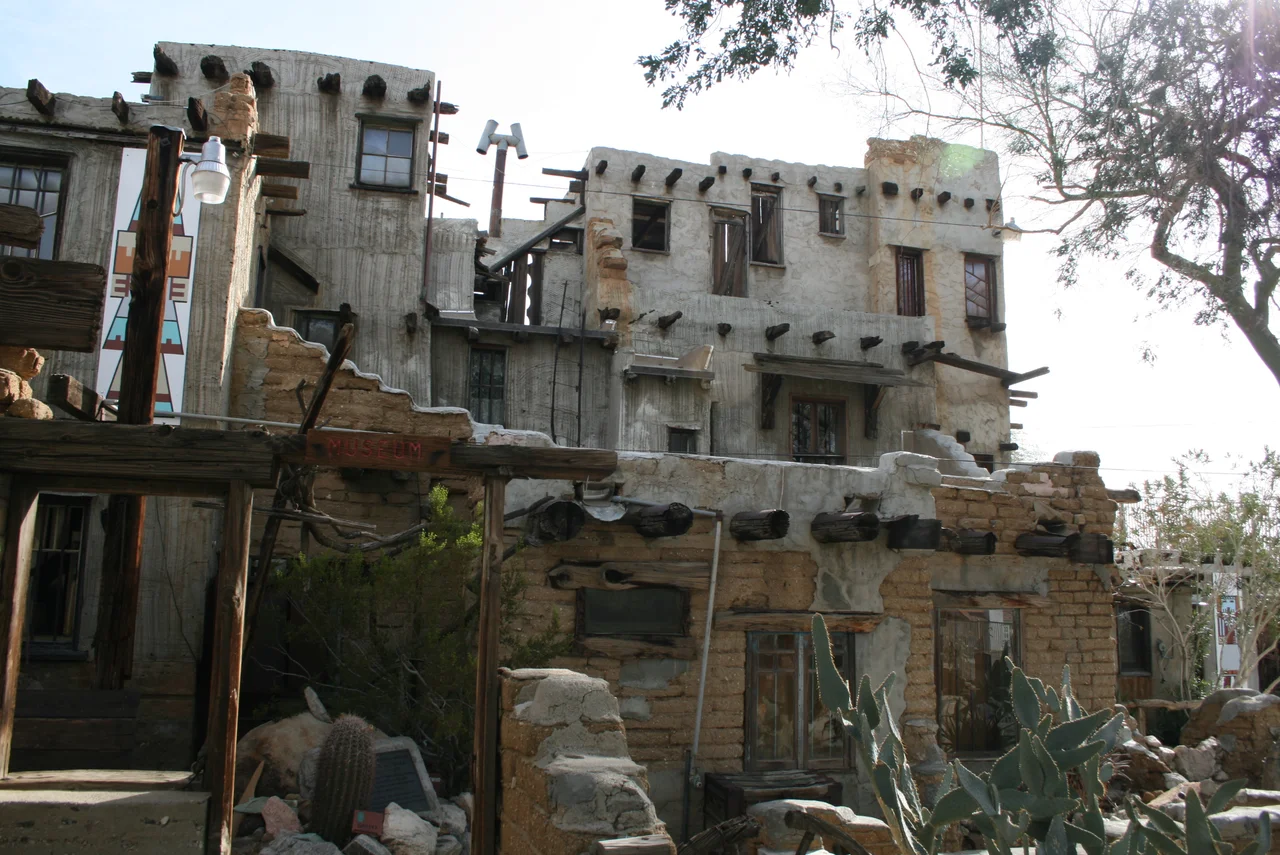

Cabot's Pueblo Museum
Cabot Yerxa arrived in the desert with little money and a prospector's tolerance for uncertainty. What he built over the next several decades — by hand, from scavenged lumber and salvaged materials, working alone in temperatures that routinely exceeded a hundred degrees — is a four-story, 35-room structure that follows no blueprints because none were ever drawn. It is one of the most unusual buildings in California, and it happened to sit above two aquifers that would eventually make Desert Hot Springs a destination.
Building Without Plans
Cabot Yerxa was born in 1883 and arrived in the desert near what is now Desert Hot Springs in the early twentieth century, drawn by the same combination of cheap land and open space that pulled many desert settlers of his era. The pueblo he began constructing was inspired by Hopi architecture — the multi-level, organically shaped dwellings of the Southwest — though his version was built from whatever materials he could gather rather than adobe made from local soil. Scrap wood, salvaged metal, discarded items of every description went into the walls and floors and ceilings of a structure that grew over three decades according to its builder's impulses. The result encompasses 5,000 square feet, 35 rooms, 150 windows, 65 doors, and 30 different roof levels. No two rooms relate to each other in quite the way conventional architecture would expect. Yerxa opened the pueblo to visitors in 1950, near the end of his life.
The Fault Beneath the Feet
Yerxa's most consequential discovery happened underground. While digging on his property, he struck water — not once, but twice. The two aquifers he found are separated by a branch of the Mission Creek Fault, a splay of the larger San Andreas system that runs through this part of the desert. One aquifer produces hot water at 110 degrees Fahrenheit; the other yields water that is cold. The geological explanation lies in how deeply the water circulates before rising: the hot water travels deep through the fault zone, where geothermal heat warms it, while the cold water comes from a shallower system. Yerxa's discovery was the foundation on which Desert Hot Springs built its entire identity as a spa destination — the mineral hot springs that draw visitors to the town trace back to the fault system he first tapped on his own land.
The Giant at the Gate
Standing outside the pueblo is a 43-foot carved wooden figure called Waokiye, the 27th installation in the Trail of Whispering Giants, a series of large Native American sculptures placed at sites across North America. The wood came from a sequoia tree that was struck by lightning in the 1950s and later fell. The statue was carved specifically for this site. Inside the pueblo, Yerxa's collections and the history of his desert life fill the rooms he built — a record of one man's decades-long project of self-sufficiency and creativity in an environment that offered little assistance. Cabot Yerxa died in 1965 at the age of 82, having outlived most of the doubts his building project must have inspired.
Museum and Memory
The structure is now operated as Cabot's Pueblo Museum, preserving both the building and the story of its builder. Tours move through rooms that Yerxa shaped over three decades, past windows he cut and doors he salvaged, through a space that feels less like architecture than like three-dimensional autobiography. The pueblo sits in Desert Hot Springs — a city that grew partly from the geological discovery Yerxa made on this same property — and it stands as an unlikely monument to what one person with modest means, a great deal of time, and no formal training can build in the desert when given enough years and enough determination.
From the Air
Located at 33.958°N, 116.482°W in Desert Hot Springs, Cabot's Pueblo Museum is in the residential areas of the city, a few miles north of Palm Springs. Desert Hot Springs lies on the north side of the Coachella Valley, visible from the air as a distinct community separated from Palm Springs by open desert. Nearest airports: KPSP (Palm Springs International, approximately 10 miles south), L22 (Bermuda Dunes Airport). The San Andreas Fault trace is visible from altitude as a linear landscape feature running through the valley just south of Desert Hot Springs.
Nearby Stories
- Tell Them Willie Boy Is Here 1.7 km away
- Murders of Jan Pietrzak and Quiana Jenkins-Pietrzak 4 km away
- Rancho Mirage Library and Observatory 11 km away
- Cholla Cactus Garden 13 km away
- San Bernardino Train Disaster 29 km away
- Tenaja Fire 31 km away
- Amboy Crater 36 km away
- Edwards Air Force Base 102 km away