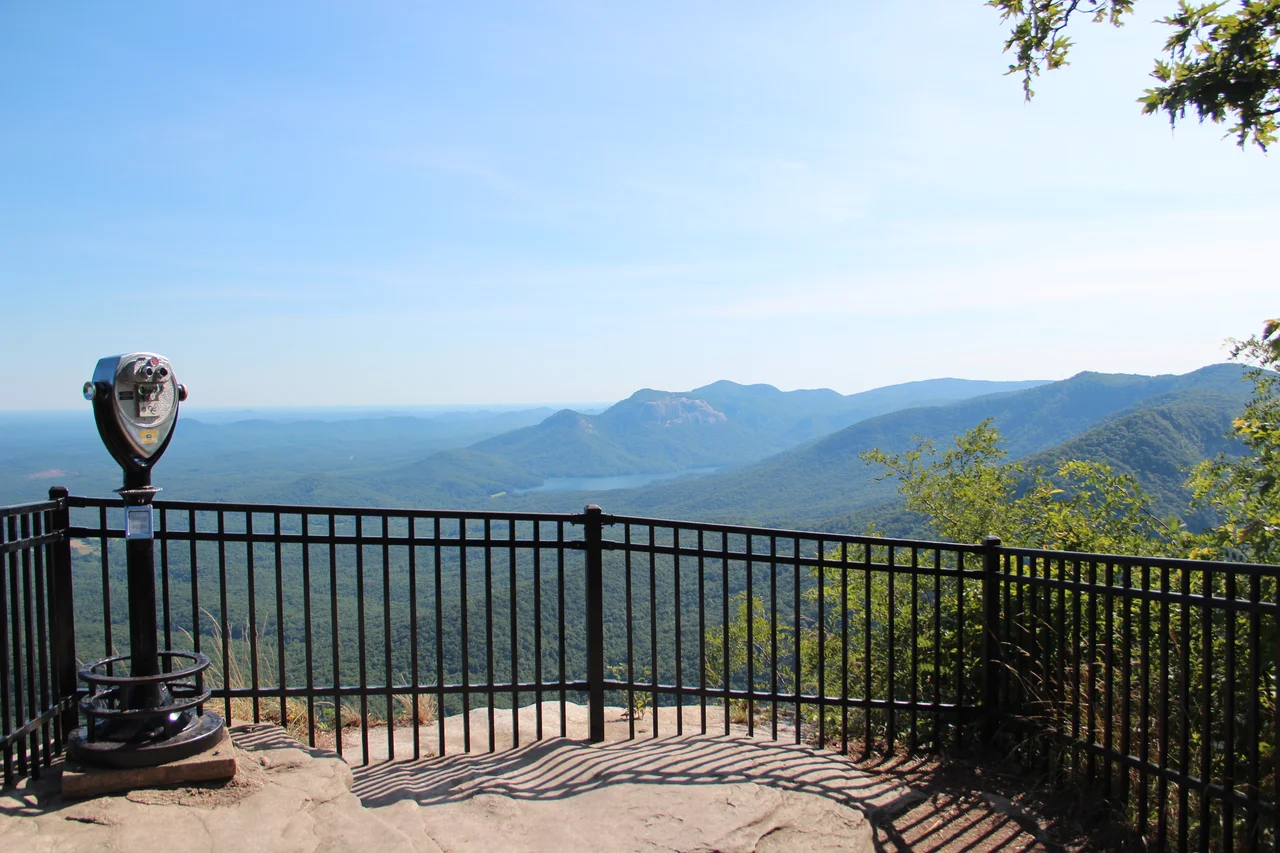

Caesars Head State Park
The most likely story is that the rock was named after a dog. Not Julius Caesar, not some imagined profile in stone visible only at certain angles - just an early mountaineer's hound called Caesar, immortalized when his owner started telling people what he called the cliff. The disputed etymology is one of the more honest things about Caesars Head: nobody quite remembers, and most of what people repeat is wrong. What is certain is the geology. A granitic gneiss outcrop juts 3,208 feet into the sky at the southern end of the Blue Ridge Escarpment, dropping roughly 2,000 feet straight down to the Piedmont below.
Robert Mills Saw It First
In 1825, when the state engineer and architect Robert Mills - the same Mills who would design the Washington Monument - rode through northern Greenville County, he stopped long enough to describe Caesars Head as a 'mass of granite, rising from the vale, through which a rapid river winds its turbulent way... the ledges of stone, rising almost perpendicular, and at length, hanging over at the top, so that they seem to totter to their fall.' Mills wasn't given to overstatement. The escarpment really does seem to lean. After the Jones Gap Road opened in 1848, former state senator Benjamin Hagood bought 2,400 acres and built a summer cottage to chase the cool breezes off the cliff. He upgraded to a hotel before he died in 1865, leaving the property to his daughter Eliza and her husband, Dr. Francis Miles.
A Hundred Years of Innkeepers
The Civil War interrupted everything. Confederate deserters hid in the woods around the mountain, and the hotel shut in 1862. By 1876 the Mileses had reopened as a health resort, then sold to E. M. Seabrook of Charleston in 1880. Seabrook expanded the inn but couldn't pay the mortgage, and the property reverted to Miles in 1885. In 1897, in a deal that says everything about how Southern gentry handled retirement, the Mileses signed the property over to Furman University in exchange for an annuity and free room and board for life. Furman sold to developers in 1924. The Marchant brothers bought it in 1946 and added tennis courts and a pool. Then, in the early morning of September 9, 1954, the hotel burned. The original Hagood house went with it.
Raven Cliff and the Hawk Migration
South Carolina's parks department acquired the land in pieces between 1976 and 1986, joining Caesars Head with neighboring Jones Gap as the Mountain Bridge Wilderness. The hiking draw is Raven Cliff Falls - 420 feet of water plunging through a notch in the escarpment, viewed from a suspension bridge that sways underfoot. Five other waterfalls lace the park. Anglers fish the Middle Saluda River and Julian and Matthews creeks for brook, rainbow and brown trout, artificial lures only. Black bear roam the woods. Peregrine falcons nest on the cliffs. The federally endangered green salamander hides in rock crevices. But the show that draws crowds is the autumn raptor migration: thousands of hawks ride the updrafts where the escarpment forces warm Piedmont air vertical, and the bare granite of Caesars Head becomes the best counting station in South Carolina.
From the Air
Located at 35.12 degrees N, 82.60 degrees W on the SC/NC border, where Greenville County meets Transylvania County. The Blue Ridge Escarpment is unmistakable from altitude - a sudden 2,000-foot drop from mountain plateau to Piedmont floor. Best viewed at 4,500-6,500 feet MSL. Nearest airports: Greenville-Spartanburg International (KGSP, 25 nm southeast), Asheville Regional (KAVL, 28 nm north). Approach with caution in autumn - thousands of migrating hawks ride the same thermals that pilots like. US 276 winds up to the visitor center from the south.
Nearby Stories
- Donaldson Air Force Base 7.9 km away
- Battle of Cowpens 12 km away
- Asheville Regional Airport 15 km away
- Chattooga River 15 km away
- Battle of Blackstock's Farm 17 km away
- Great Smoky Mountains National Park 52 km away
- Joara 57 km away
- Dahlonega, Georgia 98 km away