
Cala Galdana
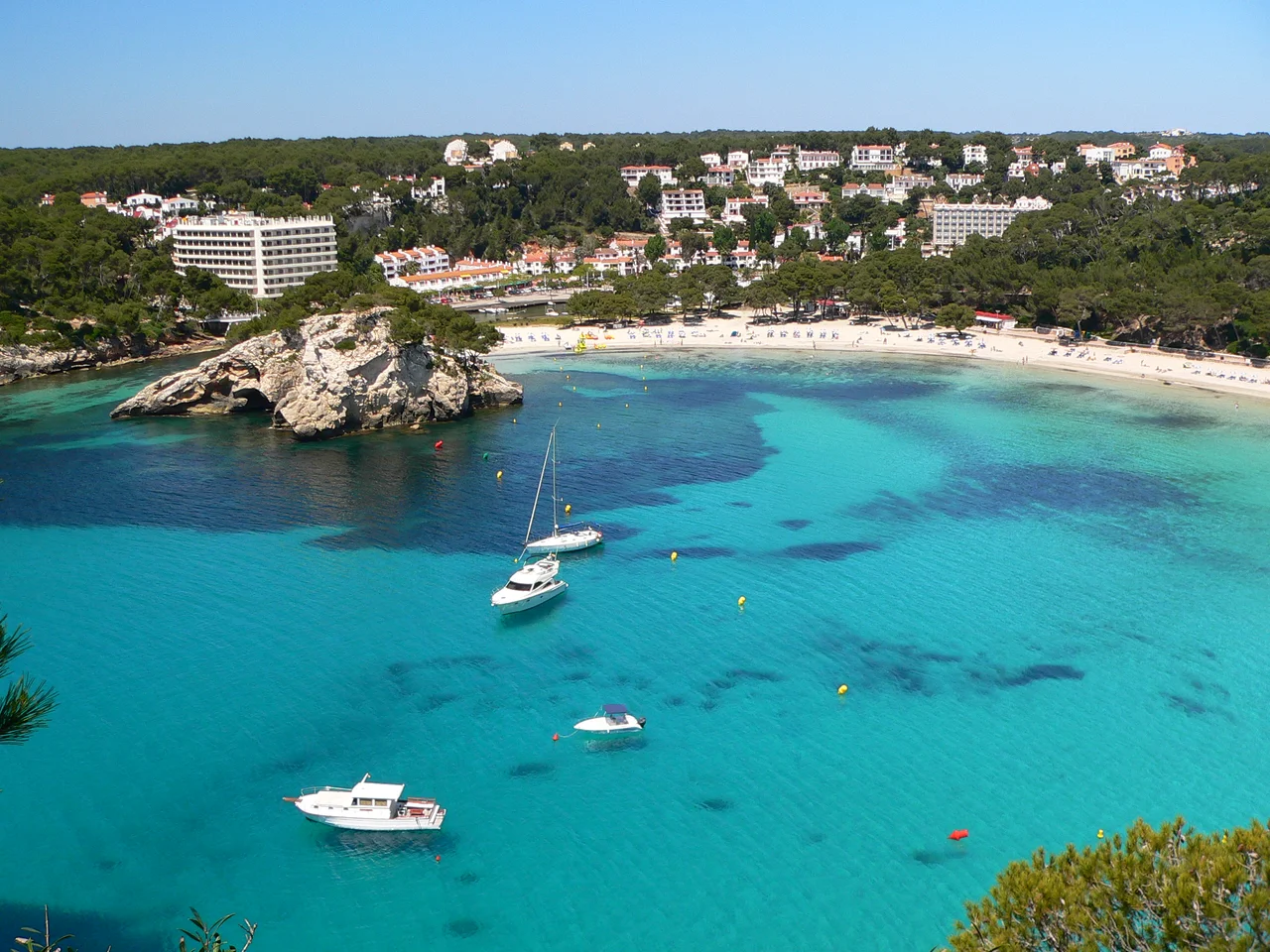
Only one road reaches Cala Galdana. The Me-22 winds down from the inland town of Ferreries, nine kilometers to the north, and simply stops at the sea. What it delivers you to is a near-perfect horseshoe: a cove scooped out of the cliffs on Menorca's south coast, where the Torrent d'Algendar river slides out of a green gorge and meets the Mediterranean. The bay curves so tightly that the water inside it stays calm while the open sea churns beyond, and that gentle geometry has made this one of the most popular beaches on the whole island.
One Road In
Cala Galdana's isolation is part of its character. With the Me-22 as the only way in or out, the cove feels tucked away from the rest of Menorca, cradled by rocky, vegetation-covered slopes that rise steeply on every side. Just to the west, the Torrent d'Algendar reaches the sea, and a small boat harbour sits in the river mouth, sheltering little craft where fresh water meets salt. The river arrives through a lush gorge, one of the greenest corners of an island better known for its dry limestone, so the approach to the beach carries a surprising touch of the tropical before the sand ever comes into view.
A Shell-Shaped Bay
The beach itself is compact and beautiful, about 300 meters long and 40 wide, floored with the fine white sand that defines Menorca's southern shore. Its shell shape is more than pretty; the tight curve shelters the water and makes this an unusually safe place to swim, which is why families flock to it. In summer the cove comes fully equipped, with lifeguards, a Red Cross post, public showers, and rentals of sunbeds, umbrellas, and water toys like kayaks and pedal boats. It draws crowds of both visiting tourists and Menorcans themselves, a rare beach that locals rate as highly as the guidebooks do.
The Wild Neighbors
Here is the twist that saves Cala Galdana from being just another busy resort beach: some of Menorca's most pristine coves lie within walking distance, and they cannot be reached by car at all. Follow the coastal footpaths west and you arrive at Cala Macarella, its tiny sibling Cala Macarelleta, and the exquisite Cala en Turqueta, names that appear on postcards across the island. Head east instead and the trails lead to Cala Mitjana and Cala Trebalúger. These undeveloped bays have no hotels, no rental stands, nothing but sand, pines, and turquoise water, and the short hike to reach them is exactly what keeps them wild.
The Built and the Bare
Cala Galdana wears its development openly. Several high-rise hotels, villas, and apartment blocks climb the slopes around the bay and the river mouth, a skyline that would be unremarkable on the mainland Costas but stands out on low-built Menorca. The effect is a study in contrasts: a fully serviced modern resort in the middle, wilderness a footpath away on either side. Before you leave, there is one local thing worth buying, the avarca, the traditional Menorcan sandal, simple flat leather footwear born on the island's farms and now worn all over Spain. It is the kind of humble, practical craft that outlasts every passing fashion in resort architecture.
From the Air
Cala Galdana sits at 39.937 N, 3.963 E on the south coast of Menorca. Recommended viewing altitude is 2,000 to 3,500 feet, low enough to appreciate the distinctive horseshoe cove and the green ribbon of the Torrent d'Algendar gorge running inland toward Ferreries. The white-sand beach and the ring of hotels on the surrounding slopes make an easy landmark, with the undeveloped coves of Macarella and Turqueta just to the west. Menorca airport (LEMH) lies about 30 km east near Maó; Palma de Mallorca (LEPA) is west across open water. The south coast is more sheltered than Menorca's windward north, offering calmer air and clear water views on settled days.
Nearby Stories
- Castle of Capdepera 7.5 km away
- Cap de Formentor 26 km away
- Ses Païsses 59 km away
- Llobregat Delta 165 km away
- Somorrostro 200 km away
- Porto Flavia 332 km away
- Cosquer Cave 336 km away
- Nuraghe Seruci 340 km away