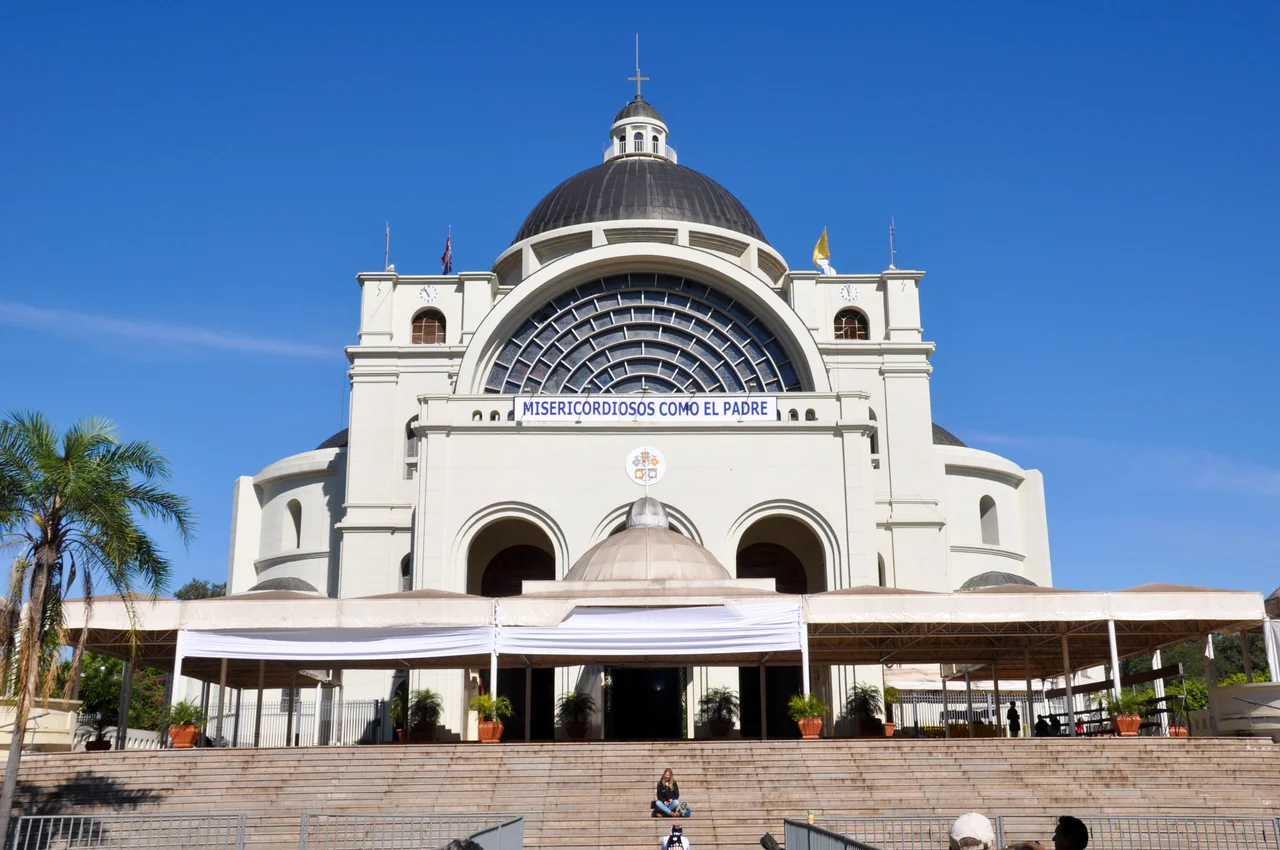

Cathedral Basilica of Our Lady of Miracles, Caacupé
Every December 8, the highways out of Asunción clot and then stop. People abandon their buses and walk the last stretch into the hills on foot, sometimes for days, candles in hand. They are climbing toward a small wooden statue, barely fifty centimeters tall, with a delicate oval face and blue eyes. This is Caacupé, and the Virgin who lives in its great blue-domed basilica is, for most Paraguayans, the closest thing the country has to a mother.
Behind the Bush
The legend begins in the early colonial period with a Guaraní man named José, converted to Christianity by French Franciscan missionaries and chosen to carve an image of the Virgin for his community's new church. Sent into the forest to find suitable wood, he was caught in the open by warriors of the rival Mbayá, who had declared themselves enemies of all converts. José fled deeper among the trees and hid inside the trunk of a great one, and there he prayed. The Virgin, the story goes, answered with two Guaraní words: "Ka'aguy kupépe" — behind the bush. He survived. From the wood of that tree he carved two images, and one of them became the Virgin of Miracles. The name Caacupé itself echoes those words. It is a place named for an act of hiding that became an act of faith, the language of the rescued woven permanently into the map.
The Statue That Floated
The miracle that fixed the Virgin in Paraguayan hearts came in 1603, when a great flood swept the region and destroyed everything in its path, including José's home. As the waters fell, the little statue was found floating on the surface of the lake, undamaged. To the people who recovered it, the message was plain: this image was meant to endure. The carving survives still — wood worn smooth by centuries, dressed in a white tunic and a sky-blue cloak embroidered with gold. Pilgrims come not to admire a museum piece but to stand before something they believe has watched over their families, their wars, and their droughts for four hundred years.
A Basilica for a Nation
The first sanctuary on this spot dates back to colonial times, but the building pilgrims see today is comparatively new, construction begun in 1945 and the church opened as the Virgin's sanctuary in 1980, with a sweeping blue dome and walls of stained glass, big enough to absorb the crowds that older chapels never could. Two popes have come here. John Paul II celebrated Mass in 1988, and in 2015 Pope Francis arrived and elevated the church to the rank of minor basilica. For a landlocked country often overlooked by the rest of the world, those visits mattered. Caacupé is where Paraguay sees itself reflected back as something sacred and seen.
The Long Walk Up
What makes Caacupé extraordinary is not the architecture but the devotion that converges on it. On the feast day, close to a million people fill a town of modest size, many having walked through the night across the Cordillera. Some come from Asunción on foot, a journey of days; others travel from across the country and beyond it. They arrive exhausted, carrying flowers, candles, and the weight of whatever they came to ask for — a healing, a job, a safe birth, a return. Guaraní hymns mix with Spanish prayers in a town built for a fraction of the crowd. The air smells of wax, sweat, and rain-soaked grass. It is less a tourist spectacle than a national reckoning with hope, the one moment each year when a quiet town in the green hills becomes, briefly, the beating heart of an entire country.
From the Air
Caacupé sits at 25.39°S, 57.14°W in Paraguay's Cordillera Department, roughly 50 km east of the capital. The basilica's large blue dome is the most prominent landmark in the town and is visible against the surrounding green hills from a recommended viewing altitude of 3,000–5,000 feet AGL. The nearest major airport is Silvio Pettirossi International in Asunción (ICAO: SGAS), about 25 nautical miles to the west-southwest. Visibility is generally excellent in the dry winter months (June–August); summer afternoons bring haze and convective buildups. Expect dense ground traffic and air activity around the December 8 feast day.
Nearby Stories
- Pilcomayo River 5.2 km away
- New Australia 5.2 km away
- Villarrica, Paraguay 19 km away
- La Colmena, Paraguay 38 km away
- Villa Hayes 41 km away
- Río Pilcomayo National Park 49 km away
- Pilar, Paraguay 148 km away
- Laguna Blanca (Paraguay) 150 km away