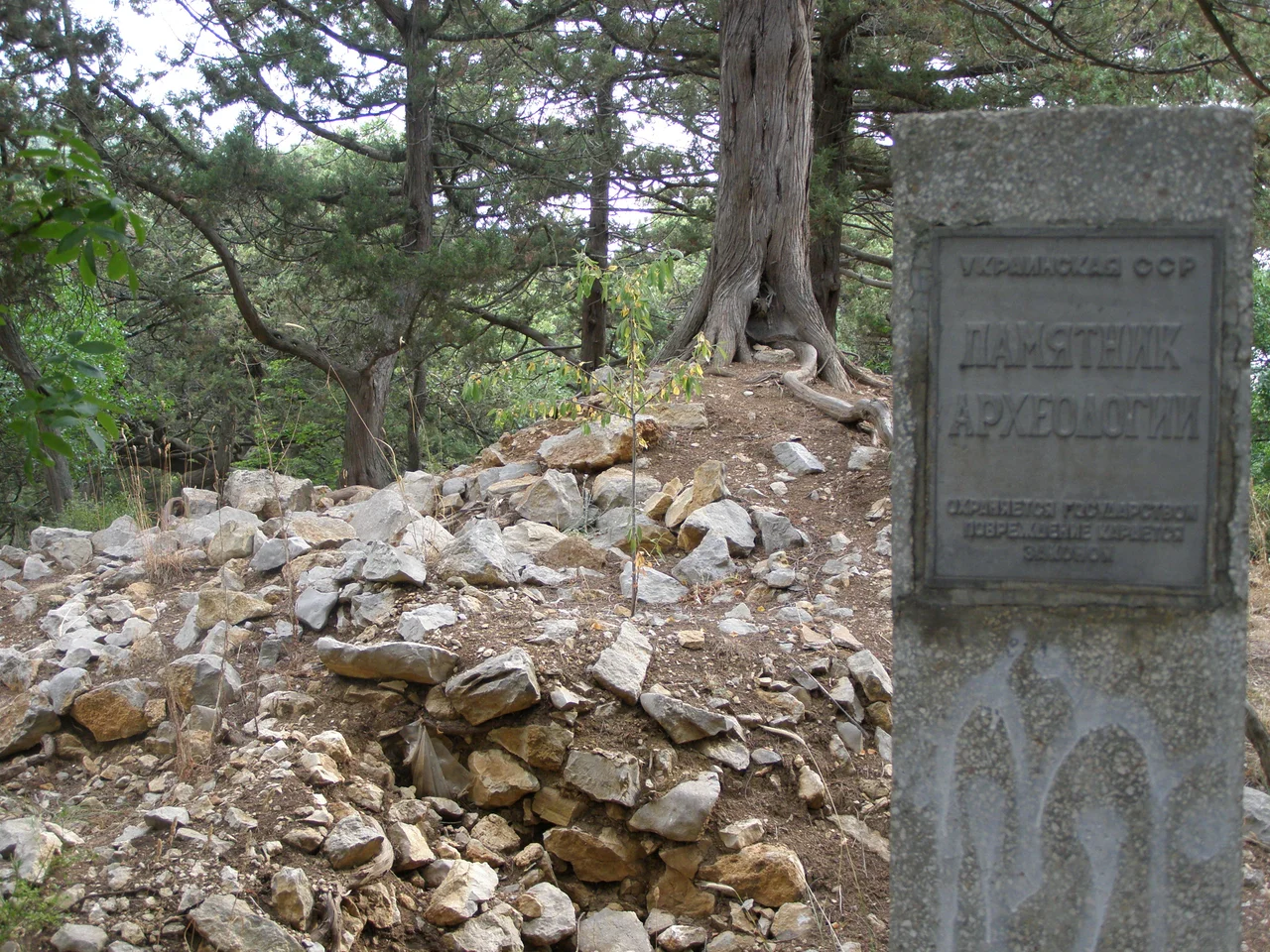

Charax, Crimea
Most people who come to this dramatic clifftop near Yalta are here for Swallow's Nest, the tiny fairy-tale castle clinging to the edge of the sea. Almost none realize they are standing on a Roman frontier. Nearly two thousand years ago, legionaries from the far side of Europe pitched their camp on this ridge of Ai-Todor, watching the Black Sea for raiders and calling their outpost by a Greek word for a fortified place. This was Charax, the largest Roman military settlement ever uncovered in Crimea, and its story is one of empire, abandonment, and a very determined rediscovery.
The Empire's Far Edge
Charax was founded under the emperor Vespasian, whose reign began in AD 69, to protect the Greek city of Chersonesus and the other Black Sea trade emporiums from the Scythians of the interior. This was Rome at its most far-flung, a garrison on a distant northern shore. The Roman presence here was not continuous. By the end of the first century AD the forces were pulled out of the peninsula entirely. Decades later the camp was restored by a detachment of the Legio I Italica, and toward the end of the second century it hosted soldiers of the Legio XI Claudia. Then, in the middle of the third century, the Romans left Charax for good, and the frontier fort fell silent on its clifftop above the sea.
A Name Borrowed From the Past
The ruins slept until 1837, when the scholar Peter Keppen discovered them and measured the defensive wall at roughly 395 meters. Keppen matched the site to Charax, meaning fortification in Greek, the only Roman camp actually named in the ancient records of Crimea. Whether this particular ridge truly was that Charax is uncertain, there is no firm proof it stood near Ai-Todor, but the name stuck, and the site has carried it ever since. Keppen's publication caught the imagination of others. In 1849, Count Shuvalov paid for the first excavations, a rather amateurish affair by later standards, but enough to begin pulling the buried Roman world back into the light after fifteen centuries underground.
A Grand Duke's Dig
Serious archaeology arrived in 1896 under an unlikely patron: Grand Duke Alexander Mikhailovich of Russia, who built his summer dacha right beside the ruins and the lighthouse of 1865. The excavations he supervised ran for fifteen years and unearthed a wealth of Roman coins and bronze artifacts. The historian Michael Rostovtzeff, working for St. Petersburg University, studied the finds and reached a striking conclusion: Charax was not merely a fort but an entire Roman city, larger and more elaborate than anyone had assumed. In 1907 a museum opened at the site to hold its treasures, turning the old frontier camp into a place of scholarship and display.
Baths, Aqueducts, and Riddles
Later excavations deepened the picture. Between 1931 and 1935, Vladimir Blavatsky uncovered the remains of two public water basins, Roman baths, and an aqueduct, along with a gymnasium and a sanctuary standing outside the walls, the infrastructure of genuine civic life on the empire's rim. Blavatsky and his colleagues also entertained the theory that the oldest, cyclopean walls at the site had been raised by the local Tauri people before the Romans ever arrived, an idea that has since faded from favor. They suggested, too, that the retreating legionaries may have deliberately wrecked the fort as they left, to keep it out of enemy hands. Today Charax remains a quiet, layered ruin, a Roman frontier hiding in plain sight beside one of Crimea's most photographed coasts.
From the Air
Located at 44.428 degrees N, 34.122 degrees E, on the Ai-Todor headland near the village of Gaspra, just above the famous Swallow's Nest castle. Best viewed from around 3,000 to 5,000 feet, where the wooded promontory and its clifftop lighthouse mark the site above the Black Sea. The nearest major airport is Simferopol (UKFF), roughly 55 km to the north.
Nearby Stories
- Cape Sarych 1 km away
- Crimean Nature Reserve 6.1 km away
- Battle of the Alma 21 km away
- Novyi Svit Winery 22 km away
- Novyi Svet 50 km away
- Januarius MacGahan 365 km away
- Tottenham (1802 Indiaman) 396 km away
- Abkhazia 513 km away