
Januarius MacGahan
The headline he would become most famous for was not a headline at all. It was a dispatch — filed from the village of Batak, Bulgaria, in the summer of 1876 — that described, in plain and devastating language, what he had seen inside a church. Skulls of women, hair dragging in the dust. Bones of children. Charred remains piled halfway to the low arches of the ceiling. Januarius MacGahan was thirty-two years old when he walked through that village, and he was already one of the most celebrated war correspondents in the world. What he wrote from Batak changed the politics of Europe.
An Ohio Farm Boy Who Learned Five Languages
Januarius Aloysius MacGahan was born on 12 June 1844 near New Lexington, Ohio, the son of an Irish immigrant who had served aboard HMS Northumberland — the ship that carried Napoleon into exile on St. Helena. The family connection to history was tenuous but real, the kind of detail MacGahan himself would have appreciated. He moved to St. Louis, worked briefly as a teacher and a journalist, and there met his cousin General Philip Sheridan, the Civil War hero, who urged him to study law in Europe. He sailed to Brussels in December 1868 and never studied much law, but discovered instead a gift for languages. He learned French and German. When the Franco-Prussian War broke out in 1870, Sheridan — who happened to be observing with the German Army — arranged for him to cover the conflict for the New York Herald. MacGahan was twenty-six. By twenty-seven, his front-line dispatches from the French collapse had made him a celebrity.
From the Paris Commune to the Kyzyl-Kum Desert
The decade before Bulgaria was a sustained education in extremity. In March 1871, MacGahan rushed to Paris and became one of the first foreign correspondents to report on the uprising of the Paris Commune; the French military arrested him and he nearly faced execution before the U.S. Minister to France intervened. Assigned to St. Petersburg in 1871, he learned Russian and married Varvara Elagina, a woman from an old Russian noble family, in 1873. That same year, hearing that Russia planned to invade the Central Asian khanate of Khiva, he defied a Russian ban on foreign correspondents, crossed the Kyzyl-Kum desert on horseback alone, and emerged at the city of Khiva just in time to witness its surrender to the Russian Army. He turned the adventure into a book, Campaigning on the Oxus and the Fall of Khiva, published in 1874. He then spent ten months in Spain covering the Third Carlist War, and in 1875 sailed with British explorer Sir Allen Young toward the Northwest Passage, reaching Peel Sound in the Canadian Arctic before pack ice forced them to turn back. He was thirty-one and had already seen more of the world's violence than most people see in a lifetime.
The Village of Batak
In April 1876, Bulgarian nationalists staged an uprising against Ottoman rule. Ottoman forces, including irregular cavalry units known as Bashi-bazouks, crushed the revolt with exceptional brutality. Reports of massacres reached Constantinople, but the Disraeli government in Britain — committed to propping up the Ottoman Empire as a counterweight to Russian expansion — was inclined to dismiss or minimize them. Eugene Schuyler, the American Consul-General in Constantinople and a friend of MacGahan's, invited him to join an investigation commission. MacGahan had by then left the New York Herald after a quarrel with its publisher; he obtained a commission from the London Daily News and departed for Bulgaria on 23 July 1876. After visiting Philippopolis, Peshtera, and Pazardjik, the commission reached the village of Batak. MacGahan reported that of a population of seven thousand, only two thousand had survived. Fifty-eight villages in Bulgaria had been destroyed, five monasteries demolished, and approximately fifteen thousand people massacred across the region. He filed his account without flinching, quoting what he had seen in the church where bodies had been burned and piled to the rafters: "Everywhere horrors upon horrors."
The Words That Changed the War
MacGahan's dispatches, published first in the Daily News and then reprinted across Europe, produced a wave of public outrage in Britain that Prime Minister Disraeli was unable to contain. Disraeli had called reports of the massacres exaggerated and suggested the Bulgarians bore equal responsibility; MacGahan's eyewitness testimony, specific and unsparing, made that position untenable. William Ewart Gladstone, the opposition leader, wrote a pamphlet titled Bulgarian Horrors that sold 200,000 copies within weeks and called on Britain to abandon its support for the Ottoman government. The Bulgarian poet Ivan Vazov dedicated a poem to MacGahan in 1876, "Жалбите на майките" — "The Sorrows of the Mothers." When Russia declared war on the Ottoman Empire on 24 April 1877, the British government could not intervene "because of the state of public feeling" — a phrase that acknowledged, obliquely, what MacGahan's reporting had done to British politics. MacGahan himself rode with the first Russian units as they crossed the Danube into Bulgaria, covered the siege of Pleven and the battle at Shipka Pass, and was present at the signing of the Treaty of San Stefano that ended the war. He wrote of his own role with characteristic dry irony: "I can safely say I have done more to smash up the Turkish empire than anybody else... except the Turks themselves."
Death in Constantinople, Memory in Bulgaria
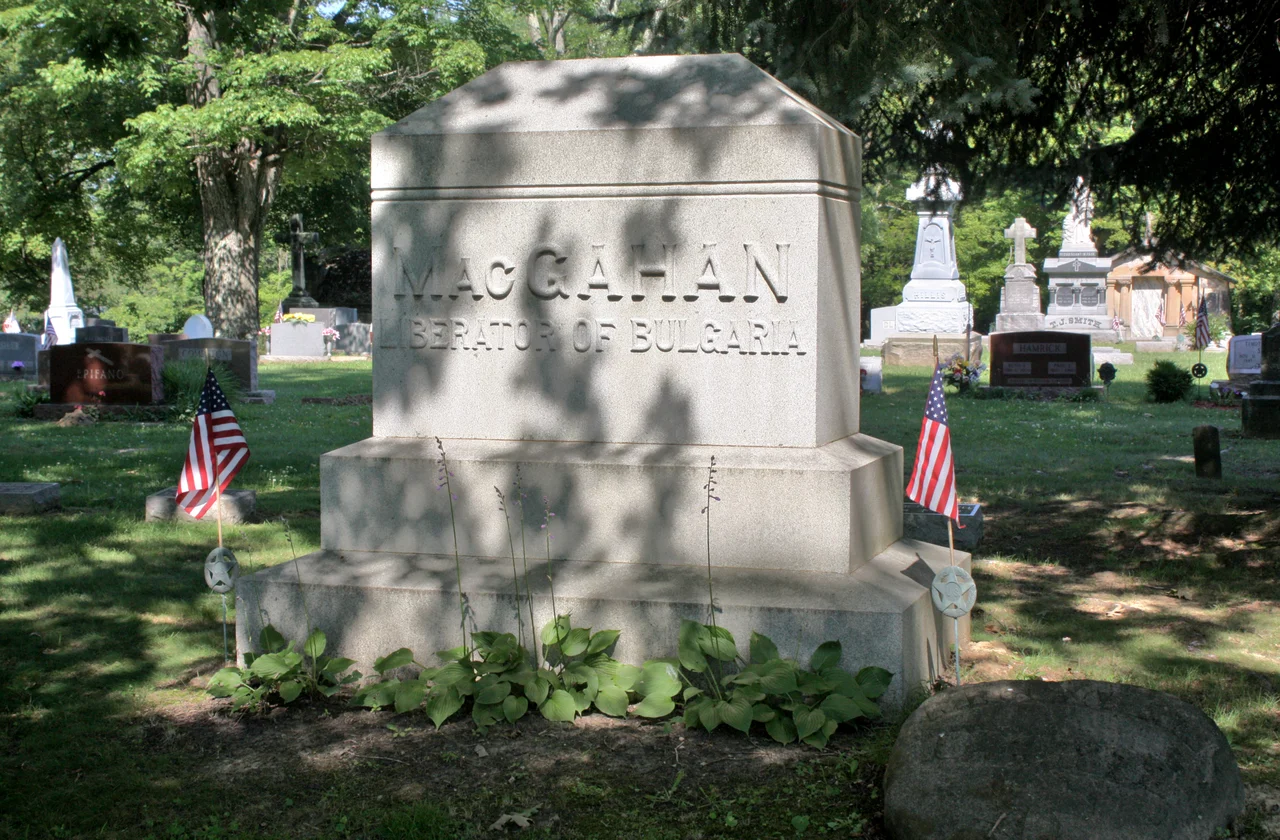
MacGahan was in Constantinople in the spring of 1878, preparing to travel to Berlin for the conference that would determine Bulgaria's final borders, when he contracted typhoid fever. He died on 9 June 1878 — three days before his thirty-fourth birthday — and was buried in the Greek cemetery in Constantinople, in the presence of diplomats, war correspondents, and General Mikhail Skobelev, the Russian commander whose friendship had given him access to the front lines. Six years later, his body was returned to the United States and reburied in New Lexington, Ohio. A society of Bulgarian-Americans erected a statue in his honor. Today, streets are named after him in Sofia, Varna, Plovdiv, Sliven, Vratsa, Montana, Panagyurishte, Pazardzhik, and Stamboliyski. A school in Sofia bears his name. A square in Plovdiv. Each June, New Lexington holds a festival and memorial service in his memory. His gravestone calls him the "Liberator of Bulgaria" — a title given by the people whose suffering he witnessed and refused to look away from.
From the Air
Januarius MacGahan is catalogued at 42.00°N, 30.32°E — coordinates on Turkey's western Black Sea coast, near the region where his story intersects geographically with the Ottoman and Russian theatres he covered. Constantinople itself, where he died, lies approximately 175 nautical miles to the southwest at 41.01°N, 28.97°E. The nearest major airport to the catalogue coordinates is LTFJ (Sabiha Gökçen International, Istanbul), approximately 110 nautical miles to the southwest. The city of Istanbul from the air shows the Bosphorus Strait dividing Europe from Asia — the same strait MacGahan would have crossed repeatedly in the 1870s, the gateway between the Ottoman capital and the Balkan wars he spent his short career covering.
Nearby Stories
- Kefken Island 51 km away
- Şile Castle 58 km away
- Battle of Constantinople (922) 79 km away
- 2025 Kartalkaya Hotel Fire 140 km away
- Varna 197 km away
- Varna Necropolis 237 km away
- Soviet Destroyer Dzerzhinsky 292 km away
- Russian Battleship Ekaterina II 330 km away