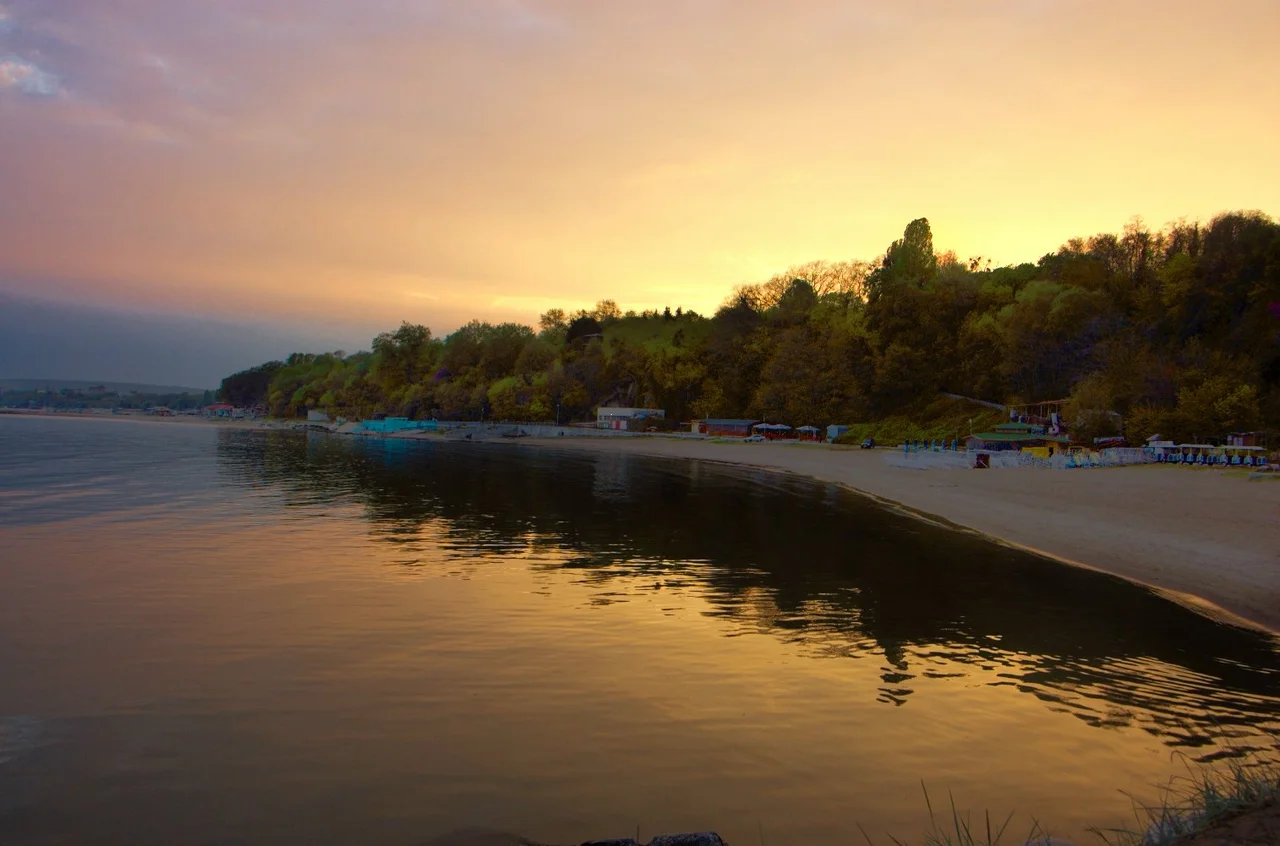

Varna
On a hot August afternoon, the Sea Garden in central Varna runs east along the cliffs above the Black Sea, and inside its boundary you can find a planetarium, a dolphinarium, an aquarium opened in 1932, a zoo, an open-air theater, and a stand of trees personally planted by Yuri Gagarin and a rotating cast of Soviet cosmonauts. People said in 2006 that Varna was Europe's new funky-town, the good-time capital of Bulgaria. They might still say it. The Black Sea coast here has been a city for at least 2,600 years, founded as the Greek colony of Odessos in the sixth century BC, and pretty much every empire that mattered between then and now has left its marks on the streets above the harbor.
What the Romans Built
Walk a few blocks back from the seafront and you come to the largest Roman baths in the Balkans. They are also among the four largest Roman baths anywhere in Europe, partial walls still standing two stories high, the brick arches of the bathing chambers open to the sky. Built in the second century AD when this was Odessus in the Roman province of Moesia, they covered seven thousand square meters and could serve hundreds of citizens at once. The hypocaust system that heated the floors is still visible in places. So is the careful brickwork that survived the Visigothic raids, the Slavic migrations, the Bulgarian conquest of the seventh century, and roughly 1,400 years of people quarrying the bath complex for stones to build their own houses.
Five Millennia of Gold
The Varna Archaeological Museum, housed in an ornate former girls' school, holds what is sometimes called the oldest worked gold on Earth. It came from a chalcolithic necropolis just west of the city, accidentally found by an excavator operator named Raycho Marinov in 1972. Hundreds of graves dating to roughly 4,500 BC, containing thousands of gold artifacts crafted by people who lived in this region nearly seven millennia ago. The museum displays many of them in dim cases — diadems, bracelets, beads, the contents of grave 43, which once held the body of a man buried with more gold than anyone else in the prehistoric world. Tourists who come to Varna for the beaches often skip the museum. The locals know the gold is the more remarkable thing.
City of Layered Faiths
By 1878, when Bulgaria emerged from five centuries of Ottoman rule, Varna had eighteen working mosques. Today only two of those Ottoman-era mosques survive, one of them still open for prayer. There are two old synagogues from the Sephardic and Ashkenazi communities — the Ashkenazi one is built in Gothic style and is being restored; the Sephardic one is dilapidated. There is the metropolitan Dormition of the Theotokos Cathedral, the seamen's church of Saint Nicholas, an Armenian Apostolic church, two Roman Catholic churches, an Evangelical Methodist church that hosts organ concerts, and a small Buddhist center. The seventeenth-century Theotokos Panagia church is built on the site of an earlier church where, possibly, the Polish-Hungarian king Władysław III is buried after his death at the Battle of Varna in 1444. The city has spent its entire existence as a meeting point, and it shows.
Sulphur Springs and Bungee Jumps
Hot mineral water bubbles up along the city beaches at temperatures up to 55 degrees Celsius — sulphurous, faintly medicinal, used in spa pools and public showers since antiquity. The two-kilometer Asparuhov bridge, fifty-two meters above the bay, draws bungee jumpers. North of the city stretch the resort districts of Golden Sands and St. Constantine, the kind of beach hotels that fill with Bulgarian, Russian, and German vacationers from June through September. South lies the strange wind-eroded landscape of Pobiti Kamani, the Stone Forest, where columns of weathered limestone rise from sand like ruined pillars. Inland is the medieval cave monastery of Aladzha, cells carved into a cliff. Varna is a Black Sea port city that has been many things across many centuries, and on a summer evening when the seagulls are loud and the planetarium is lit up against the dark, all of those layers feel like they are happening at once.
From the Air
Varna: 43.2114 N, 27.9111 E, Bulgaria's third-largest city, on the Black Sea coast. Best viewed below 5000 feet. Identifiable by the long arc of the city wrapping around Varna Bay, with Lake Varna visible to the west and the Sea Garden as a dark green strip along the cliffs east of the city center. The Asparuhov Bridge is a notable landmark crossing the channel between the bay and the lake. Varna International Airport (LBWN) sits about 8 km west of the center. Burgas (LBBG) lies about 110 km south. Class C airspace around LBWN; expect heavy seasonal traffic in summer.
Nearby Stories
- Great Basilica, Pliska 36 km away
- Battle of Constantinople (922) 102 km away
- National Transport Museum, Bulgaria 127 km away
- Bridges of Edirne 151 km away
- Istanbul's Rural Outskirts 174 km away
- Bucur Church 185 km away
- Januarius MacGahan 198 km away
- Danube Delta 214 km away