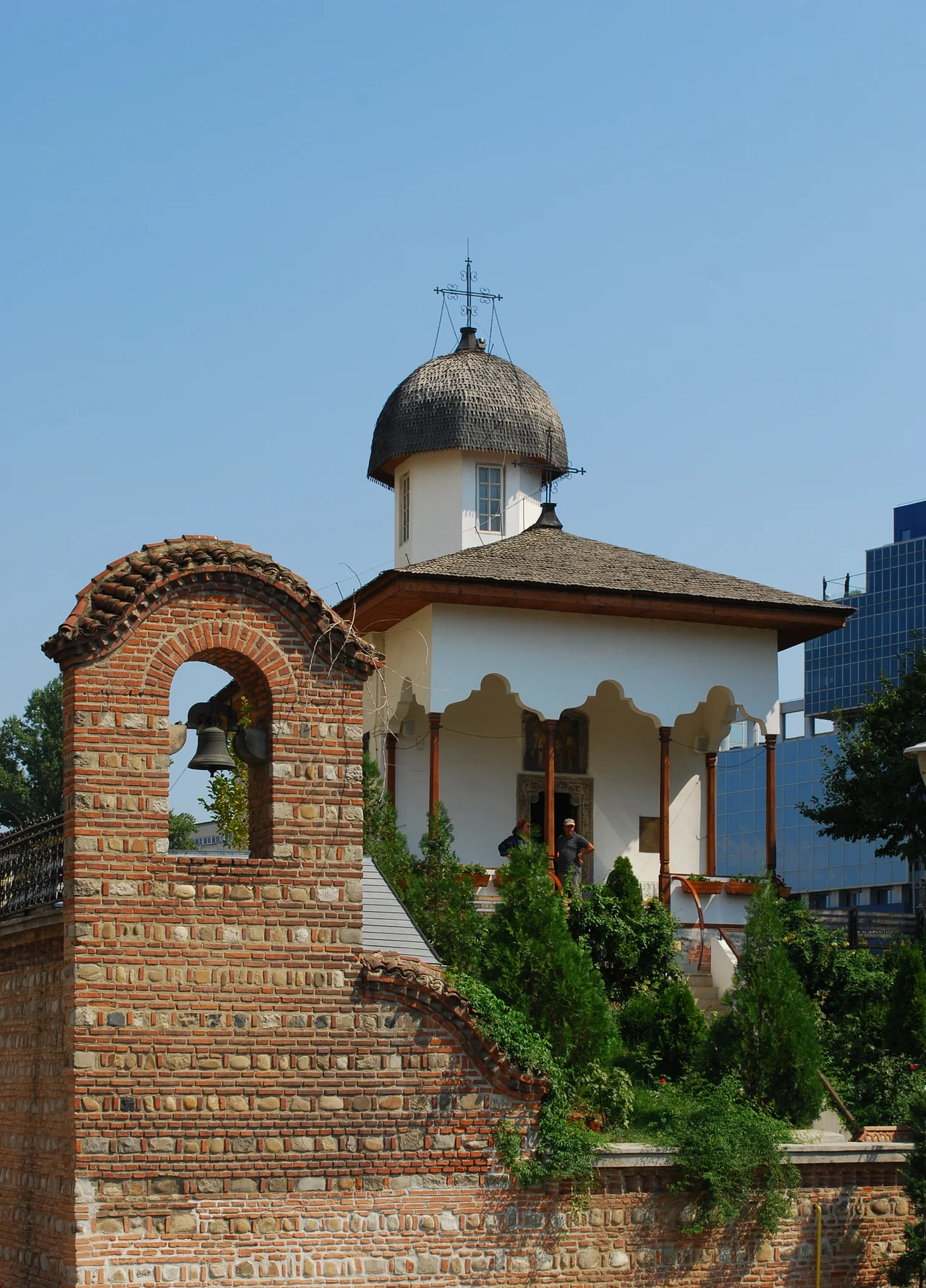

Bucur Church
Every great city has a founding story it half-believes. Romulus and the wolf. Cadmus and the dragon's teeth. In Bucharest, the founder is a shepherd. His name was Bucur - the Romanian word stem means joy - and according to legend he pastured his sheep on the banks of the Dambovita River, built a small church on a low hill, and gave the place that grew up around him its name. Historians have argued for two centuries about whether Bucur was real. The small white church bearing his name on Radu Voda Street is part of the argument. The legend is on one side. The bricks are on the other. Both have advocates.
The Quiet Building
Bucur Church is small, white, and almost rural in feel. Its walls are plain. The entrance opens through a wooden porch - the kind you see on traditional Romanian peasant houses, supported on carved wooden posts. Above sits a single cupola with a roof shaped, locals say, like a mushroom. The carved stone trim around the windows and doors was added in the early twentieth century. The church is dedicated to two saints of late-antique Egypt: Cyril of Alexandria and Pope Athanasius I. None of this looks ancient at first glance - and that is exactly what the historians have argued about. The building's style points to the eighteenth century. The legend insists on something far older.
What the Legend Says
The story first surfaces in print in 1820, in a book on the Danubian Principalities by the British consul William Wilkinson, published in London. A geography textbook by Iosif Genilie repeated it in 1835. By the late nineteenth century, the legend was thick on the ground in Bucharest - the shepherd Bucur, sometimes a fisherman, sometimes a hunter, sometimes a famous bandit, depending on who was telling the tale. Several versions agreed on one thing: he built a church. For a long time, scholars dismissed the whole story as folklore - until the 1974 discovery of a manuscript by the Catholic missionary Blasius Kleiner, written in 1761, which mentioned the legend in terms that meant it had been in local circulation long before Wilkinson found it. Kleiner wrote, with the bemused detachment of a foreign priest: they say this city gets its name from a certain shepherd or, as others say, a famous bandit, who was called Bucur. He pastured his sheep in the field by the Dambovita River. Later, he built a church and began to build a few houses for himself and a few others.
The Historians' Quarrel
In 1891, the Bucharest historian Dimitrie Papazoglu collected the early texts that asserted Bucur as the church's founder, but Papazoglu himself doubted the legend. He proposed instead that the church was built in 1568 by Alexandru II Mircea, a Wallachian voivode, in the cemetery of the nearby Radu Voda Monastery. The voivode's father, Mircea III - known as Mircea Ciobanu, Mircea the Shepherd - made the substitution suspiciously neat: a literal shepherd swapped for a princely one. In 1938, the architectural historian Grigore Ionescu added another wrinkle, recording that in 1869 the church had been rebuilt with an identity 300 years older than the one it previously claimed. Today's consensus is roughly this: the present building is seventeenth century, rebuilt in the early eighteenth, restored in 1909 to 1910. But Professor Marcel Dumitru Ciuca, who has overseen the modern republication of Papazoglu's work, has come around to the gentler position that there is no actual evidence ruling Bucur out. The church, in other words, is younger than the legend - but the legend may still be true.
What the Hill Holds
In the eighteenth century, the city engineers cut a street through the hill that the church sits on, dividing it in two. On the higher half stood the Radu Voda Monastery, founded in the late sixteenth century, which the small church served as a chapel. On the lower half, exposed by the cut, the Bucur Church sat alone with its mushroom-roofed cupola and its peasant-style porch. The setting still gives a sense of the original geography - a low rise above the Dambovita, the kind of place a shepherd really would have chosen for grazing and shelter. Stand at the porch today and the Communist-era apartment blocks crowd in on every side, but the slope is unmistakable. Whatever Bucur was - shepherd, bandit, prince, or pure invention - the spot makes physical sense. Someone, sometime, looked at this hill and decided to build.
City of Joy, Still
Bucharest grew, and grew again, and twice in the twentieth century lost much of itself to fire, earthquake, and Ceausescu's bulldozers. Through all of it, the small white church on Radu Voda survived. It survived being incorporated into a monastery and then orphaned from one. It survived the Phanariote era, when Greek administrators ran the principality for the Ottomans. It survived two World Wars, the bombing of the city, the Communist demolitions, and the rough decade after 1989. In a city that has rebuilt itself so many times that the founding story is the only continuous thread, the Bucur Church holds its place - a small physical claim on the legend, a building that may not be the original but stands where the original might have stood. Bucuria - joy. The city's name still carries it. So does the church's.
From the Air
Bucur Church is at 44.4235 N, 26.1088 E in Sector 4 of Bucharest, on the south side of the Dambovita River near the Radu Voda Monastery. Henri Coanda Airport (LROP/OTP) is about 20 km to the north; Aurel Vlaicu (LRBS/BBU) is about 12 km north. Recommended viewing altitude 1,500-3,000 m AGL. The church itself is small and easily missed from the air; navigate by the Dambovita River and the densely built fabric of inner Bucharest, with the Palace of the Parliament a short distance to the west as a more visible landmark.
Nearby Stories
- National Transport Museum, Bulgaria 34 km away
- Slanic Mine 68 km away
- Sinaia 79 km away
- Great Basilica, Pliska 87 km away
- Sinaia Monastery 108 km away
- Holy Forty Martyrs Church, Veliko Tarnovo 115 km away
- Shumen Fortress 126 km away
- Danube Delta 227 km away