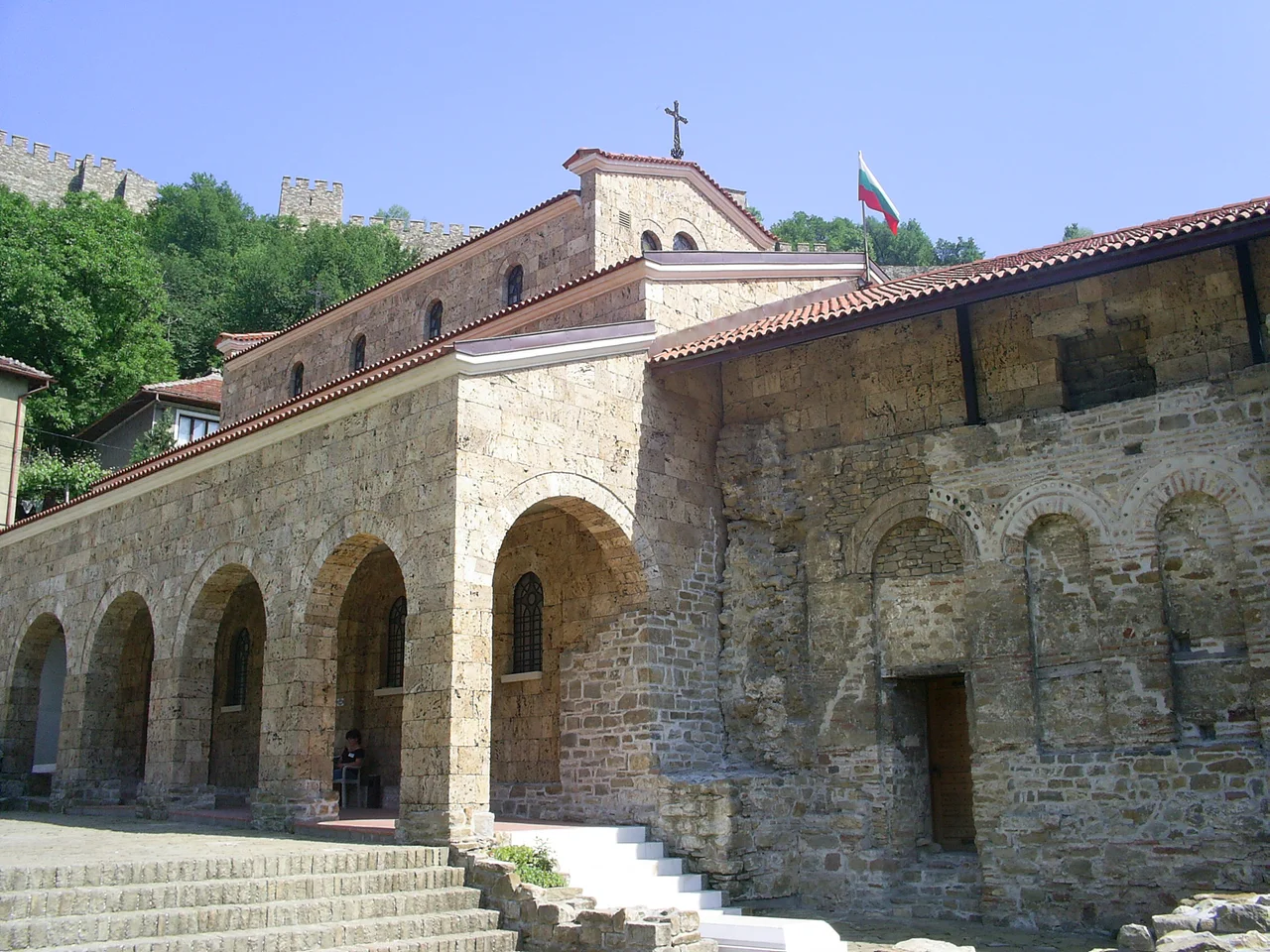

Holy Forty Martyrs Church, Veliko Tarnovo
On 9 March 1230, the Bulgarian tsar Ivan Asen II met the army of the Despotate of Epirus at the village of Klokotnitsa and shattered it so completely that the entire Balkan power balance shifted overnight. The Greek emperor of Epirus, Theodore Doukas, was captured. His ambitions toward Constantinople collapsed. Ivan Asen II, suddenly the most powerful ruler in southeastern Europe, dedicated the church he was already building in his capital to the Forty Martyrs of Sebaste, whose feast day was 9 March. He inscribed his victory on a marble column inside the new basilica. He brought in the columns of his ancestors, Khan Krum and Khan Omurtag, marked with Greek inscriptions from earlier centuries of Bulgarian glory. He was building a national pantheon, and 800 years later, that is still what the Holy Forty Martyrs Church is.
On the Bank of the Yantra
Veliko Tarnovo sits in a tight gorge of the Yantra River, the houses spilling down hillsides above water that loops in dramatic horseshoes. The Tsarevets fortress crowns one hill. The Trapezitsa fortress crowns another. Between them, on a narrow strip of bottom land along the left bank of the Yantra, stood the Great Lavra monastery. Its main church was the Holy Forty Martyrs, an elongated six-columned basilica with three semicircular apses and a narrow narthex on the west side. The interior was painted with murals, probably in 1230, and a later western addition preserves traces of the original exterior decoration: rhythmic blind arches and small ceramic plates set into the brickwork, a distinctive late Byzantine and Bulgarian technique that gave Tarnovo's churches their characteristic banded color.
The Inscriptions of Empire
Three columns inside the church anchor the historical record of medieval Bulgaria. Asen's Column carries Ivan Asen II's own triumphal inscription about Klokotnitsa, written in the formal Greek that Bulgarian rulers used for monumental display. Omurtag's Column, brought from elsewhere, records Khan Omurtag's construction of a glorious palace on the Danube whose location remains unknown. The Border Column from Rodosto, from the rule of Khan Krum in the early 9th century, was placed in the church by Ivan Asen II as a tribute to the great pagan ancestors who had built the First Bulgarian Empire. The inscription Fortress of Rodostro on Krum's column was reused upside down, an oddity that has puzzled epigraphers ever since. Together these stones make the Forty Martyrs Church the single most important repository of medieval Bulgarian inscriptions anywhere in the country.
Saint Sava and the Royal Tombs
On 14 January 1235 or 1236, Saint Sava of Serbia, the founder of the Serbian Orthodox Church and one of the most beloved saints of the South Slavic world, died in Tarnovo while visiting the Bulgarian court. He was buried temporarily at the Forty Martyrs Church. His relics were translated home to Serbia on 6 May 1237. The church continued to receive Bulgarian royal burials. Tsar Kaloyan, brother of Ivan Asen I and a brilliant warrior who briefly besieged Constantinople in 1207 before being assassinated, lies here. So does Ivan Asen II himself. So do Anna Maria of Hungary, the empress consort, and Anna (Anisia), and Irene Komnene Doukaina, and Irene Doukaina Laskarina, women whose names survive because they married into the dynasty that built this church. In 1972, archaeologists unearthing one royal grave found a 1.9-meter-tall man wearing a 61.1-gram solid gold ring inscribed with the name Kaloyan in negative, a stamping ring used to seal documents. The ring matched the king.
Mosque, Earthquake, Resurrection
When the Ottomans took Tarnovo in 1393 and ended the Second Bulgarian Empire, the Forty Martyrs Church initially kept its Christian function. Some time in the first half of the 18th century, after centuries of peaceful coexistence had soured into something colder, the building was converted to a mosque. The murals were whitewashed or destroyed. The icons and iconostasis were removed. Structural alterations were made in 1853. Only fragments of the original wall paintings survived, mostly on the north half of the narthex. Then in 1913 an earthquake badly damaged the building, and excavations began in 1906 and 1914 to understand what was salvageable. Systematic archaeological work resumed in 1969. After decades of careful reconstruction, the church reopened in modern form on 14 September 2006, with its medieval proportions restored as faithfully as scholarship allowed. The remains of Bulgarian rulers, including Kaloyan, are interred here once again.
Wedding and Independence
Two more moments cement the church in modern Bulgarian memory. On 18 May 1888, Bulgarian Prime Minister Stefan Stambolov, the iron-willed nationalist who had done as much as any single person to consolidate the new principality, married Polikseniya Kostaki Stanchova in a lavish ceremony in the Forty Martyrs Church. Twenty years later, on 22 September 1908, Tsar Ferdinand stood inside the same building and proclaimed Bulgaria's full independence from the Ottoman Empire, ending more than 500 years of nominal vassalage. He chose this church deliberately. Where Ivan Asen II had once declared that Bulgaria was again sovereign in 1230, Ferdinand declared the same thing in 1908, and the architecture itself carried the argument from the medieval empire to the modern kingdom. Walk in today and you walk past the columns of khans and the tombs of tsars. The church is small. It contains an enormous amount of country.
From the Air
Located at 43.084 degrees north, 25.65 degrees east, on the bank of the Yantra River below the Tsarevets fortress in Veliko Tarnovo, central northern Bulgaria. The nearest commercial airport is Gorna Oryahovitsa (LBGO), 13 kilometers north; Sofia (LBSF) is 220 kilometers southwest. From the air Veliko Tarnovo appears as a striking concentration of red-roofed houses tumbling down steep slopes around dramatic loops in the Yantra. The Stara Planina mountains rise to the south. Tsarevets hill, with its restored medieval fortress walls, is the most prominent landmark.
Nearby Stories
- Buzludzha Monument 19 km away
- National Transport Museum, Bulgaria 62 km away
- Round Church, Preslav 65 km away
- Battle of Philippopolis (1208) 84 km away
- 2025 Rahova Gas Explosion 110 km away
- Plovdiv 113 km away
- Bridges of Edirne 141 km away
- New Europe Bridge 175 km away