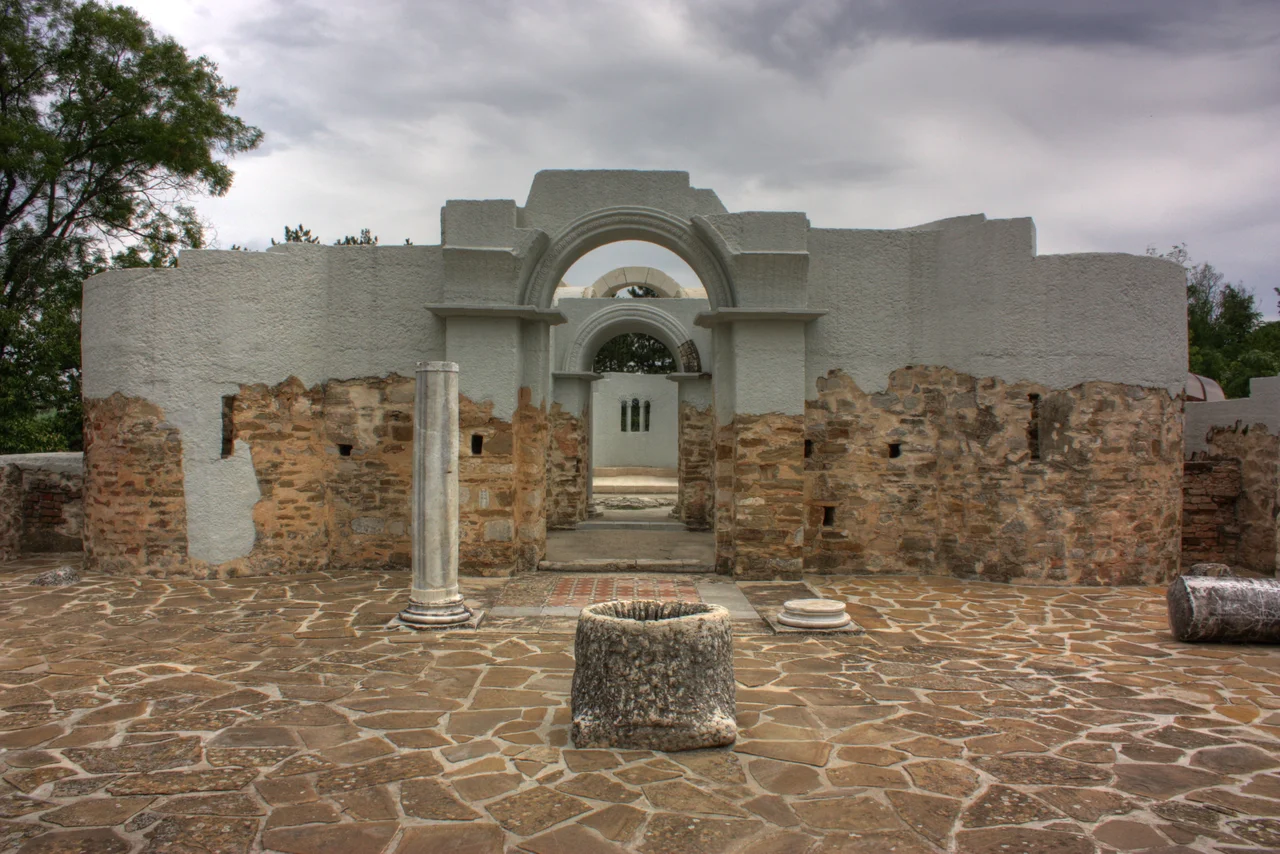

Round Church, Preslav
Tsar Simeon I had something to prove. By the early 10th century, the First Bulgarian Empire stretched from the Adriatic to the Black Sea, threatened Constantinople itself, and treated the Byzantines as more nuisance than overlord. Simeon was not interested in being a junior partner. He had moved his capital from Pliska, with its uncomfortable pagan associations, to a new city he called Preslav, and he was filling it with buildings calculated to make Constantinople jealous. The most ambitious of these was a rotunda church, completed sometime before 907 AD, whose plan resembled nothing else in the Balkans. The Bulgarians knew what they had built. They called it the Golden Church.
The Golden Age
Bulgaria had been formally Christianized only a generation earlier under Simeon's father Boris I, who had played Byzantium and the Papacy against each other to win church autonomy. Simeon, raised and educated in Constantinople, returned home determined to make Bulgaria a literary and architectural rival to the empire that had taught him. The Preslav Literary School produced Old Church Slavonic translations of biblical and patristic texts. Eminent scholars, painters, and architects gathered around the new capital. Simeon's reign is remembered as Bulgaria's first cultural Golden Age, and the Round Church was its showpiece architectural statement.
Three Sections, One Improbable Plan
The church has three parts. A wide atrium courtyard, decorated with fourteen vaults and lined with limestone columns, fronts the building. A rectangular narthex with two circular turrets, each three meters in diameter and originally fitted with spiral staircases, serves as the entrance hall. Then comes the cella, a rotunda 10.5 meters across, ringed by twelve niches and a curved apse where the bishop's cathedra would have stood. No other surviving Bulgarian church from this era follows a centralized circular plan. Some scholars trace the design to Caucasian Armenian or Georgian models, perhaps brought by traveling monks. Others see Carolingian influence, comparing it to Charlemagne's Palatine Chapel at Aachen, with which Bulgaria had diplomatic contact in the 9th and 10th centuries.
The Decoration
The Round Church was unmatched in Preslav for the richness of its interior. Polychrome ceramic tiles, glazed in brown, yellow, green, blue, and blue-green, covered surfaces in geometric and floral patterns. Mosaic and ceramic icons in clay, glass, and colored stone, set against gold backgrounds, ranged from miniature to nearly life-sized. Marble revetment with encrusted shapes lined the walls. The Corinthian and Doric column capitals were spolia from earlier Roman or Byzantine buildings, but everything else was made expressly for the church. Inscriptions on the walls preserve a moment when the new Cyrillic alphabet was still emerging from Greek and Glagolitic letterforms, recording the actual development of literacy in early medieval Bulgaria.
Tudora and the Travelers
The walls hold graffiti that medieval visitors carved or inked: Christian crosses, ships, animals, names of saints. One epitaph identifies a tombstone as belonging to 'God's servant Tudora,' a woman buried somewhere in the church complex. Hundreds of small drawings cover the surviving plaster. Fauna, ships, religious figures. The hands that drew them were probably literate Bulgarians from the Preslav Literary School, the first generation to write fluent Old Bulgarian. They left these little sketches partly as devotion, partly as practice, partly because surfaces were for marking. Tudora's tombstone is a reminder that this place was not just a monument. People worked here, prayed here, were buried here.
Discovery and Reconstruction
After Bulgaria fell to Byzantium in 1018, Preslav declined and was eventually abandoned. The Round Church collapsed at some point. By the modern era it was a ruin known mostly to local farmers. Archaeologists from the National Archaeological Museum in Sofia and the Bulgarian Antiquities Society began the first systematic excavations in 1927-28, under Yordan Gospodinov. The site was protected as a national antiquity that same year. In 2009, plans were announced to fully reconstruct the church without altering any original remains. Today, despite not being an active parish, the Round Church regularly hosts baptisms and weddings, the rituals returning to the rotunda where Simeon's bishops once read the liturgy in Old Bulgarian.
From the Air
Located at 43.1423 N, 26.8130 E in northeastern Bulgaria, just outside the modern town of Veliki Preslav in Shumen Province. The site sits in rolling hills west of the Black Sea coast. Varna Airport (LBWN) lies 90 km east. Burgas Airport (LBBG) is 130 km southeast. Bucharest Otopeni (LROP) is 180 km north across the Danube. The Stara Planina (Balkan Range) rises south of the site.
Nearby Stories
- Varna Necropolis 37 km away
- Tsarevets Fortress 59 km away
- National Transport Museum, Bulgaria 59 km away
- Buzludzha Monument 81 km away
- Bucur Church 128 km away
- Bridges of Edirne 136 km away
- Battle of Constantinople (922) 156 km away
- Danube Delta 258 km away