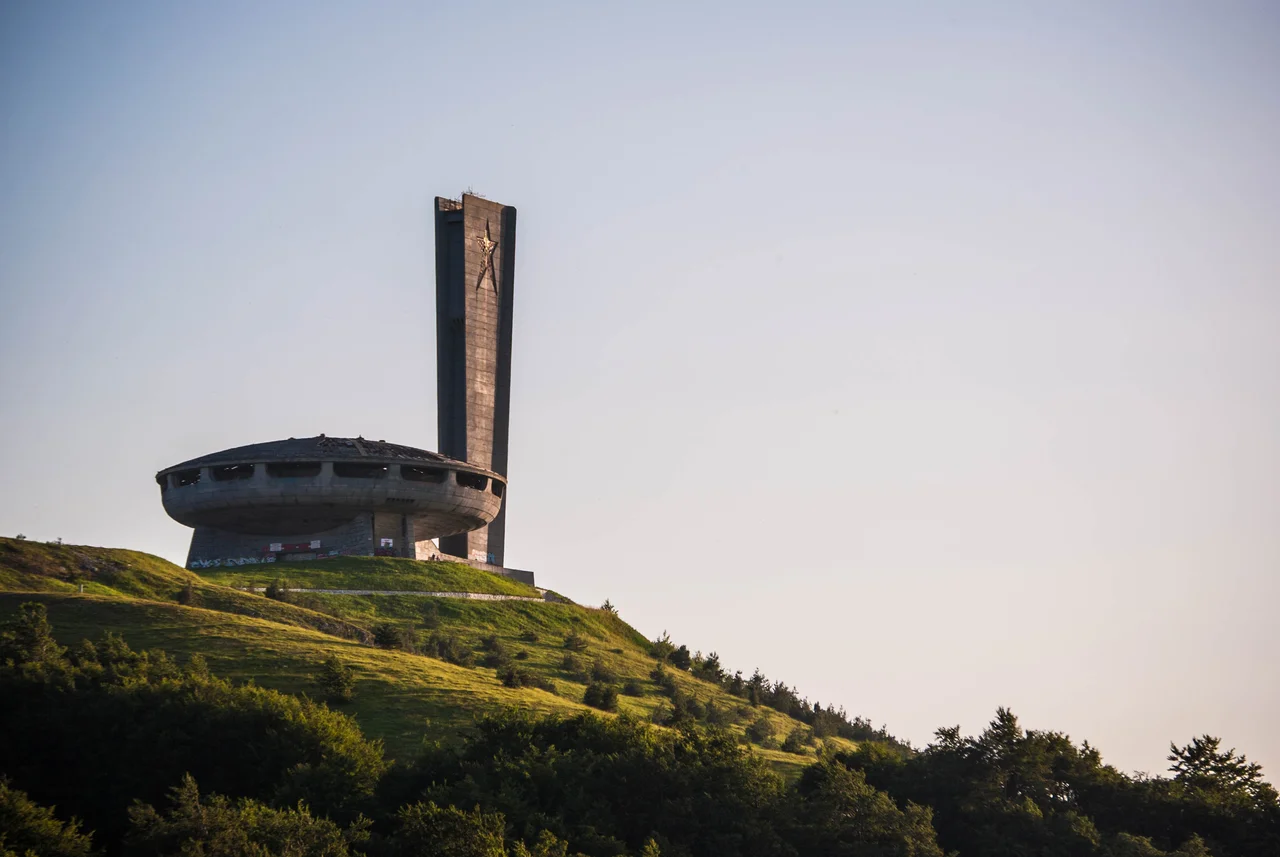

Buzludzha Monument
It looks like a flying saucer parked on a mountaintop. That is the first thing every visitor says, and the comparison is not unfair: a flat concrete disc 60 metres across, raised on a pylon at 1,432 metres above sea level, with a 70-metre torch tower spiking the sky beside it. The Bulgarian Communist Party built the Buzludzha Monument in 1981 to glorify itself, lined the interior with 937 square metres of mosaics, and held its anniversary celebrations inside its circular hall. Eight years later the regime fell. The mosaics were stripped, the bronze torch above the entrance was looted, and the building has been settling slowly into the weather ever since.
Why a Mountain
Buzludzha Peak, in central Bulgaria's Stara Planina range, was not chosen for its view. It was chosen for what happened there in 1891. That year a small group of socialists led by Dimitar Blagoev climbed the mountain in secret to organize themselves into the Bulgarian Social Democratic Party - the forerunner of the Bulgarian Communist Party that would rule the country from 1944 to 1989. The site was already a Bulgarian patriotic landmark from earlier nineteenth-century battles against the Ottomans. Communism layered its own meaning on top. By the time construction began in January 1974, the peak had been folded into a sacred narrative: the place where Bulgarian socialism was born. Architect Georgi Stoilov, a former mayor of Sofia and co-founder of the Bulgarian Union of Architects, designed a monument big enough to match the claim. The peak itself was levelled with TNT, lowering the mountain from 1,441 to 1,432 metres so the foundation would hold.
The Mosaics
Inside, the building was extraordinary. Mosaics covered roughly 937 square metres of wall and ceiling - 35 tons of cobalt glass had been imported to make them. The largest panels glorified Lenin and Marx. A corridor of fourteen panels showed the labour of ordinary workers - miners, factory hands, women with sheaves of wheat - rendered in a Soviet-influenced socialist realism that nevertheless drew on Bulgarian folk pattern and colour. The main ceiling mosaic showed the hammer and sickle ringed by the famous closing line of the Communist Manifesto: Proletarians of all countries, unite. A red star of stained glass crowned the main hall like a secular rose window. Outside, on the ring of the disc, mosaics made from natural stones gathered from rivers across Bulgaria caught the light at altitude. Most of those exterior mosaics have weathered away. About a fifth of the interior panels are gone. The rest are damaged but salvageable, and that fraction is now the focus of an international preservation effort.
The People in That System
Communism in Bulgaria was not one thing. Some Bulgarians believed in it, especially the older generations who remembered pre-war poverty and the early socialist promises of education, healthcare, and industrial work for everyone. Others endured it, paying for the regime's cruelties with prison time, lost careers, and silenced families. Many simply lived inside it because it was the only available life. The opening ceremony at Buzludzha on 23 August 1981 drew tens of thousands of people; the speech by long-ruling leader Todor Zhivkov was carried live across the country. Eight years later the same Zhivkov was forced from power. The monument outlasted him by a wide margin, and it now serves a more honest purpose than the propaganda it was built for: a physical record of what people built when they believed, or said they believed, in a system that did not, in the end, last.
Decline and Rediscovery
After 1989 the new Bulgarian government had no use for the building, no money to maintain it, and no instinct to keep it sacred. Looters stripped the bronze, the copper roof flashing, anything portable. Snowmelt found its way under the seams of the disc and began to peel mosaic panels off the walls one tessera at a time. Finnish, Dutch, and British rock bands started filming music videos there. The Hollywood action movie Mechanic: Resurrection used it as a set in 2016 with computer-generated additions. By the late 2010s the abandoned saucer had become an Instagram pilgrimage site, and architects began arguing seriously about whether it could be saved. In 2018 Europa Nostra named it one of the seven most endangered heritage sites in Europe. The Buzludzha Project Foundation, led by the Bulgarian architect Dora Ivanova, began a serious conservation effort the following year, partnering with ICOMOS Germany and the municipality of Stara Zagora. The Getty Foundation funded a Conservation Management Plan in 2019 with a 185,000 dollar grant, then a second grant in 2020 to stabilize the surviving mosaics. Early structural assessments concluded that the building can in fact be preserved. The work continues.
What It Becomes Now
The road from Kazanlak in the south climbs sixteen kilometres up to the monument; from Gabrovo in the north, twelve. Both are open in summer. In winter the snow can be deep enough to bury the lower ring of the disc. Visitors who reach the entrance find the doors welded shut against further looting - you can walk around the building, look up at the torch tower, and trace what the mosaics looked like only by climbing onto the rim of the disc and peering through the holes left by the broken windows. Inside, salvaged sections of the workers' panels have been crated and stored; the central red star is gone. The plan, as it slowly takes shape, is for Buzludzha to reopen as a museum - not a museum to Communism, but a museum to what was built in its name and to what the Bulgarian people made and lived through. It will be one of the strangest museums in Europe. The mountain it sits on has held larger meanings before. It is holding another now.
From the Air
The Buzludzha Monument sits at 42.7358 N, 25.3939 E on Buzludzha Peak (1,432 m) in the Stara Planina (Balkan Mountains), central Bulgaria. The closest civilian airport is Plovdiv (LBPD) about 90 km south; Sofia (LBSF) is about 220 km west. Recommended viewing altitude 2,000-3,500 m AGL. The monument's distinctive saucer-on-pylon profile is unmistakable from the air, and the slim 70-metre torch tower beside it gives it a silhouette unlike anything else in the surrounding mountain range. Use the Shipka Pass to the west as a navigation reference.
Nearby Stories
- Trapezitsa Fortress 12 km away
- 1928 Chirpan-Plovdiv Earthquakes 40 km away
- Battle of Philippopolis (1208) 47 km away
- Round Church, Preslav 65 km away
- Plovdiv 75 km away
- Palace of Omurtag 83 km away
- Bridges of Edirne 104 km away
- New Europe Bridge 193 km away