
Battle of Philippopolis (1208)
Three years earlier, the same Cuman horsemen had ridden circles around a Crusader army at Adrianople, baited it into a chase, and watched it shatter on Bulgarian lances. The Latin Emperor Baldwin himself had been dragged off to die in a Tarnovo prison. Now, on 30 June 1208, the new Bulgarian tsar Boril rode south of the Balkan Mountains expecting the same script. The men in chainmail riding to meet him near Philippopolis - modern Plovdiv - had spent those three years remembering exactly what had gone wrong.
A Throne Stolen Twice
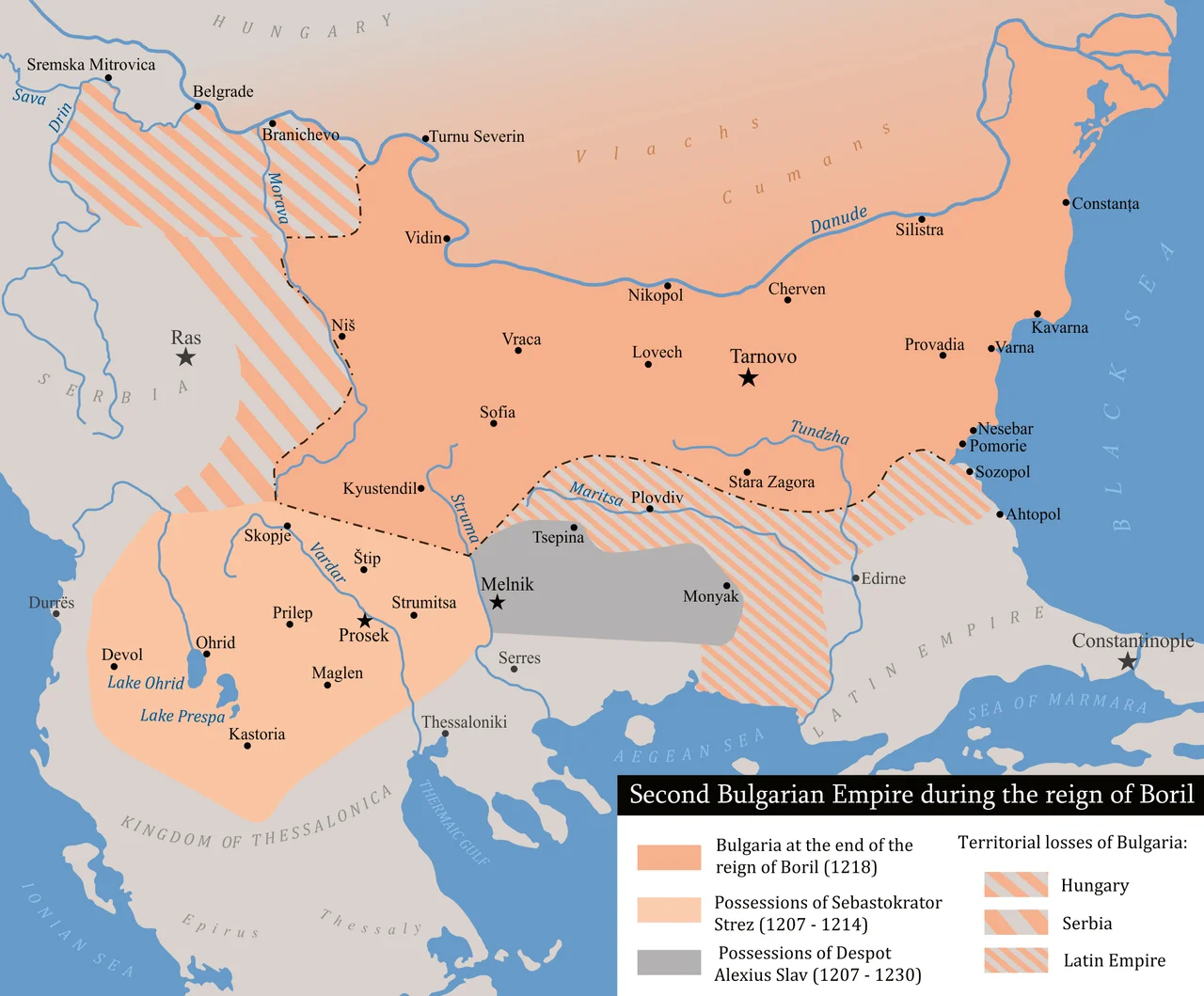
The Second Bulgarian Empire had been a force in the Balkans for barely two decades when its luck began to turn on its own people. Tsar Kaloyan, the conqueror of Baldwin, was murdered during the siege of Thessalonica in 1207 by conspirators organized by his cousin Boril. The murdered tsar left a son, the rightful heir Ivan Asen II, but the boy was too young to fight back, so Boril took the crown and began the difficult work of holding it. While he hunted down the legitimist faction at home, the Latin Empire of Constantinople - the Crusader state stitched together from the wreckage of 1204 - quietly rebuilt the army Kaloyan had broken. By the spring of 1208, both sides were ready to test each other again.
The Plain Below Plovdiv
Boril rode south with somewhere between 27,000 and 30,000 soldiers, including 7,000 Cuman cavalry - the same nomadic horse-archers whose feigned retreat had destroyed Baldwin's knights. The Latin army that came to meet him was roughly the same size, several hundred mounted knights at its core. When the two forces met on the plain north of Philippopolis on 30 June, Boril ordered the old playbook: send the Cumans forward, harass the line, draw the heavy cavalry into a chase, then close the trap. But the knights this time refused the bait. They had buried friends after Adrianople. Instead of charging, they sprung a trap of their own, isolating the detachment of 1,600 men around the tsar himself. Boril's bodyguard could not hold. He fled north, and his army peeled away with him.
A Running Fight Through the Hills
Bulgarians knew their geography. The Balkan Mountains rose as a wall to the north, and the Latin knights would not follow them into the high passes. The retreating army made for the Turia pass, but their rear guard turned at hilly ground near the modern village of Zelenikovo and bloodied the pursuing Crusaders before being driven off when the main Latin force arrived. The fight dragged on for hours - longer than anyone wanted - while the bulk of the Bulgarian army slipped through the mountains to safety. Then the Crusaders pulled back to Philippopolis, claiming victory but understanding that they had only stopped a raid, not won a war.
The Long Game
Boril was not finished. The defeat had not been catastrophic, and the next year he was back in the field. But the Latin emperor Henry was a more careful diplomat than his brother Baldwin had been, and he peeled away Bulgaria's allies one by one. He won over Alexius Slav, the lord of the Rhodopes, and married him to his daughter. Boril answered by elevating his own brother Strez to sevastokrator over the lands around Prosek in modern North Macedonia. In 1211 the Bulgarians and the empire of Nicaea tried to take Constantinople from both sides at once, and failed. Eventually Boril did what defeated rulers often do - he made peace, sealing it with the marriage of Kaloyan's daughter Maria to the very Latin emperor whose army had chased him through these hills.
What the Plain Holds
The plain below Plovdiv has hosted armies for three thousand years. Thracians, Macedonians, Romans, Goths, Bulgars, Crusaders, Ottomans, Russians, all have marched across it. Today the city's seven hills rise out of farmland and suburbs, the cobbled lanes of the old town climbing past Roman ruins and Bulgarian Revival houses. The exact field where Boril's bodyguard broke is unmarked - 1208 left no monument here - but the geography that decided the battle still does. Look north from the city and the Balkan Mountains hold the horizon, the same wall the retreating Bulgarians ran for, the same wall the knights would not cross.
From the Air
Located at 42.15 N, 24.75 E, on the Thracian plain south of the Balkan Mountains. Best viewed at 5,000-10,000 feet altitude. Plovdiv's seven hills are the most distinctive landmark, with the Rhodope Mountains rising sharply to the south. Nearest airport is Plovdiv International (LBPD), with Sofia (LBSF) about 150 km west.
Nearby Stories
- Batak Massacre 18 km away
- Buzludzha Monument 42 km away
- Museum of Socialist Art 81 km away
- Battle of Kresna Gorge 91 km away
- Battle of Philippi 101 km away
- Complex of Sultan Bayezid II 104 km away
- Trapezitsa Fortress 106 km away
- Bridges of Edirne 113 km away